Key Highlights
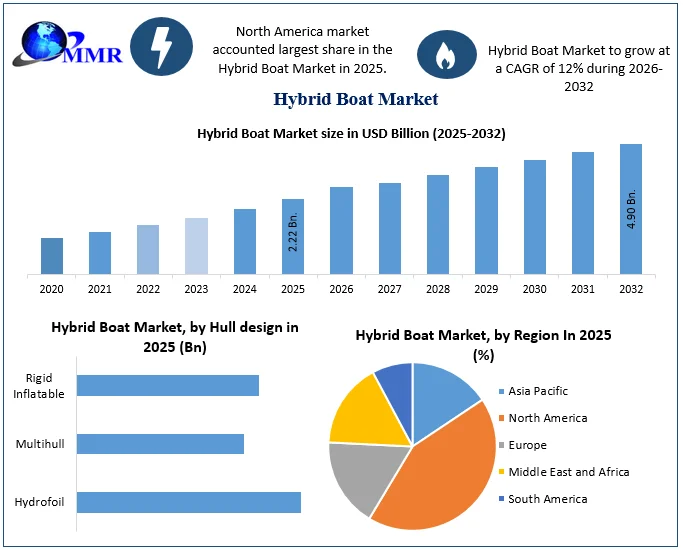
- Hybrid Boat Market valued at USD 2.22 Billion in 2025
- Expected to reach nearly USD 4.90 Billion by 2032
- Forecast CAGR of 12% during 2026–2032
- North America remains the leading regional market
- Multihull dominates the hull design segment
- Electric propulsion leads the propulsion segment
- Rising environmental regulations continue accelerating hybrid vessel adoption
- Battery innovation and marine electrification remain key technology drivers
Why This Matters Now
Marine transportation is entering a structural transition as regulators, commercial operators, and recreational boat owners pursue lower-emission propulsion systems. Hybrid boats have moved beyond niche adoption and are becoming strategic investments for organizations seeking lower operating costs, reduced emissions, and compliance with tightening environmental regulations.
Unlike conventional boats that depend entirely on fossil fuels, hybrid boats combine diesel and electric propulsion to improve efficiency while reducing fuel consumption by up to 30% in economy navigation mode. That operational improvement directly lowers running costs while supporting sustainability objectives, making hybrid propulsion increasingly attractive across commercial and recreational marine applications.
Market Overview
The Hybrid Boat Market was valued at USD 2.22 Billion in 2025 and is projected to reach nearly USD 4.90 Billion by 2032, expanding at a CAGR of 12% during the forecast period.
Market momentum reflects growing demand for vessels capable of balancing operational performance with environmental responsibility. Hybrid propulsion systems integrate conventional diesel engines with electric motors, allowing operators to optimize propulsion based on voyage conditions, operating speed, charging availability, and emission requirements.
Manufacturers are also prioritizing battery research and propulsion efficiency to improve vessel performance while extending operational flexibility. As sustainability becomes a purchasing criterion across recreational and commercial boating, hybrid technologies are steadily strengthening their competitive position within the broader marine industry.
Key Trends Driving Growth
Environmental awareness remains the strongest catalyst behind market expansion. Hybrid propulsion significantly lowers greenhouse gas emissions, reduces water pollution, and improves fuel efficiency compared with traditional combustion-powered vessels. These environmental benefits align with increasingly stringent maritime regulations while supporting long-term sustainability goals.
Battery innovation is creating another growth avenue. The adoption of Vanadium Redox Flow Batteries (VRFB) is gaining attention within marine hybrid propulsion because the technology uses recyclable vanadium electrolyte while offering improved safety characteristics through non-flammable aqueous electrolytes. Commercial development initiatives focused on next-generation marine VRFB systems illustrate continued investment in advanced energy storage technologies.
Hybrid propulsion systems also provide operational flexibility by allowing vessels to alternate between electric power, diesel engines, or both simultaneously depending on operating conditions. This capability supports diverse vessel profiles, from recreational cruising to commercial transportation, where varying speed requirements and voyage distances demand adaptable propulsion solutions.
Despite these advantages, market expansion continues to face challenges. Alternative low-emission technologies, particularly hydrogen fuel cells, compete for future marine decarbonization investments by offering potential advantages in range and power output for larger vessels. In addition, higher acquisition costs associated with hybrid propulsion systems remain a purchasing barrier for budget-sensitive buyers, especially within recreational boating.
Explore detailed analysis, insights, and growth opportunities
Segment Insights
- Dominant Segment – Hull Design: Multihull leads the market due to superior stability, lower drag, reduced power consumption, and greater compatibility with hybrid propulsion systems. Improved seaworthiness allows efficient operation across diverse marine conditions while supporting higher energy efficiency.
- Dominant Segment – Propulsion: Electric propulsion holds the largest market share. Electric boats generate substantially lower CO₂ emissions than conventional internal combustion engines while improving propulsion efficiency and supporting ecosystem preservation across inland waterways and coastal regions.
- Hybrid propulsion continues expanding across recreational, commercial, and specialized marine applications as operators pursue operational efficiency alongside sustainability objectives.
- Vessel versatility, reduced maintenance requirements, and lower long-term operating costs continue strengthening customer adoption across multiple boating categories.
About Maximize Market Research:
Maximize Market Research is one of the fastest-growing market research and business consulting firms serving clients globally. Our revenue impact and focused growth-driven research initiatives make us a proud partner of majority of the Fortune 500 companies. We have a diversified portfolio and serve a variety of industries such as IT & telecom, chemical, food & beverage, aerospace & defense, healthcare and others.
Contact Maximize Market Research:
MAXIMIZE MARKET RESEARCH PVT. LTD.
⮝ 3rd Floor, Navale IT park Phase 2,
Pune Banglore Highway, Narhe
Pune, Maharashtra 411041, India.
✆ +91 9607365656
🖂 sales@maximizemarketresearch.com
