Key Highlights
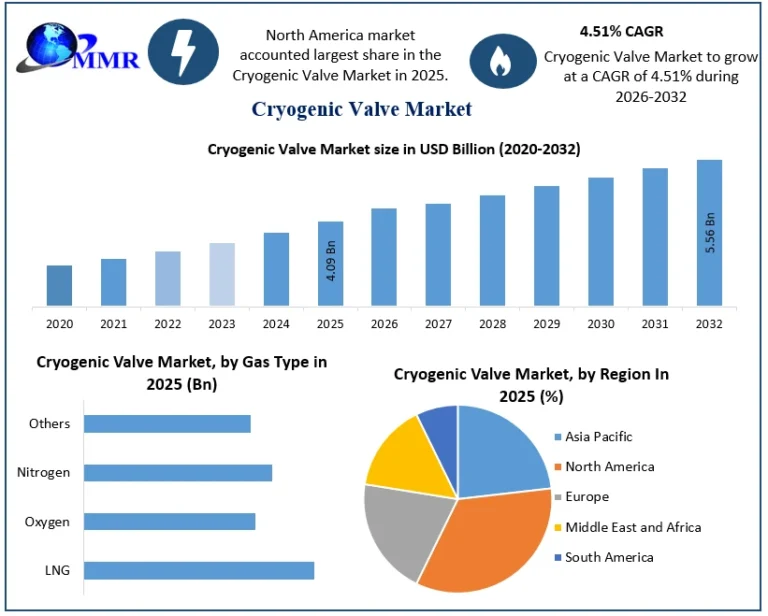
- Global Cryogenic Valve Market valued at USD 4.09 Billion in 2025.
- Market projected to reach USD 5.56 Billion by 2032.
- Revenue expected to expand at a 4.51% CAGR from 2026 to 2032.
- LNG infrastructure and industrial gas investments remain major growth catalysts.
- Industry 4.0 initiatives are increasing demand for intelligent flow-control systems.
- Predictive maintenance and digital monitoring are becoming competitive differentiators.
- Automation investments continue to improve operational safety and process efficiency.
Why This Matters Now
Industrial operators are redesigning production assets for higher efficiency, lower emissions, and greater reliability. Cryogenic systems sit at the center of LNG, industrial gases, hydrogen, healthcare, chemicals, and energy infrastructure, making valve performance a strategic operational priority rather than a maintenance consideration.
As manufacturers accelerate Industry 4.0 adoption, cryogenic valves are evolving into connected assets capable of supporting predictive maintenance, digital diagnostics, and automated process control. That transition is reshaping procurement priorities for plant managers, EPC contractors, and automation providers.
Market Overview
The Cryogenic Valve Market was valued at USD 4.09 Billion in 2025 and is expected to reach USD 5.56 Billion by 2032, growing at a 4.51% CAGR. The growth trajectory signals sustained investment across LNG infrastructure, industrial gas production, healthcare applications, and emerging hydrogen projects. For equipment manufacturers, this translates into a stable replacement market alongside expanding opportunities in new industrial facilities.
Demand is increasingly linked to operational reliability rather than simple equipment replacement. Plant operators require valves capable of maintaining sealing performance under extremely low temperatures while integrating seamlessly with digital control architectures such as PLCs, DCS, and SCADA systems. This shift elevates cryogenic valves from mechanical components to strategic assets within automated industrial operations.
Key Trends Driving Growth
Industry 4.0 is changing how cryogenic systems are designed, monitored, and maintained. Smart factories increasingly require equipment capable of continuous diagnostics, enabling predictive maintenance programs that reduce downtime and improve production availability. Connected valves equipped for digital monitoring fit directly into these operational strategies.
Industrial Internet of Things (IIoT) adoption continues to strengthen process visibility. Real-time operating data allows maintenance teams to identify wear patterns before failures occur, improving asset utilization while lowering maintenance costs. For industries operating around the clock, every avoided shutdown delivers measurable financial value.
Artificial intelligence is also influencing process optimization. AI-assisted monitoring helps operators analyze operational data from cryogenic systems, supporting faster decision-making and improving process stability across LNG terminals, industrial gas facilities, and chemical plants.
Factory modernization initiatives further accelerate adoption. Manufacturing facilities upgrading automation architectures increasingly prioritize components compatible with digital communication networks, remote monitoring, and integrated asset management platforms.
Hydrogen development represents another strategic opportunity. As countries expand investments in clean energy infrastructure, cryogenic handling technologies become increasingly important, positioning valve manufacturers to participate in long-term energy transition projects.
Industrial cybersecurity has also become more relevant. As connected devices proliferate across operational technology environments, manufacturers increasingly focus on secure communication between field devices and control systems to maintain production integrity.
Get a Sample Report Packed with Industry Statistics and Forecasts
Segment Insights
The supplied report excerpt does not provide segment-level leadership or fastest-growing segment details. Unsupported classifications have therefore been intentionally omitted.
- Dominant Segment: Not specified in the supplied report.
- Fastest-Growing Segment: Not specified in the supplied report.
- Automation-ready valve designs are gaining attention as manufacturers modernize process plants.
- LNG, industrial gases, healthcare, and emerging hydrogen applications continue supporting equipment demand.
- Smart diagnostics and predictive maintenance capabilities are becoming important purchasing criteria.
Regional Growth Story
Asia-Pacific continues to benefit from industrial expansion, LNG infrastructure development, manufacturing investments, and rising energy demand. Countries such as China, India, Japan, and South Korea continue expanding industrial capacity while investing in modern production facilities equipped with advanced automation systems.
The United States remains a strategic market due to ongoing LNG investments, industrial modernization, and increasing adoption of digital process automation. Manufacturers continue upgrading legacy infrastructure to improve productivity, safety, and operational resilience.
Germany maintains leadership in industrial automation through advanced manufacturing practices, strong engineering capabilities, and continued Industry 4.0 deployment. Digital factories require reliable process control equipment capable of integrating into intelligent production environments.
Across developed industrial economies, automation investment is increasingly driven by workforce shortages, higher productivity targets, and the need for continuous plant availability. Cryogenic valve suppliers aligned with these priorities are positioned to benefit from long-term modernization cycles.
Competitive Landscape
Competition is shifting beyond mechanical engineering toward digital capability. Manufacturers are increasingly differentiating themselves through automation compatibility, intelligent diagnostics, reliability improvements, and lifecycle service offerings.
Technology leadership increasingly depends on integrating valves into broader operational ecosystems rather than selling standalone hardware. Suppliers that enable predictive maintenance, remote monitoring, and digital asset management strengthen their position with plant operators seeking higher equipment availability and lower operating costs.
Automation partnerships, manufacturing investments, and product innovation also signal a broader transition toward connected industrial infrastructure. Companies capable of supporting IIoT integration, advanced process control, and smart manufacturing initiatives will likely capture greater value as industrial customers prioritize total operational performance over initial equipment cost.
Recent Developments
Only developments supported by the supplied report should be reported. The provided source excerpt does not include specific company announcements.
- Continued investment in LNG infrastructure supports demand for cryogenic flow-control equipment.
- Industry 4.0 initiatives are increasing demand for digitally compatible process equipment.
- Factory modernization programs continue encouraging automation-ready valve deployment.
- Predictive maintenance technologies are influencing procurement strategies across industrial facilities.
Strategic Implications
For manufacturers, competitive advantage increasingly depends on combining mechanical reliability with digital intelligence. Buyers are evaluating total lifecycle value, maintenance efficiency, automation compatibility, and operational resilience rather than focusing solely on product specifications.
System integrators benefit from greater demand for integrated automation solutions connecting valves with SCADA, DCS, PLC, and enterprise asset management platforms. This creates opportunities for broader digital transformation projects rather than isolated equipment upgrades.
Technology investors should monitor companies expanding capabilities in intelligent flow control, digital monitoring, and predictive maintenance software. These capabilities align closely with long-term industrial digitization trends and increasing operational technology investment.
Operations leaders should also recognize that cryogenic infrastructure is becoming a data-generating asset. Better operational visibility enables improved maintenance planning, reduced downtime, stronger safety performance, and more efficient production scheduling.
Future Outlook
The Cryogenic Valve Market is moving beyond traditional hardware replacement toward intelligent industrial infrastructure. Digital diagnostics, AI-assisted monitoring, IIoT connectivity, predictive maintenance, and smart manufacturing integration will increasingly define purchasing decisions across energy, industrial gas, chemical, and emerging hydrogen sectors.
Manufacturers that design automation-ready products capable of integrating into digital factories will strengthen their competitive position as industrial customers prioritize operational intelligence alongside reliability. The companies leading this transition will shape the next generation of process automation, while those delaying Industry 4.0 integration risk losing relevance in increasingly autonomous industrial operations.
Analyst Perspective
“The Cryogenic Valve Market continues to benefit from expanding industrial infrastructure and increasing demand for reliable cryogenic flow-control solutions. As automation and digital manufacturing become central to industrial investment, intelligent valve technologies will play an increasingly important role in operational efficiency and long-term plant performance.” — Gaurav Deshmukh, Analyst, Maximize Market Research
About Maximize Market Research
Maximize Market Research Pvt. Ltd. (MMR) is a global market research and consulting company that provides reliable, data-focused, and practical business insights. The firm serves a wide range of industries, including healthcare, pharmaceuticals, technology, automotive, electronics, chemicals, personal care, and consumer goods. Through market forecasts, competitive analysis, strategic consulting, and industry impact assessments, MMR helps organizations understand changing market conditions, identify growth opportunities, and make informed business decisions for long-term success.
Contact Us
2nd Floor, Navale IT Park Phase 3
Pune Banglore Highway, Narhe
Pune, Maharashtra 411041, India
+91 9607365656
sales@maximizemarketresearch.com
