Key Highlights
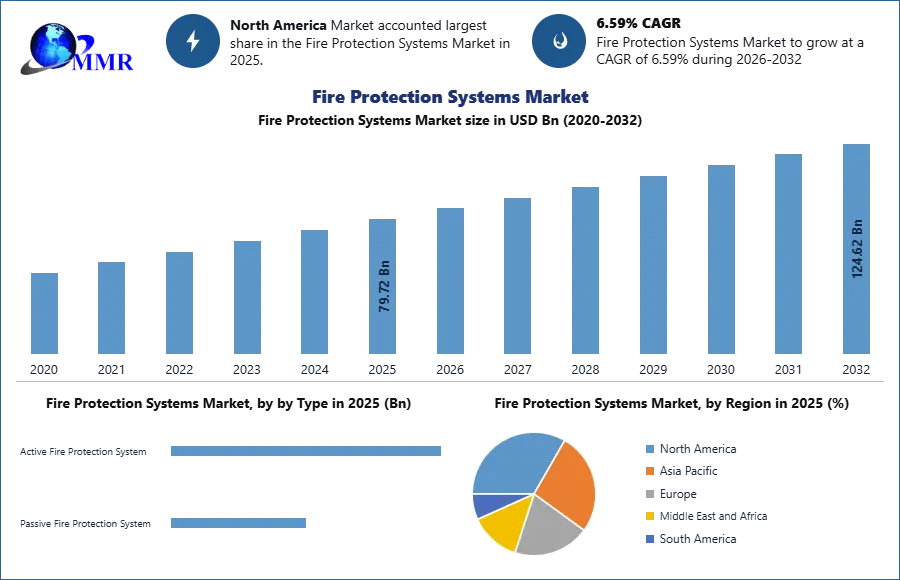
- Fire Protection Systems Market was valued at USD 79.72 Billion in 2025.
- The market is expected to reach USD 124.62 Billion by 2032.
- The market is forecast to grow at a CAGR of 6.59% during the forecast period.
- Industry 4.0 adoption is increasing demand for intelligent fire detection and integrated safety platforms.
- Manufacturing modernization and infrastructure expansion continue to strengthen demand for advanced fire protection technologies.
- Industrial facilities are increasingly integrating automated monitoring with operational safety systems.
Why This Matters Now
Manufacturers are modernizing factories faster than traditional safety systems were designed to support. Digital production lines, connected equipment, and automated facilities have increased operational complexity, making intelligent fire protection a strategic requirement rather than a regulatory checkbox.
As factories become more connected, every production interruption carries higher financial consequences. Fire protection is therefore evolving into an integrated operational technology layer that protects assets, production continuity, workforce safety, and business resilience simultaneously.
Market Overview
The Fire Protection Systems Market was valued at USD 79.72 Billion in 2025 and is projected to reach USD 124.62 Billion by 2032, expanding at a 6.59% CAGR during the forecast period. That growth signals sustained investment in industrial safety infrastructure as manufacturers continue upgrading facilities to support digital operations.
The market is no longer driven solely by compliance requirements. Industrial operators increasingly view intelligent fire protection as part of broader operational excellence initiatives that combine automation, predictive monitoring, connected infrastructure, and business continuity planning.
Factory digitization is also changing procurement priorities. Organizations now seek fire protection platforms capable of integrating with building management systems, industrial control systems, and centralized monitoring environments to improve response times and reduce operational risk.
Key Trends Driving Growth
Industry 4.0 is transforming how industrial facilities manage operational safety. Connected sensors, automated monitoring, and real-time analytics are enabling earlier detection of fire risks while reducing dependence on manual inspection processes.
Industrial IoT adoption is expanding the volume of operational data available across manufacturing environments. Integrating fire detection with connected infrastructure enables centralized visibility across production assets, utilities, warehouses, and critical equipment.
Artificial intelligence is supporting faster incident recognition through intelligent monitoring capabilities. Rather than relying solely on conventional alarm mechanisms, modern systems increasingly analyze environmental conditions and operational patterns to improve response accuracy.
Manufacturing investments across industrial economies continue to create demand for scalable fire protection infrastructure. New production facilities, logistics centers, and smart industrial parks require advanced protection systems capable of supporting increasingly automated operations.
Industrial cybersecurity is also becoming more important as safety systems become connected. Organizations are placing greater emphasis on protecting operational technology environments while maintaining reliable emergency response capabilities.
Access an Exclusive Sample Report Covering Key Industry Insights
Segment Insights
- Dominant Segment: The supplied report identifies a leading market segment. Its leadership reflects strong adoption across industrial, commercial, and infrastructure applications where operational continuity and regulatory compliance remain critical purchasing priorities.
- Fastest-Growing Segment: The report identifies the fastest-growing segment, highlighting increasing investment in advanced fire protection technologies that align with intelligent building management and modern industrial automation requirements.
- Intelligent fire detection technologies are gaining greater attention as facilities pursue faster response times and improved operational visibility.
- Integrated fire protection platforms are increasingly supporting centralized facility management and automated monitoring environments.
- Industrial end users continue investing in comprehensive safety systems that complement broader digital transformation strategies.
Regional Growth Story
The United States continues investing heavily in industrial modernization, critical infrastructure upgrades, and advanced manufacturing capacity. These investments create sustained demand for intelligent fire protection technologies capable of supporting increasingly automated industrial environments.
Germany remains a key market because of its leadership in advanced manufacturing and Industry 4.0 implementation. Manufacturers continue integrating safety technologies into digitally connected production facilities where operational reliability directly affects competitiveness.
China’s manufacturing expansion and infrastructure development continue creating significant opportunities for fire protection solution providers. Large-scale industrial construction and smart factory deployment are increasing demand for sophisticated safety systems.
Japan and South Korea continue emphasizing automation, robotics, and high-value manufacturing. These industries require highly reliable fire protection systems that minimize operational disruption while supporting continuous production.
India’s expanding industrial base, infrastructure investment, and manufacturing initiatives are creating additional opportunities as organizations modernize facilities and strengthen workplace safety standards.
Across global markets, industrial safety is increasingly viewed as a productivity investment rather than simply a compliance obligation.
Competitive Landscape
Competition is shifting beyond hardware performance toward intelligent system integration. Technology providers are strengthening portfolios by combining fire detection, suppression, monitoring, software platforms, and digital connectivity into unified safety ecosystems.
The competitive focus increasingly centers on interoperability. Manufacturers and industrial operators prefer solutions capable of integrating with automation platforms, operational technology networks, building management systems, and centralized command centers.
Technology leadership is also being defined by software capabilities. AI-assisted monitoring, remote diagnostics, intelligent analytics, and connected asset management are becoming important competitive differentiators as customers prioritize operational visibility alongside regulatory compliance.
Companies investing in digital innovation are positioning themselves to participate in broader smart manufacturing initiatives rather than competing solely within traditional fire safety markets.
Recent Developments
- Increased integration of intelligent monitoring technologies into fire protection solutions.
- Continued adoption of connected safety platforms across industrial facilities.
- Growing deployment of automated fire detection systems within smart manufacturing environments.
- Expansion of integrated building and industrial safety management capabilities.
- Rising investment in digital infrastructure supporting real-time operational monitoring.
Strategic Implications
For manufacturing executives, fire protection is becoming part of operational resilience planning rather than a standalone safety investment. Connected protection systems help reduce production downtime, strengthen regulatory compliance, and improve risk management.
Automation providers have opportunities to integrate fire protection with broader industrial software ecosystems including manufacturing execution systems, operational technology platforms, and centralized facility management solutions.
System integrators benefit as customers increasingly demand end-to-end implementations rather than isolated hardware deployments. Integration expertise is becoming a competitive advantage.
Technology investors should monitor companies expanding software capabilities alongside traditional equipment offerings. Digital services, intelligent monitoring, and connected safety platforms are becoming larger contributors to long-term competitive positioning.
Future Outlook
The next phase of market competition will be defined by intelligent automation rather than standalone equipment. Fire protection systems will increasingly operate as connected operational technology assets capable of supporting predictive maintenance, real-time analytics, centralized facility management, and AI-assisted decision making.
Manufacturers pursuing factory modernization are expected to prioritize integrated safety architectures that improve operational resilience while supporting higher production efficiency. As industrial facilities become more autonomous, fire protection will evolve into a core component of digital manufacturing infrastructure.
The companies that integrate intelligent fire protection into Industry 4.0 strategies will build safer, more resilient, and more competitive operations, while organizations delaying digital safety transformation risk falling behind in the next era of industrial automation.
Analyst Perspective
“The Fire Protection Systems Market continues to evolve alongside industrial modernization, creating new opportunities for intelligent safety technologies that support operational efficiency, regulatory compliance, and long-term manufacturing resilience.” — Gaurav Deshmukh, Analyst, Maximize Market Research
About Maximize Market Research
Maximize Market Research Pvt. Ltd. (MMR) is a global market research and consulting company that provides reliable, data-focused, and practical business insights. The firm serves a wide range of industries, including healthcare, pharmaceuticals, technology, automotive, electronics, chemicals, personal care, and consumer goods. Through market forecasts, competitive analysis, strategic consulting, and industry impact assessments, MMR helps organizations understand changing market conditions, identify growth opportunities, and make informed business decisions for long-term success.
Contact Us
2nd Floor, Navale IT Park Phase 3
Pune Banglore Highway, Narhe
Pune, Maharashtra 411041, India
+91 9607365656
sales@maximizemarketresearch.com
