Key Highlights
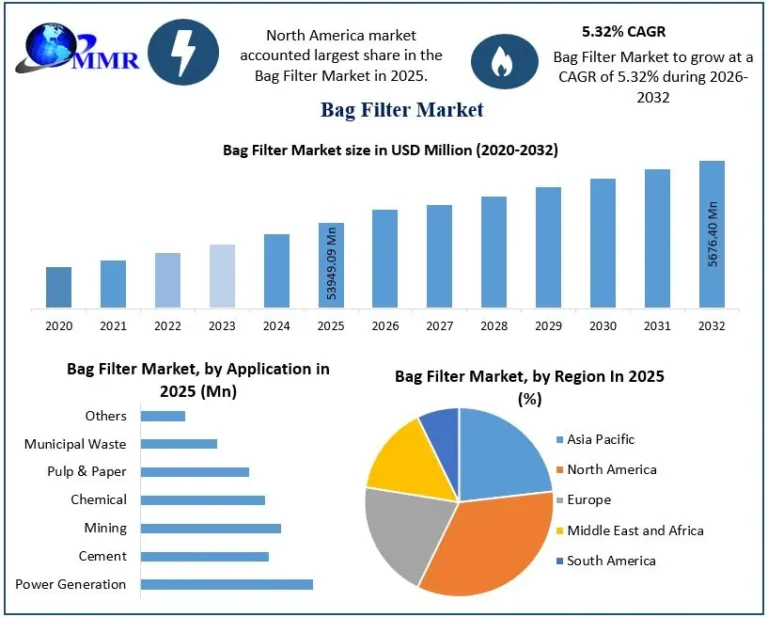
- Market valued at USD 3,560.21 million in 2023
- Forecast to reach USD 5,117.43 million by 2030
- CAGR of 5.32% during 2024–2030
- Environmental regulations remain the primary market catalyst
- Technological innovation improves filtration efficiency and equipment life
- North America is expected to maintain market leadership
- Cement, power generation, mining, and chemical industries remain major end users
Why This Matters Now
Industrial manufacturers are facing two simultaneous pressures: increasing production while complying with stricter environmental regulations. Dust collection systems are no longer viewed as auxiliary equipment. They have become operational assets that directly influence plant uptime, regulatory compliance, worker safety, and production efficiency.
The Bag Filter Market, valued at USD 3,560.21 million in 2023, is projected to reach USD 5,117.43 million by 2030, expanding at a 5.32% CAGR. This steady growth reflects sustained investment in cleaner manufacturing, advanced filtration technologies, and digital plant modernization across process industries.
Market Overview
Bag filters Market commonly referred to as baghouses—remove particulate matter from industrial air and gas streams using fabric filtration media housed within enclosed chambers. Their ability to capture dust through surface filtration, depth filtration, and electrostatic attraction makes them indispensable across power generation, cement production, mining, chemical manufacturing, pharmaceuticals, food processing, and municipal applications.
Growing industrial production is increasing demand for filtration systems capable of maintaining high air quality while meeting increasingly stringent emission standards. As governments tighten environmental regulations, manufacturers are upgrading filtration infrastructure to improve compliance without sacrificing operational efficiency.
The market is also benefiting from continuous innovation in filter media. High-efficiency fabrics, improved needle-felt materials, and advanced pulse-jet cleaning systems are extending filter life while improving dust collection efficiency. These improvements reduce maintenance requirements, lower operating costs, and improve plant reliability.
Key Trends Driving Growth
Environmental regulation remains the strongest growth driver. Governments worldwide continue strengthening air-quality standards, requiring industries to reduce particulate emissions. Regulations established by organizations such as the U.S. Environmental Protection Agency (EPA) and the European Union’s Industrial Emissions Directive are accelerating investments in advanced filtration technologies. This regulatory environment is transforming bag filters from compliance equipment into strategic manufacturing assets.
Technology innovation is reshaping filtration performance. Manufacturers are developing advanced filter media with improved durability, higher filtration efficiency, and longer operational life. Modern pulse-jet cleaning technologies enable continuous operation while minimizing maintenance interruptions, supporting higher production efficiency across industrial facilities.
Health and workplace safety concerns are also strengthening market demand. Industrial operators increasingly recognize the importance of controlling airborne dust to protect workers from respiratory hazards while maintaining safer production environments. Effective filtration contributes directly to occupational safety and regulatory compliance.
Digital manufacturing initiatives are creating new opportunities for intelligent filtration systems. Although traditional bag filters remain mechanical systems, integration with industrial automation platforms enables performance monitoring, predictive maintenance planning, and process optimization. Connected monitoring solutions support better maintenance scheduling, reduce unexpected shutdowns, and improve operational visibility across manufacturing facilities.
Industrial IoT is further enhancing filtration management by enabling continuous equipment monitoring. Connected sensors can provide operational data that helps maintenance teams identify declining filter performance before production is affected. These capabilities align with broader Industry 4.0 strategies focused on maximizing equipment availability and improving asset utilization.
One example of ongoing product innovation comes from Eaton, which introduced the SENTINEL MAXPO and DURAGAF MAXPOXL filter bag ranges featuring integrated pre-filter technology for enhanced particle and oil separation. The design combines particle retention and oil absorption into a single filtration step while improving service life and reducing filter blockage, demonstrating how manufacturers are increasing operational efficiency through product engineering.
Explore detailed analysis, insights, and growth opportunities
About Maximize Market Research:
Maximize Market Research is one of the fastest-growing market research and business consulting firms serving clients globally. Our revenue impact and focused growth-driven research initiatives make us a proud partner of majority of the Fortune 500 companies. We have a diversified portfolio and serve a variety of industries such as IT & telecom, chemical, food & beverage, aerospace & defense, healthcare and others.
Contact Maximize Market Research:
MAXIMIZE MARKET RESEARCH PVT. LTD.
⮝ 3rd Floor, Navale IT park Phase 2,
Pune Banglore Highway, Narhe
Pune, Maharashtra 411041, India.
✆ +91 9607365656
🖂 sales@maximizemarketresearch.com
