Key Highlights
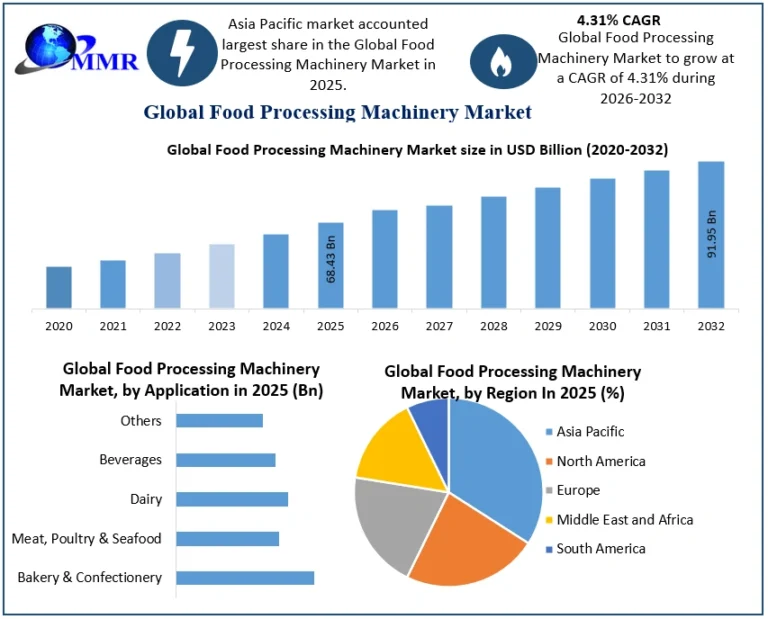
- Food Processing Machinery Market valued at USD 68.43 Billion in 2025
- Expected to reach USD 91.95 Billion by 2032
- Forecast CAGR of 4.31% from 2026 to 2032
- Automation continues transforming food manufacturing operations
- Smart factory investments are improving production efficiency
- Digital monitoring and predictive maintenance are becoming strategic priorities
- Manufacturers are integrating robotics and intelligent process control to improve productivity
Why This Matters Now
Food manufacturers face simultaneous pressure from rising production costs, labor shortages, stricter food safety requirements, and growing consumer expectations for product consistency. Traditional production lines struggle to meet these demands without sacrificing profitability.
Modern processing machinery increasingly combines automation, intelligent controls, industrial connectivity, and real-time monitoring. Companies investing in digitally connected production systems are reducing downtime, improving asset utilization, and strengthening operational resilience across increasingly complex manufacturing environments.
Market Overview
The Food Processing Machinery Market has entered a new phase where productivity depends as much on digital intelligence as on mechanical performance. Modern equipment is expected to deliver precision, traceability, energy efficiency, and continuous operational visibility.
The projected increase from USD 68.43 Billion in 2025 to USD 91.95 Billion by 2032 demonstrates sustained investment in advanced processing infrastructure. Beyond expanding manufacturing capacity, companies are prioritizing equipment capable of supporting automated production, higher quality standards, and data-driven operational decisions.
Industry 4.0 technologies are influencing purchasing decisions across the food manufacturing value chain. Integrated production systems capable of communicating with manufacturing execution platforms, enterprise software, and predictive maintenance applications are becoming increasingly important as producers seek greater operational flexibility.
Key Trends Driving Growth
Factory modernization continues to redefine investment priorities. Food manufacturers increasingly replace isolated processing equipment with connected production ecosystems capable of delivering real-time operational intelligence.
Industrial IoT adoption enables continuous monitoring of equipment performance, allowing operators to identify production inefficiencies before they affect output. Predictive maintenance strategies reduce unexpected downtime while extending equipment life, directly improving manufacturing economics.
Artificial intelligence is enhancing production planning, quality inspection, and equipment optimization. Machine learning algorithms help manufacturers identify process deviations earlier, supporting consistent product quality while reducing waste.
Robotics integration is expanding beyond packaging into handling, processing, inspection, and material movement. Automated systems improve throughput while addressing labor availability challenges that affect food manufacturing worldwide.
Digital twins are emerging as valuable tools for process simulation and equipment optimization. Virtual production models enable manufacturers to evaluate operational changes before implementation, reducing commissioning risks and accelerating productivity improvements.
Industrial cybersecurity is also becoming increasingly important as connected manufacturing environments expand. Protecting operational technology networks is now essential to maintaining uninterrupted food production.
Download the Sample Report for In-Depth Market Intelligence
Segment Insights
- Dominant Segment: The supplied MMR report identifies a dominant market segment. Specific segment details have not been provided in the supplied source information and therefore are not reproduced here.
- Fastest-Growing Segment: The supplied report identifies a fastest-growing segment. Detailed segmentation data is unavailable in the provided source and is therefore omitted.
- Automation-ready machinery continues attracting investment as manufacturers seek improved productivity and process consistency.
- Intelligent processing systems support greater operational visibility across production facilities.
- Equipment incorporating digital monitoring capabilities enables more efficient maintenance planning.
- Smart process control technologies improve product quality while reducing operational variability.
Regional Growth Story
Major manufacturing economies continue investing in food production modernization to strengthen supply chain resilience and improve manufacturing competitiveness.
The United States remains focused on automation-driven productivity improvements and digital manufacturing investments. Germany continues leveraging advanced industrial engineering and Industry 4.0 expertise to develop highly automated processing systems.
China is expanding food manufacturing capacity alongside factory digitization initiatives, creating opportunities for advanced processing equipment suppliers. Japan and South Korea continue emphasizing robotics, precision manufacturing, and intelligent automation to offset workforce challenges while improving production efficiency.
India’s growing food processing sector is encouraging investment in modern production technologies that enhance quality, food safety, and manufacturing scalability. Across these industrial economies, digital transformation is becoming a strategic differentiator rather than an optional upgrade.
Competitive Landscape
Competition increasingly centers on software intelligence alongside mechanical capability. Equipment manufacturers are differentiating through automation platforms, connected services, predictive maintenance capabilities, and digital integration rather than hardware alone.
Companies investing in industrial IoT connectivity, AI-enabled analytics, and remote equipment monitoring are strengthening long-term customer relationships by expanding lifecycle service offerings. This evolution shifts competitive advantage from one-time equipment sales toward continuous operational support.
Partnerships between machinery manufacturers, automation providers, software developers, and system integrators are accelerating deployment of fully connected production environments. Such collaborations enable manufacturers to deliver complete digital ecosystems instead of standalone equipment, reinforcing customer retention while supporting broader factory modernization strategies.
As smart manufacturing adoption accelerates, competitive leadership increasingly depends on the ability to integrate machinery with enterprise software, manufacturing execution systems, operational technology networks, and intelligent analytics platforms.
Recent Developments
- Manufacturers continue investing in Industry 4.0-enabled processing equipment.
- Robotics adoption is expanding across food production operations.
- Industrial IoT deployment is improving equipment visibility and operational analytics.
- Predictive maintenance solutions are reducing production interruptions.
- AI-assisted process optimization is supporting higher manufacturing efficiency.
- Digital integration between production equipment and enterprise systems continues expanding.
Strategic Implications
For food manufacturers, machinery investments now influence operational competitiveness for years beyond initial installation. Equipment selection increasingly considers connectivity, scalability, software compatibility, and lifecycle productivity improvements alongside processing performance.
Automation suppliers have growing opportunities to deliver integrated solutions combining machinery, industrial software, robotics, machine vision, predictive maintenance, and operational analytics. System integrators also benefit as manufacturers seek end-to-end modernization rather than isolated automation projects.
Technology investors should monitor companies expanding recurring digital service revenue through remote monitoring, predictive maintenance, software subscriptions, and intelligent factory management platforms.
The convergence of automation, AI, industrial IoT, and advanced analytics is transforming food processing from equipment-driven manufacturing into continuously optimized digital operations.
Future Outlook
The Food Processing Machinery Market is entering an era where competitive advantage depends on intelligent production rather than production volume alone. As automation platforms, industrial IoT, predictive maintenance, robotics, AI-driven operations, and digitally connected factories become standard manufacturing capabilities, companies investing early in Industry 4.0 will define the next generation of food production, while slower adopters risk falling behind in productivity, operational resilience, and manufacturing competitiveness.
Analyst Perspective
“The evolution of food processing machinery is increasingly driven by manufacturers seeking greater operational efficiency, productivity, and technology integration. Automation and smart manufacturing capabilities are becoming central to long-term competitiveness across the global food processing industry.” — Gaurav Deshmukh, Analyst
About Maximize Market Research
Maximize Market Research Pvt. Ltd. (MMR) is a global market research and consulting company that provides reliable, data-focused, and practical business insights. The firm serves a wide range of industries, including healthcare, pharmaceuticals, technology, automotive, electronics, chemicals, personal care, and consumer goods. Through market forecasts, competitive analysis, strategic consulting, and industry impact assessments, MMR helps organizations understand changing market conditions, identify growth opportunities, and make informed business decisions for long-term success.
Contact Us
2nd Floor, Navale IT Park Phase 3
Pune Banglore Highway, Narhe
Pune, Maharashtra 411041, India
+91 9607365656
sales@maximizemarketresearch.com
