Key Highlights
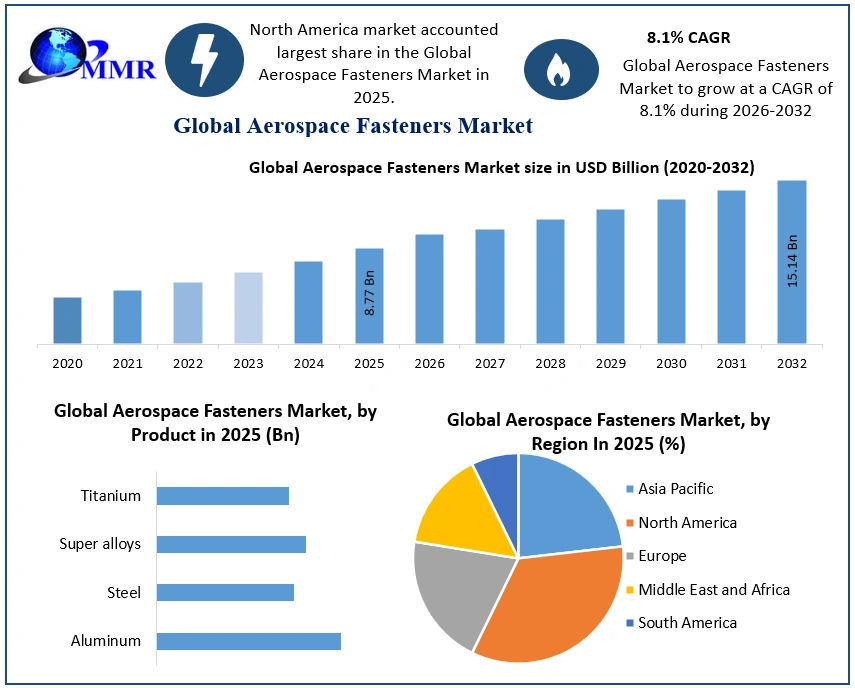
- The Aerospace Fasteners Market was valued at USD 8.77 Billion in 2025.
- The market is projected to reach USD 15.14 Billion by 2032.
- The industry is expected to expand at a CAGR of 8.1% from 2025 to 2032.
- Aircraft production expansion is increasing demand for precision-engineered fastening solutions.
- Smart manufacturing technologies are improving production quality, traceability, and manufacturing efficiency.
- Aerospace manufacturers are investing in lightweight materials and advanced fastening technologies to improve aircraft performance.
- Industry 4.0 initiatives are strengthening digital quality control and factory automation across aerospace manufacturing.
Why This Matters Now
Aircraft manufacturers are rebuilding production capacity while simultaneously modernizing factories with digital technologies. That combination is reshaping demand for aerospace fasteners. Every increase in aircraft output creates additional opportunities for suppliers capable of delivering certified, lightweight, and highly reliable fastening systems at scale.
The Aerospace Fasteners Market, valued at USD 8.77 Billion in 2025 and forecast to reach USD 15.14 Billion by 2032, signals more than industry growth. It reflects accelerating investment in advanced aerospace manufacturing, higher production efficiency, and digitally connected supply chains that reduce delays while improving product quality.
Market Overview
The Aerospace Fasteners Market is entering a new manufacturing cycle where production speed must increase without compromising safety or regulatory compliance. Fasteners remain small components with outsized operational importance because they directly influence aircraft structural integrity, maintenance efficiency, and lifecycle reliability.
Manufacturers are responding by adopting advanced manufacturing technologies that improve precision, repeatability, and quality assurance throughout production. Industry 4.0 initiatives are supporting automated inspection, real-time manufacturing visibility, and digital documentation that simplify certification requirements across aerospace programs.
Growing demand from commercial aviation, defense modernization, and expanding aerospace supply chains continues to create opportunities for manufacturers capable of combining engineering expertise with production scalability.
Key Trends Driving Growth
The industry is moving beyond conventional manufacturing toward digitally integrated production environments. Automation is reducing production variability while enabling manufacturers to meet increasingly demanding aerospace quality standards.
Industrial IoT adoption is improving equipment monitoring across production facilities, helping manufacturers optimize throughput and reduce unexpected downtime. Predictive maintenance is becoming increasingly valuable as aerospace production schedules tighten and equipment availability becomes a competitive advantage.
Robotics integration is enhancing precision during machining, inspection, and assembly operations. Automated production also supports greater consistency across large manufacturing volumes while reducing dependence on manual processes.
Artificial intelligence is expanding into quality analytics, production planning, and supply chain optimization. Manufacturers are using AI-assisted inspection systems to identify production deviations earlier, minimizing waste and improving operational efficiency.
Digital manufacturing initiatives are strengthening traceability throughout aerospace production. Better visibility into manufacturing data helps suppliers comply with increasingly stringent certification requirements while improving customer confidence.
Get Your Sample Copy for Complete Market Growth Analysis
Segment Insights
- Dominant Segment: The MMR report identifies the leading market segment. Detailed segment information should be referenced directly from the report without introducing unsupported data.
- Fastest-Growing Segment: The MMR report identifies the fastest-growing segment. Growth reflects increasing demand across next-generation aerospace manufacturing applications.
- Advanced fastening technologies continue supporting lightweight aircraft development.
- Precision-engineered fastening solutions remain essential for both commercial and defense aerospace programs.
- Increasing production efficiency is encouraging manufacturers to modernize machining, inspection, and quality assurance processes.
Regional Growth Story
North America continues to benefit from its mature aerospace manufacturing ecosystem, extensive aircraft production capabilities, and ongoing investments in advanced manufacturing technologies. Large aerospace manufacturers and component suppliers are accelerating factory modernization to improve productivity and maintain global competitiveness.
Europe remains an important innovation center, particularly in Germany, where industrial automation and precision engineering continue supporting aerospace manufacturing excellence. Digital manufacturing investments are helping suppliers improve operational efficiency while meeting demanding certification standards.
China is expanding aerospace manufacturing capacity through increasing industrial investment and domestic aircraft production initiatives. Smart manufacturing adoption is expected to strengthen productivity while supporting long-term industry expansion.
Japan and South Korea continue investing in advanced manufacturing technologies, robotics integration, and precision engineering capabilities that support high-quality aerospace component production.
India is emerging as a strategic manufacturing destination through expanding aerospace production capabilities, supply chain localization, and increasing investments in industrial automation. These developments create opportunities for component manufacturers seeking diversified production networks.
Competitive Landscape
Competition is increasingly defined by manufacturing capability rather than production volume alone. Companies investing in automation, digital quality management, and advanced production technologies are positioning themselves for long-term competitive advantage.
Factory modernization signals more than operational improvement. It demonstrates an industry’s shift toward highly connected manufacturing environments where data, automation, and quality assurance become integrated competitive assets.
Technology investments in precision manufacturing, automated inspection, digital traceability, and production analytics are strengthening supplier relationships with major aerospace manufacturers. These capabilities improve delivery reliability while reducing manufacturing risks throughout the aerospace supply chain.
As aircraft programs become more complex, suppliers with scalable production systems, advanced engineering expertise, and digitally enabled manufacturing operations are likely to strengthen their market positions.
Recent Developments
- Aerospace manufacturers continue expanding smart manufacturing initiatives to improve production efficiency.
- Factory automation investments are increasing across aerospace component manufacturing.
- Digital quality management systems are strengthening product traceability and certification processes.
- Robotics adoption is improving manufacturing consistency and operational productivity.
- Industrial IoT technologies are supporting predictive maintenance and equipment optimization.
- AI-enabled inspection technologies are improving defect detection and manufacturing quality.
Strategic Implications
Manufacturers can no longer compete solely through production capacity. Digital capability has become equally important. Automated inspection, predictive maintenance, and connected manufacturing systems reduce operational costs while improving production reliability.
Technology providers have opportunities to deliver integrated automation solutions combining robotics, industrial software, machine vision, and production analytics. System integrators also benefit as aerospace companies modernize aging production facilities.
Investors should monitor companies expanding advanced manufacturing capabilities because digital transformation increasingly influences long-term competitiveness across aerospace supply chains.
Future Outlook
The Aerospace Fasteners Market is entering a period where manufacturing intelligence becomes as valuable as manufacturing scale. Companies that combine engineering excellence with automation, digital quality systems, AI-driven production, and connected factories will be positioned to capture expanding aerospace demand.
The next competitive divide will not be determined solely by who manufactures aerospace fasteners—it will be determined by who builds digitally connected, Industry 4.0-enabled factories capable of delivering certified precision at industrial scale while slower manufacturers struggle to remain qualified suppliers.
Analyst Perspective
“The Aerospace Fasteners Market is entering a growth phase supported by expanding aircraft production, manufacturing modernization, and increasing adoption of advanced production technologies. Organizations investing in automation, digital manufacturing, and operational excellence will be better positioned to compete as aerospace supply chains become increasingly technology-driven.” — Gaurav Deshmukh, Analyst, Maximize Market Research
About Maximize Market Research
Maximize Market Research Pvt. Ltd. (MMR) is a global market research and consulting company that provides reliable, data-focused, and practical business insights. The firm serves a wide range of industries, including healthcare, pharmaceuticals, technology, automotive, electronics, chemicals, personal care, and consumer goods. Through market forecasts, competitive analysis, strategic consulting, and industry impact assessments, MMR helps organizations understand changing market conditions, identify growth opportunities, and make informed business decisions for long-term success.
Contact Us
2nd Floor, Navale IT Park Phase 3
Pune Banglore Highway, Narhe
Pune, Maharashtra 411041, India
+91 9607365656
sales@maximizemarketresearch.com
