Key Highlights
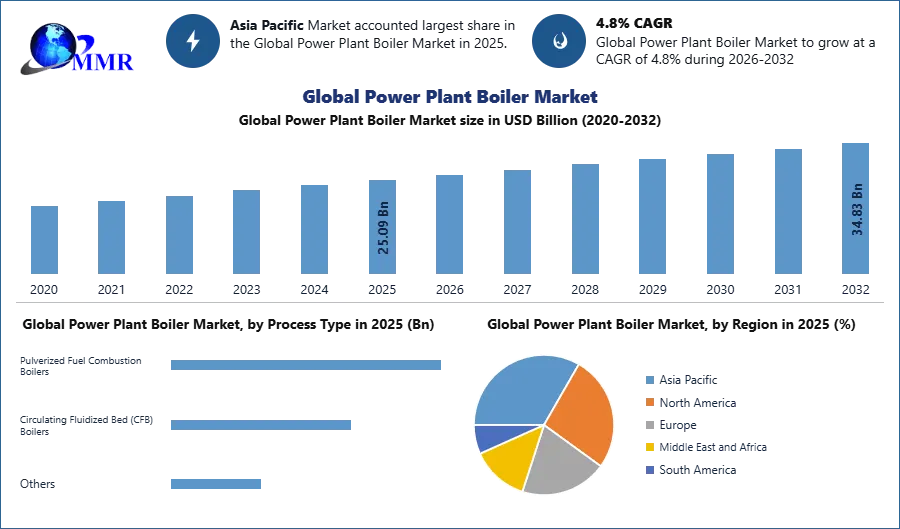
- Power Plant Boiler Market projected to reach USD 34.83 Bn by forecast end
- Market expanding at a CAGR of 4.8% across global power infrastructure upgrades
- Rising adoption of industrial automation in thermal power operations
- Digital twin and predictive maintenance reshaping boiler lifecycle management
- Increasing integration of SCADA, PLC, and DCS systems in plant operations
- Strong modernization push across Asia-Pacific, Europe, and North America power assets
Why This Matters Now
Thermal power operators are under pressure to run legacy boiler systems with near-digital precision. Aging infrastructure, grid reliability demands, and emissions compliance are forcing utilities to digitize core process systems. Boilers, once purely mechanical assets, are now becoming data-driven control nodes inside integrated power plant ecosystems.
The USD 34.83 Bn trajectory signals more than replacement demand. It reflects a structural shift toward automation-led power generation where efficiency, uptime, and predictive intelligence define operational competitiveness.
Market Overview
The Power Plant Boiler Market is entering a phase defined by control system convergence and operational intelligence. Boilers remain central to thermal power generation, but their role is shifting from standalone heat generation units to fully instrumented, software-enabled assets.
Growth to USD 34.83 Bn at a 4.8% CAGR highlights sustained capital investment in upgrading boiler efficiency, improving fuel utilization, and reducing downtime across coal, gas, and hybrid power infrastructure.
Operators are increasingly aligning boiler systems with digital control environments that connect field instrumentation, plant-wide SCADA architectures, and enterprise-level energy management platforms. The result is tighter control over combustion efficiency, steam generation stability, and load responsiveness.
Key Trends Driving Growth
Industrial automation is redefining how boiler systems are designed, monitored, and optimized. The transition from manual supervision to autonomous control loops is accelerating across power plants.
Predictive maintenance is gaining traction as sensor networks embedded in boilers generate continuous performance data. This enables early detection of tube leaks, pressure deviations, and thermal inefficiencies, reducing unplanned outages.
Digital twin models are being deployed to simulate boiler performance under variable load conditions. This allows operators to test operational scenarios without disrupting live plant output.
Industrial IoT integration is expanding visibility across boiler subsystems, connecting combustion controls, feedwater systems, and emissions monitoring into unified dashboards.
AI-driven analytics are increasingly used to optimize combustion efficiency and reduce fuel wastage, directly impacting plant economics.
.Explore detailed analysis, insights, and growth opportunities
Segment Insights
- Dominant Segment: Not explicitly disclosed in the supplied MMR source
- Fastest-Growing Segment: Not explicitly disclosed in the supplied MMR source
Despite the absence of detailed segmentation in the provided dataset, industry adoption patterns indicate that automation-linked boiler systems are gaining prominence across retrofit and new-build projects. Demand is concentrated in systems that support advanced control architectures and efficiency optimization.
Fuel-flexible and high-efficiency boiler configurations are increasingly aligned with digital monitoring layers, enabling tighter integration with plant-wide automation systems.
Regional Growth Story
Asia-Pacific remains the most active region for power plant boiler deployment, driven by large-scale electricity demand and continuous expansion of thermal generation capacity. Industrial economies such as China and India are prioritizing grid stability and efficiency upgrades, accelerating modernization cycles.
North America is focused on efficiency retrofits, where aging infrastructure is being upgraded with advanced control systems, emissions monitoring tools, and predictive maintenance platforms.
Europe’s growth is shaped by decarbonization pressures. While thermal assets are under transition, remaining operational plants are being digitized to maximize efficiency and extend asset life under stricter environmental constraints.
Japan and South Korea continue to invest in high-efficiency, automation-heavy boiler systems aligned with smart grid integration and industrial reliability standards.
Competitive Landscape
The competitive environment is defined by boiler OEMs, EPC contractors, and industrial automation integrators competing for lifecycle control of power generation assets.
Competition is shifting away from hardware-only delivery toward integrated solutions combining mechanical systems with digital control platforms. This reflects a broader industry move toward service-based revenue models anchored in long-term plant performance optimization.
Automation integration capability is becoming a key differentiator. Vendors capable of embedding SCADA connectivity, predictive analytics, and digital monitoring layers into boiler systems are gaining strategic advantage.
The market is also witnessing increased collaboration between equipment manufacturers and software-driven automation providers. This convergence signals a future where boiler performance is managed as a continuously optimized digital asset rather than a static installation.
Recent Developments
- Expansion of digital monitoring systems integrated into boiler control environments
- Increased deployment of predictive maintenance frameworks in thermal power plants
- Growing adoption of IIoT-enabled sensors for combustion and pressure optimization
- Rising use of digital twin models for operational simulation and efficiency tuning
- Strengthening integration of SCADA and DCS platforms in boiler operations
Strategic Implications
Power plant operators are shifting capital allocation from maintenance-heavy models to intelligence-led operations. Boilers are no longer isolated mechanical units; they are becoming data nodes inside fully connected energy ecosystems.
For automation providers, the opportunity lies in embedding control intelligence deeper into physical infrastructure. PLC, DCS, and SCADA systems are evolving into real-time optimization layers rather than supervisory tools.
For investors, value creation is increasingly tied to platforms that extend boiler lifecycle efficiency rather than standalone equipment sales. Software integration, analytics capability, and service contracts are becoming central revenue drivers.
Manufacturers that fail to integrate digital monitoring and predictive capabilities risk operational inefficiency gaps that widen over asset lifecycles.
Future Outlook
The next phase of competition in the Power Plant Boiler Market will be defined not by who builds the most durable systems, but by who converts thermal infrastructure into continuously learning, self-optimizing industrial assets through full-stack automation.
Analyst Perspective
“Boiler systems are being repositioned from mechanical infrastructure to intelligent process platforms. The integration of automation, predictive maintenance, and digital control systems is redefining operational efficiency across global power generation,” says Gaurav Deshmukh, Analyst.
About Maximize Market Research:
Maximize Market Research is one of the fastest-growing market research and business consulting firms serving clients globally. Our revenue impact and focused growth-driven research initiatives make us a proud partner of majority of the Fortune 500 companies. We have a diversified portfolio and serve a variety of industries such as IT & telecom, chemical, food & beverage, aerospace & defense, healthcare and others.
Contact Maximize Market Research:
MAXIMIZE MARKET RESEARCH PVT. LTD.
⮝ 3rd Floor, Navale IT park Phase 2,
Pune Banglore Highway, Narhe
Pune, Maharashtra 411041, India.
✆ +91 9607365656
🖂 sales@maximizemarketresearch.com
