Key Highlights
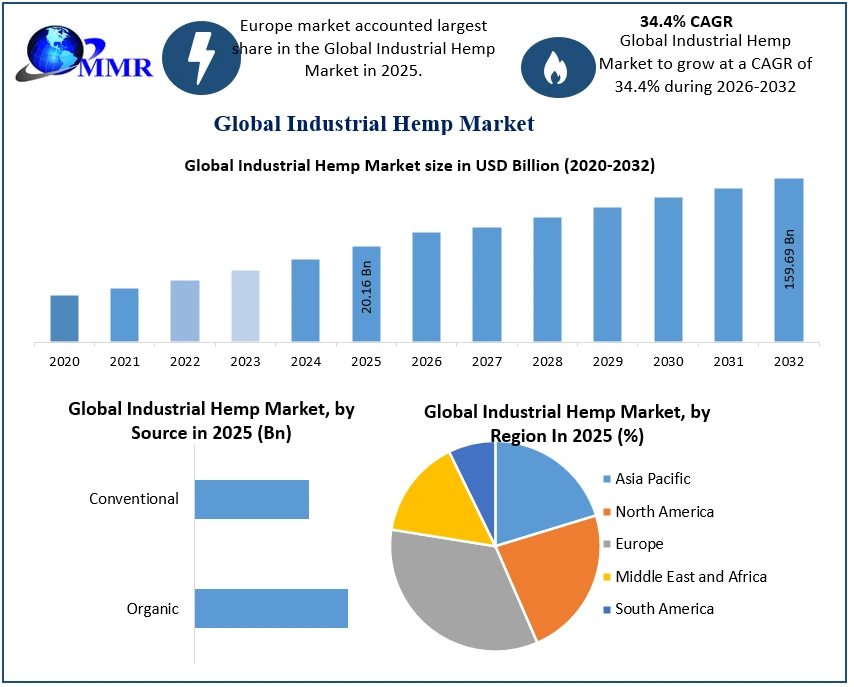
- The Industrial Hemp Market was valued at USD 20.16 Billion in 2025.
- The market is projected to reach USD 159.69 Billion by 2032.
- Revenue is expected to grow at a 34.4% CAGR from 2026 to 2032, signaling one of the fastest expansion rates across agricultural value chains.
- Consumer demand for sustainable and plant-based products continues to reshape investment priorities.
- Expanding applications across food, beverages, personal care, textiles, and industrial materials are broadening revenue opportunities.
- Sustainability and product innovation remain central competitive differentiators.
Why This Matters Now
Companies that delay industrial hemp investments risk losing access to one of the fastest-growing ingredient ecosystems in the global consumer economy. As sustainability regulations tighten and consumers increasingly prioritize plant-based alternatives, industrial hemp is moving from a niche agricultural crop to a strategic raw material.
The market’s projected growth from USD 20.16 Billion in 2025 to USD 159.69 Billion by 2032 carries a clear business implication: manufacturers, processors, ingredient suppliers, and consumer brands must prepare for significantly larger production capacity, supply-chain expansion, and product innovation over the coming decade.
Market Overview
The Industrial Hemp Market has evolved beyond its traditional agricultural role into a versatile commercial resource supporting multiple FMCG categories. Food manufacturers are incorporating hemp-derived ingredients into protein-rich foods, edible oils, snacks, and functional beverages, while personal care companies continue introducing hemp-based skincare and wellness products.
The market’s anticipated 34.4% CAGR between 2026 and 2032 indicates accelerating commercial adoption rather than incremental category growth. For businesses, this creates pressure to secure reliable sourcing, invest in processing capabilities, and develop differentiated product portfolios before market competition intensifies.
Rather than competing on commodity pricing alone, companies are increasingly competing on ingredient quality, sustainability credentials, processing technology, and product innovation.
Key Trends Driving Growth
Health-conscious consumers are driving greater interest in naturally sourced ingredients that support balanced nutrition. Hemp-derived ingredients align with demand for protein-rich, plant-based food products and functional nutrition, encouraging manufacturers to diversify product portfolios.
Clean-label purchasing continues influencing product development strategies. Consumers increasingly seek recognizable ingredients and transparent sourcing, encouraging brands to integrate hemp into food, beverage, and personal care formulations.
Sustainability has also become a commercial advantage rather than simply a compliance objective. Industrial hemp supports broader environmental initiatives through renewable raw materials and diversified agricultural production, making it attractive for companies pursuing ESG commitments.
Digital commerce is expanding product visibility and consumer education. Online retail channels allow emerging hemp brands to reach wider audiences while accelerating category awareness and product discovery.
Innovation remains another defining trend. Companies are extending hemp applications across functional foods, nutritional supplements, cosmetics, textiles, and industrial products, reducing dependence on any single end-use market.
Request a Sample Report for Strategic Business Analysis
Segment Insights
- Dominant Segment: Information available in the MMR report; specific dominant segment details were not provided in the supplied source material.
- Fastest-Growing Segment: Information available in the MMR report; specific fastest-growing segment details were not provided in the supplied source material.
- Hemp continues expanding into food and beverage applications as manufacturers respond to demand for plant-based nutrition.
- Personal care companies are increasing product innovation through hemp-derived formulations.
- Industrial applications continue supporting market diversification beyond consumer products.
Regional Growth Story
Regional competition is increasingly shaped by regulatory developments, agricultural capabilities, processing infrastructure, and consumer acceptance. Markets with supportive cultivation policies and established manufacturing ecosystems are positioned to capture larger portions of future investment.
For multinational FMCG companies, regional diversification reduces supply-chain risk while creating opportunities to establish localized production and distribution networks. Companies capable of balancing global sourcing with regional manufacturing flexibility are likely to improve resilience as demand accelerates.
The market’s long-term expansion also encourages governments and agricultural stakeholders to strengthen cultivation ecosystems, supporting future industrial development and downstream manufacturing.
Competitive Landscape
Competition is shifting from cultivation capacity toward value creation across the supply chain. Manufacturers are increasingly investing in processing technologies, branded ingredients, product innovation, and strategic partnerships to strengthen competitive positioning.
Competitive activity signals an industry transitioning from early commercialization toward scaled industrial production. Companies pursuing partnerships, product development, and operational expansion are positioning themselves to capture future demand rather than simply responding to current consumption patterns.
For rivals, this signals rising barriers to entry over the next 12–24 months. Businesses that establish stronger supplier relationships, processing capabilities, and differentiated product portfolios are likely to gain pricing power and customer loyalty as commercialization accelerates.
Recent Developments
- Continued expansion of hemp applications across food, beverages, personal care, and industrial products.
- Growing investment focus on sustainable and plant-based ingredient innovation.
- Increasing emphasis on strengthening processing capabilities and commercial-scale production.
- Rising strategic interest in diversified end-use applications to support long-term revenue growth.
Strategic Implications
Industrial hemp is becoming a strategic ingredient platform rather than a single-product opportunity. Companies that integrate sourcing, processing, product innovation, and sustainability into one operating model will likely strengthen long-term competitiveness.
For FMCG manufacturers, success increasingly depends on accelerating innovation cycles while maintaining transparent supply chains. Ingredient suppliers capable of delivering consistent quality alongside sustainability credentials may become preferred long-term partners for global consumer brands.
Investors should also recognize that value creation is expanding beyond cultivation into processing technologies, branded consumer products, and advanced ingredient development.
Future Outlook
The Industrial Hemp Market is entering a period of rapid commercial expansion supported by sustainability priorities, plant-based nutrition, and broad industrial adoption. Companies that invest early in innovation, supply-chain resilience, and differentiated product development will be better positioned to capture long-term market value.
The next competitive advantage will belong not to the companies that simply grow hemp, but to those that build scalable ecosystems around it. By 2032, market leaders will be defined by integrated value chains and innovation, while slower adopters risk losing relevance in one of the fastest-growing sustainable ingredient markets.
Analyst Perspective
“Industrial hemp is rapidly evolving into a high-value commercial ecosystem supported by sustainability, product innovation, and expanding end-use applications. Organizations that strengthen processing capabilities and develop differentiated offerings today will be better positioned to capitalize on the market’s exceptional long-term growth trajectory.” — Siddhi Dole, Analyst
About Maximize Market Research
Maximize Market Research Pvt. Ltd. (MMR) is a global market research and consulting company that provides reliable, data-focused, and practical business insights. The firm serves a wide range of industries, including healthcare, pharmaceuticals, technology, automotive, electronics, chemicals, personal care, and consumer goods. Through market forecasts, competitive analysis, strategic consulting, and industry impact assessments, MMR helps organizations understand changing market conditions, identify growth opportunities, and make informed business decisions for long-term success.
Contact Us
2nd Floor, Navale IT Park Phase 3
Pune Banglore Highway, Narhe
Pune, Maharashtra 411041, India
+91 9607365656
sales@maximizemarketresearch.com
