Key Highlights
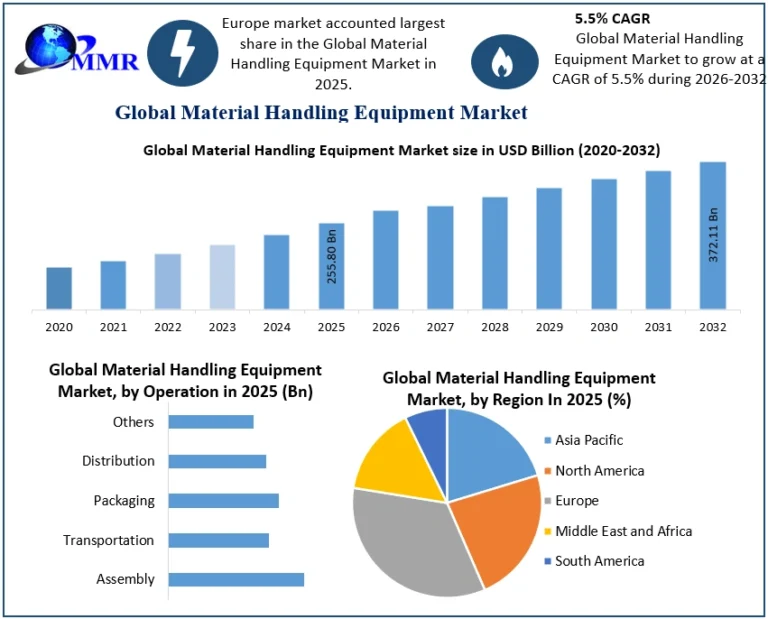
- Market valued at USD 255.80 Billion in 2025
- Projected to reach USD 372.11 Billion by 2032 at a CAGR of 5.5%
- Rising adoption of automated warehousing and logistics systems
- Strong integration of robotics, AGVs, and conveyor automation
- Increasing deployment of IIoT-enabled material flow tracking systems
- Expansion of smart factory logistics infrastructure across global manufacturing hubs
Why This Matters Now
Manufacturing competitiveness is shifting from production efficiency alone to end-to-end material flow intelligence. Delays in internal logistics now directly impact throughput, cost efficiency, and order fulfillment speed.
The Material Handling Equipment Market sits at the center of this transformation. At USD 255.80 Billion in 2025, it reflects massive global investment in automating warehouse operations, production line feeding systems, and intralogistics networks. The 5.5% CAGR through 2032 signals sustained capital shift toward robotics-driven and data-enabled supply chain infrastructure.
Market Overview
Material handling equipment Market has moved beyond mechanical lifting and transport functions. It now operates as a digitally integrated layer within smart factories and automated warehouses.
The market’s growth to USD 372.11 Billion by 2032 is driven by the convergence of robotics, industrial IoT, and AI-based logistics orchestration. Manufacturers are increasingly treating internal logistics as a programmable system rather than a manual workflow.
AGVs, AMRs, conveyor systems, and automated storage and retrieval systems are being integrated into centralized control environments. These systems connect directly with MES, WMS, and SCADA platforms, enabling real-time synchronization between production planning and material movement.
This shift is reducing bottlenecks, improving throughput predictability, and enabling just-in-time manufacturing at scale.
Key Trends Driving Growth
Industrial automation is fundamentally redefining intralogistics architecture. Material movement is now being treated as a controlled, data-driven process rather than a support function.
Robotics integration is accelerating across warehouses and manufacturing floors. Autonomous Mobile Robots (AMRs) and Automated Guided Vehicles (AGVs) are increasingly deployed for repetitive transport tasks, reducing reliance on manual labor.
IIoT-enabled tracking systems are providing real-time visibility into inventory flow, equipment utilization, and system performance. This improves coordination between production lines and logistics hubs.
Predictive maintenance is being applied to conveyors, lifts, and robotic systems. Sensor-based monitoring reduces downtime and extends equipment lifecycle.
AI-driven route optimization systems are improving warehouse efficiency by dynamically adjusting material flow paths based on demand fluctuations and operational constraints.
Edge computing is enabling faster decision-making at the equipment level, reducing latency in high-speed logistics environments.
Explore detailed analysis, insights, and growth opportunities
Segment Insights
- Dominant Segment: Not explicitly disclosed in the supplied MMR source
- Fastest-Growing Segment: Not explicitly disclosed in the supplied MMR source
Despite the absence of explicit segmentation data, automation-heavy subsegments such as robotics-enabled handling systems and automated storage solutions are witnessing strong adoption across large-scale manufacturing and logistics operations.
Conveyor systems integrated with digital control architectures remain foundational across industrial plants, while autonomous mobile robotics is expanding rapidly in e-commerce-driven and high-volume distribution environments.
Regional Growth Story
Asia-Pacific remains the primary growth engine for material handling equipment, driven by large-scale manufacturing expansion, export-oriented industrial growth, and rapid warehouse automation investments.
China and India are investing heavily in smart logistics infrastructure to support expanding industrial output and e-commerce supply chains. This is accelerating adoption of automated storage systems and robotics-enabled material flow solutions.
North America is focusing on warehouse modernization and reshoring-driven manufacturing expansion. Companies are investing in automation to offset labor shortages and improve operational resilience.
Europe is advancing automation adoption under strict efficiency and sustainability mandates. Material handling systems are being optimized for energy efficiency and reduced operational waste.
Japan and South Korea continue to lead in high-precision automation environments, where robotics integration and system reliability are key priorities.
Competitive Landscape
The Material Handling Equipment Market is defined by competition between traditional equipment manufacturers and robotics-driven automation providers.
Market leadership is shifting toward companies that integrate mechanical systems with digital control platforms. Equipment is no longer evaluated solely on load capacity or durability but on its ability to integrate with MES, WMS, and IIoT ecosystems.
This transition signals a broader structural change in industrial logistics. Vendors are moving toward platform-based models where hardware, software, and analytics are bundled into unified automation ecosystems.
Strategic partnerships between robotics firms, software providers, and industrial equipment manufacturers are increasing. This reflects a convergence of physical logistics and digital intelligence.
Competitive advantage is increasingly defined by system interoperability, data integration capability, and lifecycle optimization services rather than standalone equipment performance.
Recent Developments
- Expansion of AMR and AGV deployments across manufacturing and warehouse environments
- Increasing integration of IIoT sensors in conveyor and storage systems
- Growing adoption of AI-based warehouse orchestration platforms
- Deployment of predictive maintenance systems for logistics equipment
- Rising investment in fully automated distribution centers and smart factories
Strategic Implications
Material handling is becoming a core determinant of manufacturing competitiveness. Companies that optimize internal logistics are achieving faster production cycles and improved inventory accuracy.
For automation providers, the opportunity lies in creating fully integrated logistics ecosystems rather than standalone equipment. Interoperability with factory-wide digital systems is now essential.
For manufacturers, the shift requires rethinking warehouse and production line coordination as a unified system. Manual handling inefficiencies are increasingly incompatible with modern production speeds.
Investors are focusing on robotics-enabled logistics platforms that combine hardware, software, and AI-driven optimization capabilities.
Future Outlook
As manufacturing ecosystems evolve into fully autonomous production environments, material handling systems will transition from mechanical transport layers into intelligent orchestration networks that determine factory speed, efficiency, and competitiveness—separating digitally synchronized industrial leaders from fragmented laggards.
Analyst Perspective
“Material handling is no longer a support function. It is becoming a real-time control layer in smart factories where robotics, data, and automation converge to define throughput efficiency,” says Gaurav Deshmukh.
About Maximize Market Research:
Maximize Market Research is one of the fastest-growing market research and business consulting firms serving clients globally. Our revenue impact and focused growth-driven research initiatives make us a proud partner of majority of the Fortune 500 companies. We have a diversified portfolio and serve a variety of industries such as IT & telecom, chemical, food & beverage, aerospace & defense, healthcare and others.
Contact Maximize Market Research:
MAXIMIZE MARKET RESEARCH PVT. LTD.
⮝ 3rd Floor, Navale IT park Phase 2,
Pune Banglore Highway, Narhe
Pune, Maharashtra 411041, India.
✆ +91 9607365656
🖂 sales@maximizemarketresearch.com
