Key Highlights
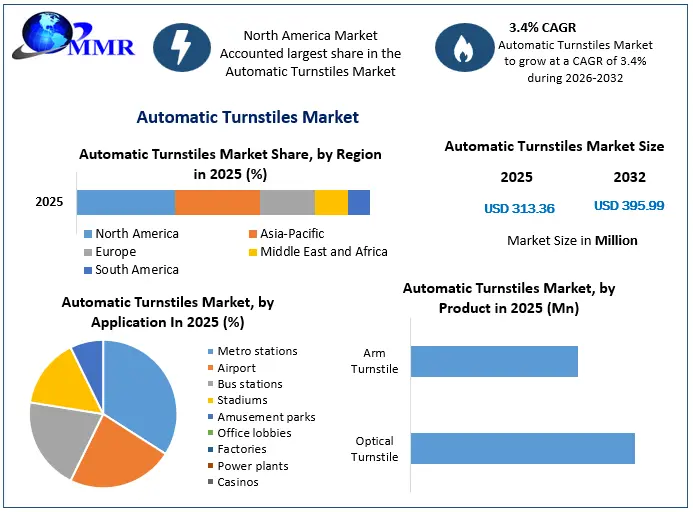
- Market valued at USD 313.36 Mn in 2025
- Expected to reach USD 395.99 Mn by 2032 at a CAGR of 3.4%
- Rising adoption of automated access control systems across infrastructure
- Increasing integration of biometric and RFID-based turnstiles
- Growing deployment in metro stations, airports, and commercial buildings
- Expansion of IoT-enabled security and smart building systems
Why This Matters Now
Physical access control is becoming a core component of digital infrastructure strategy. Organizations are no longer treating entry systems as standalone security tools but as integrated nodes in smart building and industrial automation ecosystems.
The Automatic Turnstiles Market reflects this shift. At USD 313.36 Mn in 2025, it signals steady modernization of access infrastructure across high-traffic environments. The 3.4% CAGR through 2032 highlights gradual but sustained investment in secure, automated, and data-enabled entry systems.
Market Overview
Automatic turnstiles Market have transitioned from mechanical crowd-control devices into digitally connected access management systems. They now function as part of integrated security architectures linking physical movement with digital identity verification.
Market expansion to USD 395.99 Mn by 2032 is driven by rising demand for controlled access in transportation hubs, commercial buildings, stadiums, and industrial facilities. Organizations are prioritizing security systems that combine speed, traceability, and automation.
Modern turnstiles increasingly integrate RFID readers, biometric scanners, and AI-based recognition systems. These technologies enable real-time authentication and seamless entry flow, reducing congestion while strengthening security enforcement.
Turnstiles are also being integrated into broader smart building ecosystems. They now communicate with centralized security platforms, enabling unified monitoring of occupancy, access logs, and movement patterns.
Key Trends Driving Growth
Industrial automation principles are increasingly shaping physical security infrastructure. Access control systems are evolving into data-driven, networked components of smart environments.
Biometric authentication is becoming standard in high-security installations. Facial recognition and fingerprint scanning are replacing traditional card-based systems in critical infrastructure environments.
IoT integration is enabling real-time synchronization between turnstiles and centralized security platforms. This allows facility managers to monitor access patterns and detect anomalies instantly.
AI-based surveillance systems are enhancing threat detection capabilities. Turnstiles are now part of broader intelligent security ecosystems that combine video analytics with access control data.
Edge computing is improving response times at entry points by enabling local processing of authentication data, reducing latency and improving throughput in high-traffic areas.
Explore detailed analysis, insights, and growth opportunities
Segment Insights
- Dominant Segment: Not explicitly disclosed in the supplied MMR source
- Fastest-Growing Segment: Not explicitly disclosed in the supplied MMR source
Although segmentation details are not provided in the source, adoption trends indicate strong demand for biometric-enabled and RFID-integrated turnstile systems across transportation and commercial infrastructure.
Speed gates and full-height turnstiles are increasingly deployed in high-security environments, while tripod turnstiles continue to dominate cost-sensitive installations.
Regional Growth Story
Asia-Pacific is a key adoption region, driven by rapid urbanization, expansion of metro rail networks, and large-scale infrastructure development. Smart city initiatives are accelerating deployment of automated access control systems.
China and India are investing heavily in transportation infrastructure, leading to widespread installation of automated turnstiles in transit systems and commercial complexes.
North America is focused on upgrading existing security infrastructure across airports, corporate campuses, and government facilities. The emphasis is on integrating access control with broader digital security platforms.
Europe continues to adopt advanced security systems under strict regulatory frameworks, particularly in transportation hubs and public infrastructure environments.
Japan and South Korea are leading in high-efficiency, technology-driven deployments where automation, speed, and precision in access control are critical.
Competitive Landscape
The Automatic Turnstiles Market is characterized by competition between traditional security equipment manufacturers and advanced smart infrastructure providers.
Market dynamics are shifting toward integrated access ecosystems rather than standalone hardware solutions. Vendors are increasingly differentiating based on software integration, biometric capabilities, and IoT connectivity.
This shift signals a broader transformation in physical security. Turnstiles are becoming intelligent endpoints within digital security networks rather than isolated mechanical systems.
Strategic partnerships between security hardware firms and software analytics providers are increasing. This reflects a convergence of physical infrastructure and digital identity management systems.
Competitive advantage is now defined by interoperability with smart building platforms, scalability across large facilities, and ability to integrate with AI-driven surveillance systems.
Recent Developments
- Expansion of biometric-enabled turnstile deployments in transport hubs
- Increasing integration of IoT-based access control systems in smart buildings
- Adoption of AI-powered surveillance linked with entry management systems
- Deployment of RFID-enabled automated gates in commercial facilities
- Growing modernization of metro and airport security infrastructure globally
Strategic Implications
Automatic turnstiles are becoming a critical interface between physical infrastructure and digital identity systems. This transformation is elevating their role in enterprise security architecture.
For infrastructure operators, the focus is shifting from simple entry control to intelligent occupancy and movement management. Real-time data from turnstiles is increasingly used for operational planning and security analytics.
For technology providers, success depends on building interoperable systems that connect access control with broader smart city and smart building ecosystems.
For investors, the market represents stable, infrastructure-linked growth driven by long-term modernization cycles rather than short-term demand spikes.
Future Outlook
As smart infrastructure ecosystems mature, automatic turnstiles will evolve into fully networked identity gateways, separating digitally synchronized security environments from legacy access systems that lack real-time intelligence and integration capability.
Analyst Perspective
“Automatic turnstiles are no longer mechanical barriers. They are becoming intelligent access nodes that connect physical movement with digital identity and security intelligence,” says Gaurav Deshmukh.
About Maximize Market Research:
Maximize Market Research is one of the fastest-growing market research and business consulting firms serving clients globally. Our revenue impact and focused growth-driven research initiatives make us a proud partner of majority of the Fortune 500 companies. We have a diversified portfolio and serve a variety of industries such as IT & telecom, chemical, food & beverage, aerospace & defense, healthcare and others.
Contact Maximize Market Research:
MAXIMIZE MARKET RESEARCH PVT. LTD.
⮝ 3rd Floor, Navale IT park Phase 2,
Pune Banglore Highway, Narhe
Pune, Maharashtra 411041, India.
✆ +91 9607365656
🖂 sales@maximizemarketresearch.com
