Key Highlights
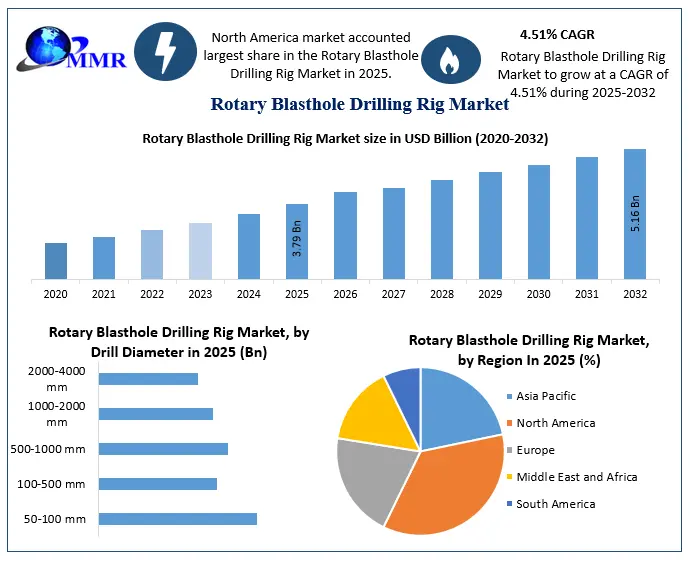
- Market valued at USD 3.79 Billion in 2025
- Projected to reach USD 5.16 Billion by 2032 at a CAGR of 4.51%
- Rising adoption of automated and semi-autonomous drilling systems
- Increasing integration of IoT sensors in mining equipment
- Expansion of predictive maintenance in heavy-duty drilling operations
- Strong demand from surface mining and large-scale mineral extraction projects
Why This Matters Now
Mining operators are under pressure to increase output while reducing operational risk and equipment downtime. Drilling performance has become a direct determinant of productivity in open-pit mining environments.
The Rotary Blasthole Drilling Rig Market reflects this operational shift. At USD 3.79 Billion in 2025, it signals steady investment in high-efficiency drilling systems that can deliver precision, consistency, and uptime. The 4.51% CAGR through 2032 highlights the gradual but firm transition from manual-heavy drilling operations to digitally monitored and partially autonomous systems.
Market Overview
Rotary blasthole drilling rigs Market remain a core asset in surface mining operations, enabling blast hole creation for ore fragmentation. However, their role is evolving from purely mechanical drilling machines to data-enabled production assets integrated into digital mining ecosystems.
The market’s growth to USD 5.16 Billion by 2032 reflects increasing demand for equipment that can operate with higher precision, lower fuel consumption, and reduced unplanned downtime. Mining companies are prioritizing operational efficiency as ore grades decline and extraction costs rise.
Modern drilling rigs are increasingly equipped with sensor arrays, onboard diagnostics, and automated control systems. These features allow real-time monitoring of drilling parameters such as penetration rate, torque, vibration, and hydraulic pressure.
The integration of digital systems into drilling fleets is enabling centralized monitoring of multiple rigs across mining sites. This improves coordination, enhances safety compliance, and reduces variability in drilling performance.
Key Trends Driving Growth
Mining operations are undergoing a structural shift toward automation-led productivity. Drilling rigs are at the center of this transformation due to their direct impact on blasting efficiency and downstream processing performance.
IoT-enabled drilling systems are becoming standard in modern mining fleets. These systems transmit operational data in real time, enabling supervisors to track machine health and performance remotely.
Predictive maintenance is emerging as a key operational strategy. Sensor-based monitoring of hydraulic systems, drill bits, and engine performance helps identify wear patterns before failure occurs. This reduces unplanned downtime and improves asset utilization.
Automation in drilling control systems is improving consistency in blast hole accuracy. Semi-autonomous rigs can maintain optimal drilling angles and depths, reducing human error and improving fragmentation outcomes.
Fleet management software is being integrated with drilling operations to optimize equipment deployment across mining sites. This ensures higher equipment utilization and better coordination between drilling, loading, and hauling operations.
Edge computing is also gaining relevance in remote mining environments. Onboard data processing reduces latency and enables faster operational decisions without relying on continuous cloud connectivity.
Explore detailed analysis, insights, and growth opportunities
Segment Insights
- Dominant Segment: Not explicitly disclosed in the supplied MMR report
- Fastest-Growing Segment: Not explicitly disclosed in the supplied MMR report
Although segmentation is not provided in the source, industry deployment patterns indicate that automation-enabled and sensor-integrated drilling rigs are gaining traction across large-scale mining operations.
Conventional mechanically operated rigs continue to serve cost-sensitive applications, while digitally enabled rigs are increasingly deployed in high-output mining sites requiring precision and uptime optimization.
Regional Growth Story
Global demand for rotary blasthole drilling rigs is closely tied to mining activity and mineral extraction investments.
Asia-Pacific remains a major growth hub, driven by expanding industrial production and rising demand for raw materials. Countries with large-scale mining operations are investing in automation-enabled drilling fleets to improve efficiency and reduce operational risk.
North America is focused on upgrading existing mining infrastructure with advanced drilling technologies. Operators are prioritizing equipment that enhances productivity while reducing maintenance downtime and fuel consumption.
Latin America continues to play a significant role due to large mineral reserves and ongoing investments in surface mining projects. Drilling rig demand is closely linked to copper and iron ore extraction activities.
Africa is emerging as a long-term growth region supported by increasing exploration activity and expansion of mining concessions.
Australia remains a key technology adopter, with mining operators leading in autonomous and semi-autonomous drilling systems integrated with digital fleet management platforms.
Competitive Landscape
The rotary blasthole drilling rig market is defined by competition between established heavy equipment manufacturers and technology-driven mining automation providers.
Competitive dynamics are shifting from mechanical performance alone to integrated digital capability. Equipment manufacturers are increasingly differentiating through automation features, connectivity, and data analytics integration.
This transition signals a broader shift in mining operations toward digitally controlled extraction systems. Drilling rigs are no longer standalone machines but integrated nodes within connected mining ecosystems.
Strategic focus is moving toward lifecycle optimization. Manufacturers are offering service-based models that include remote monitoring, predictive maintenance support, and performance optimization services.
Partnerships between equipment manufacturers and mining software providers are increasing. This reflects a convergence of physical mining operations with digital intelligence platforms.
Competitive advantage is increasingly defined by autonomy readiness, system interoperability, and ability to integrate with mine-wide automation platforms.
Recent Developments
- Expansion of sensor-equipped drilling rigs in large-scale mining operations
- Increasing adoption of predictive maintenance systems in heavy equipment fleets
- Deployment of semi-autonomous drilling systems for improved accuracy and efficiency
- Integration of fleet management software with drilling operations
- Growing use of real-time monitoring systems for equipment performance optimization
Strategic Implications
Mining companies are shifting toward data-driven drilling operations where productivity is measured in real-time performance metrics rather than manual output tracking.
For equipment manufacturers, the opportunity lies in embedding intelligence directly into drilling systems. Machines that can self-monitor and communicate operational status are becoming industry standard.
For mining operators, the focus is shifting toward reducing unplanned downtime and improving drilling accuracy to enhance downstream processing efficiency.
For investors, the market represents a stable but evolving industrial segment where value creation is increasingly tied to digital capabilities rather than mechanical scale alone.
Future Outlook
As mining operations continue transitioning toward autonomous extraction ecosystems, rotary blasthole drilling rigs will evolve into fully connected, semi-autonomous production assets that define operational efficiency—separating digitally optimized mining leaders from traditional operators reliant on manual control systems.
Analyst Perspective
“Drilling operations are becoming increasingly data-driven, where equipment performance is continuously monitored and optimized. This shift is reshaping productivity standards across the mining sector,” says Gaurav Deshmukh.
About Maximize Market Research:
Maximize Market Research is one of the fastest-growing market research and business consulting firms serving clients globally. Our revenue impact and focused growth-driven research initiatives make us a proud partner of majority of the Fortune 500 companies. We have a diversified portfolio and serve a variety of industries such as IT & telecom, chemical, food & beverage, aerospace & defense, healthcare and others.
Contact Maximize Market Research:
MAXIMIZE MARKET RESEARCH PVT. LTD.
⮝ 3rd Floor, Navale IT park Phase 2,
Pune Banglore Highway, Narhe
Pune, Maharashtra 411041, India.
✆ +91 9607365656
🖂 sales@maximizemarketresearch.com
