Key Highlights
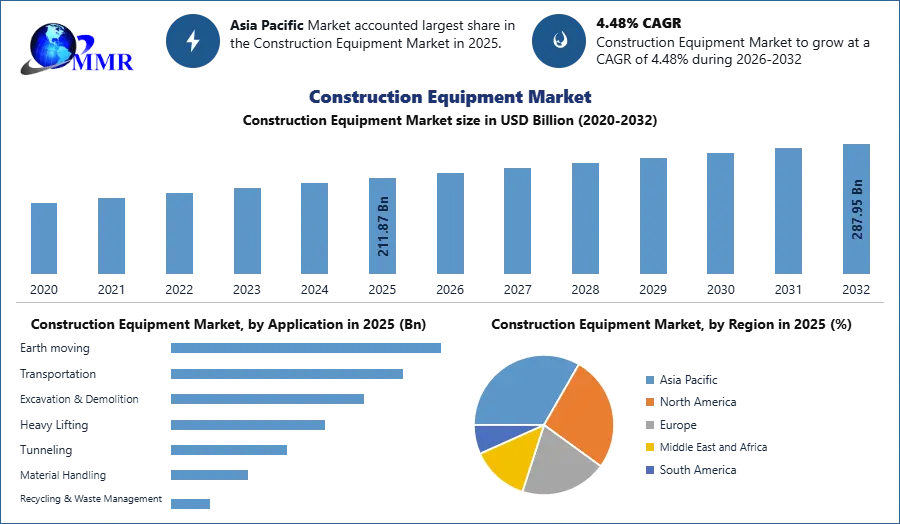
- Construction Equipment Market valued at USD 211.87 Billion in 2025
- Market projected to reach USD 287.95 Billion by 2032
- CAGR of 4.48% from 2026–2032
- Infrastructure modernization continues to reshape equipment demand
- Automation, telematics, AI, and connected machinery redefine equipment productivity
- Industry 4.0 technologies increasingly influence fleet operations and equipment lifecycle management
Why This Matters Now
Construction is entering a technology cycle rather than simply another investment cycle. Equipment manufacturers, contractors, automation providers, and infrastructure developers are racing to improve productivity as labor shortages, project complexity, and sustainability targets intensify.
The Construction Equipment Market, valued at USD 211.87 Billion in 2025, is expected to reach USD 287.95 Billion by 2032, growing at a 4.48% CAGR. That expansion signals more than rising equipment sales. It reflects accelerating investment in intelligent machines, connected fleets, predictive maintenance platforms, and digital jobsite operations that reduce downtime and improve project delivery.
Market Overview
The Construction Equipment Market is entering a new operating model where equipment functions as connected industrial assets rather than standalone machines. Infrastructure investments, urban expansion, mining activity, and industrial development continue to generate demand, while digital technologies are redefining how equipment is managed throughout its lifecycle.
Manufacturers are responding by integrating Industrial IoT platforms, intelligent diagnostics, remote monitoring, machine automation, and cloud-connected fleet management into heavy equipment portfolios. The business objective has shifted from selling machinery alone to delivering measurable improvements in productivity, fuel efficiency, safety, and lifecycle costs.
This evolution is accelerating collaboration between equipment manufacturers, software providers, automation specialists, and construction technology companies.
Key Trends Driving Growth
Infrastructure investment remains the principal catalyst for equipment demand across developed and emerging economies. Governments continue prioritizing transportation, energy, industrial facilities, commercial development, and urban expansion, creating sustained opportunities for equipment manufacturers.
Artificial intelligence is changing fleet operations. Intelligent analytics help contractors optimize equipment utilization, fuel efficiency, maintenance schedules, and operator performance. Instead of reacting to breakdowns, businesses increasingly use predictive maintenance strategies that reduce costly downtime.
Industrial IoT connectivity is strengthening equipment visibility. Connected sensors continuously transmit operating conditions, allowing fleet managers to monitor asset health remotely while improving maintenance planning.
Automation is also reshaping machine operation. Semi-autonomous capabilities, advanced guidance systems, precision excavation technologies, and intelligent machine controls improve consistency while reducing operator fatigue.
Digital construction platforms increasingly integrate equipment data with project management software, enabling real-time coordination between field operations and project execution teams.
Sustainability continues influencing equipment development as manufacturers invest in cleaner powertrains, improved fuel efficiency, and technologies that reduce emissions without sacrificing productivity.
Download a Sample Report Featuring Industry Trends and Opportunities
Segment Insights
- Dominant Segment: Available in the Maximize Market Research report.
- Fastest-Growing Segment: Available in the Maximize Market Research report.
- Intelligent earthmoving equipment continues benefiting from digital machine control technologies that improve grading accuracy and project efficiency.
- Connected fleet management solutions are becoming increasingly valuable as contractors seek higher equipment utilization and lower operating costs.
- Predictive maintenance capabilities are extending equipment life while minimizing unexpected failures across construction fleets.
- AI-enabled operational analytics help contractors optimize project planning, equipment allocation, and maintenance scheduling.
Regional Growth Story
The United States continues investing in transportation modernization, utilities, industrial facilities, and public infrastructure. These projects create sustained demand for technologically advanced construction equipment capable of improving productivity and reducing project timelines.
Germany remains a significant center for engineering innovation and advanced manufacturing. Equipment producers continue integrating automation, digital controls, and intelligent machine technologies into premium construction machinery.
China continues expanding infrastructure while investing heavily in manufacturing modernization. Equipment manufacturers are accelerating digital capabilities to support large-scale construction activities and increasingly sophisticated domestic customers.
Japan and South Korea continue emphasizing robotics, automation engineering, and precision manufacturing, strengthening innovation across intelligent construction equipment technologies.
India represents an important long-term opportunity as infrastructure expansion, urbanization, industrial corridors, and transportation investments continue generating demand for modern construction machinery and connected equipment solutions.
Across these regions, digital transformation is becoming as important as mechanical capability. Contractors increasingly evaluate equipment based on lifecycle productivity rather than purchase price alone.
Competitive Landscape
Competition is shifting from machine performance toward technology ecosystems.
Manufacturers increasingly differentiate themselves through software integration, connected services, predictive maintenance platforms, telematics, remote diagnostics, automation capabilities, and digital fleet management rather than hardware specifications alone.
Equipment companies investing in AI, Industrial IoT, and intelligent control systems strengthen long-term customer relationships because software-enabled operational improvements continue generating value throughout the equipment lifecycle.
Strategic investments in automation also improve aftermarket opportunities. Predictive maintenance services, software subscriptions, digital fleet optimization, and remote monitoring create recurring revenue while improving customer retention.
Technology partnerships increasingly signal ecosystem competition, where manufacturers seek to connect equipment, operators, construction management software, and enterprise platforms into unified digital environments.
The industry’s competitive advantage is therefore moving toward integrated intelligent equipment rather than standalone machines.
Recent Developments
- Growing integration of AI-enabled fleet analytics across construction operations.
- Expansion of Industrial IoT connectivity within heavy equipment portfolios.
- Increased adoption of predictive maintenance technologies to improve equipment availability.
- Continued investment in automation-enabled machine control systems.
- Greater deployment of telematics for remote diagnostics and operational visibility.
- Digital fleet management platforms becoming core components of equipment offerings.
- Ongoing development of sustainable and intelligent construction machinery.
Strategic Implications
Equipment buyers increasingly evaluate total operational performance instead of initial acquisition costs. Digital capabilities directly influence project profitability through reduced downtime, improved utilization, lower maintenance costs, and higher workforce productivity.
Automation providers have expanding opportunities to integrate machine vision, AI analytics, edge computing, remote diagnostics, and predictive maintenance solutions into heavy equipment fleets.
System integrators benefit as construction companies require connected ecosystems linking equipment data, enterprise software, maintenance platforms, and project management systems.
Investors should recognize that future competitive leadership will increasingly depend on software capabilities alongside manufacturing scale. Companies capable of delivering integrated digital ecosystems may capture greater long-term value than those competing primarily on mechanical engineering.
The convergence of automation, connectivity, and intelligent equipment management is transforming construction machinery into strategic digital infrastructure assets.
Future Outlook
The Construction Equipment Market is steadily evolving from mechanical engineering toward intelligent industrial operations. As automation, Industrial IoT, predictive maintenance, AI-assisted decision-making, connected fleets, and smart construction platforms become standard capabilities, competitive advantage will increasingly depend on digital productivity rather than equipment ownership alone. The next generation of market leaders will be defined not by the number of machines they build, but by how intelligently those machines operate within connected construction ecosystems.
Analyst Perspective
“The Construction Equipment Market is entering a new phase where digital technologies, intelligent equipment, and operational efficiency are becoming as important as traditional engineering performance. Companies investing in automation, connected equipment, and smart fleet capabilities will be better positioned to capture long-term value as infrastructure development accelerates globally.” — Gaurav Deshmukh, Analyst
About Maximize Market Research
Maximize Market Research Pvt. Ltd. (MMR) is a global market research and consulting company that provides reliable, data-focused, and practical business insights. The firm serves a wide range of industries, including healthcare, pharmaceuticals, technology, automotive, electronics, chemicals, personal care, and consumer goods. Through market forecasts, competitive analysis, strategic consulting, and industry impact assessments, MMR helps organizations understand changing market conditions, identify growth opportunities, and make informed business decisions for long-term success.
Contact Us
2nd Floor, Navale IT Park Phase 3
Pune Banglore Highway, Narhe
Pune, Maharashtra 411041, India
+91 9607365656
sales@maximizemarketresearch.com
