Key Highlights
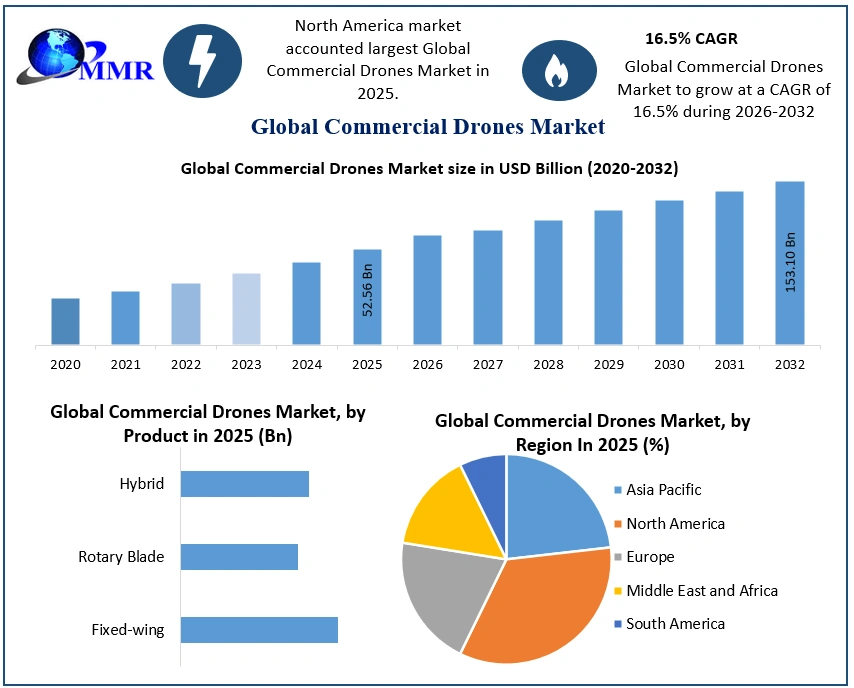
- Commercial Drones Market valued at USD 52.56 Billion in 2025
- Expected to reach USD 153.10 Billion by 2032
- Forecast CAGR of 16.5% from 2025 to 2032
- Industrial inspection and enterprise automation remain major demand drivers
- AI, Industrial IoT, and autonomous operations continue expanding commercial drone capabilities
- Manufacturing, infrastructure, agriculture, logistics, and energy sectors are accelerating enterprise drone adoption
Why This Matters Now
Industrial automation is no longer limited to factory floors. Enterprise leaders are extending automation into the air as commercial drones become intelligent operational assets capable of inspecting infrastructure, collecting industrial data, supporting predictive maintenance, and improving workforce productivity.
The Commercial Drones Market, valued at USD 52.56 Billion in 2025, is projected to reach USD 153.10 Billion by 2032, expanding at a 16.5% CAGR. That growth signals more than rising equipment sales—it reflects a structural shift toward AI-enabled aerial operations that reduce inspection costs, improve operational visibility, and strengthen industrial decision-making.
Market Overview
The Commercial Drones Market have evolved from specialized imaging tools into connected enterprise platforms supporting automation across manufacturing, utilities, construction, mining, agriculture, logistics, telecommunications, and public infrastructure.
Organizations increasingly view drones as extensions of digital operations rather than standalone hardware. Combined with artificial intelligence, machine vision, cloud analytics, Industrial IoT platforms, and edge computing, drones enable continuous monitoring without disrupting operations.
Manufacturers are integrating drone-generated data into maintenance planning, asset management, and operational intelligence systems. Infrastructure operators are replacing manual inspections with autonomous aerial surveys that improve worker safety while reducing downtime.
The market’s projected expansion to USD 153.10 Billion by 2032 illustrates how drone technology is becoming part of broader digital transformation initiatives instead of remaining an isolated technology investment.
Key Trends Driving Growth
Artificial intelligence is significantly changing commercial drone capabilities. Automated flight planning, intelligent object detection, anomaly recognition, and real-time analytics are allowing organizations to move beyond image collection toward actionable operational intelligence.
Industry 4.0 initiatives are creating additional demand. Smart factories increasingly require automated monitoring of large industrial campuses, warehouse inventories, production infrastructure, and critical assets. Commercial drones complement existing automation technologies by extending visibility beyond fixed sensors.
Industrial IoT adoption is another catalyst. Connected drones collect operational data that can be integrated into enterprise analytics platforms, digital twins, predictive maintenance systems, and asset performance management software.
Predictive maintenance is becoming a high-value application. Rather than waiting for failures, industrial operators can use drone inspections to identify equipment degradation, corrosion, structural defects, thermal anomalies, and maintenance priorities before production is affected.
Robotics integration is also expanding. Autonomous drones increasingly operate alongside mobile robots, automated guided vehicles, warehouse automation systems, and intelligent inspection platforms to support end-to-end operational automation.
Growing investments in industrial cybersecurity further influence deployment strategies as organizations seek secure communication between drones, operational technology environments, cloud platforms, and enterprise networks.
Request a Sample Report for Competitive Industry Intelligence
Segment Insights
- Dominant Segment: Not specified in the supplied report.
- Fastest-Growing Segment: Not specified in the supplied report.
- Commercial drones are seeing increasing deployment across industrial inspection, infrastructure monitoring, agriculture, logistics, construction, mining, energy, and public safety applications.
- AI-powered analytics are expanding the business value of aerial data collection beyond traditional imaging.
- Integration with Industrial IoT ecosystems is increasing enterprise adoption across operational environments.
Regional Growth Story
Major industrial economies are positioning commercial drones as strategic productivity tools rather than experimental technologies.
The United States continues expanding enterprise drone deployment across utilities, infrastructure inspection, logistics, and manufacturing modernization. Companies increasingly integrate drone operations with digital asset management and predictive maintenance initiatives.
Germany’s emphasis on Industry 4.0 supports adoption within advanced manufacturing facilities where drones contribute to factory digitization, automated inspections, and operational efficiency.
China remains an important innovation hub for commercial drone manufacturing and enterprise deployment, supported by investments in intelligent manufacturing, automation technologies, and AI development.
Japan and South Korea continue investing in robotics, industrial automation, and smart manufacturing ecosystems where autonomous aerial systems enhance operational visibility and workforce productivity.
India is emerging as a significant opportunity through expanding industrial infrastructure, manufacturing investments, digital transformation initiatives, and growing enterprise adoption across energy, agriculture, mining, and construction sectors.
Competitive Landscape
Competition is shifting away from hardware specifications alone toward complete enterprise ecosystems. Technology leaders are increasingly combining drones with AI software, cloud analytics, machine vision, autonomous navigation, and enterprise integration capabilities.
This evolution signals a broader competitive transition. Companies capable of delivering connected aerial intelligence platforms rather than standalone aircraft are strengthening their long-term market positioning.
Software integration is becoming a critical differentiator. Enterprise buyers increasingly prioritize interoperability with manufacturing execution systems (MES), Industrial IoT platforms, digital twins, predictive maintenance software, and operational analytics solutions.
Strategic partnerships across automation providers, software developers, sensor manufacturers, and industrial technology companies are also expanding solution capabilities while reducing deployment complexity for enterprise customers.
Recent Developments
- AI-powered autonomous flight capabilities continue advancing enterprise drone operations.
- Industrial inspection applications are expanding across critical infrastructure.
- Integration with Industrial IoT ecosystems is strengthening operational intelligence.
- Digital transformation initiatives are accelerating enterprise drone investments.
- Predictive maintenance applications continue gaining adoption across industrial sectors.
- Robotics, machine vision, and edge computing technologies are increasing automation capabilities.
Strategic Implications
Commercial drones are becoming operational infrastructure rather than discretionary technology purchases.
Manufacturers can improve asset utilization by incorporating autonomous aerial inspections into maintenance workflows. Utilities gain continuous visibility across geographically dispersed infrastructure. Construction companies accelerate project monitoring while reducing manual survey requirements. Logistics operators improve inventory visibility and operational coordination.
Technology providers benefit from growing demand for integrated software platforms, AI analytics, cybersecurity solutions, cloud connectivity, and enterprise workflow automation.
Investors should also recognize that future value creation is likely to come from software, analytics, autonomous operations, and recurring digital services rather than drone hardware alone.
Future Outlook
The next phase of market expansion will be defined by autonomous decision-making rather than autonomous flight alone. Commercial drones are expected to become connected intelligence platforms supporting predictive maintenance, AI-powered inspections, digital twins, Industrial IoT ecosystems, and enterprise automation strategies.
Organizations that integrate drone intelligence into broader Industry 4.0 initiatives will create measurable gains in productivity, safety, and operational efficiency, while those treating drones as isolated hardware investments risk falling behind competitors building fully connected autonomous operations.
Analyst Perspective
“The Commercial Drones Market is entering a period where enterprise value increasingly depends on intelligent automation rather than aerial mobility alone. Organizations integrating AI, industrial analytics, and connected drone operations into broader digital transformation strategies will be positioned to unlock greater operational efficiency and long-term competitive advantage.” — Gaurav Deshmukh, Analyst
About Maximize Market Research
Maximize Market Research Pvt. Ltd. (MMR) is a global market research and consulting company that provides reliable, data-focused, and practical business insights. The firm serves a wide range of industries, including healthcare, pharmaceuticals, technology, automotive, electronics, chemicals, personal care, and consumer goods. Through market forecasts, competitive analysis, strategic consulting, and industry impact assessments, MMR helps organizations understand changing market conditions, identify growth opportunities, and make informed business decisions for long-term success.
Contact Us
2nd Floor, Navale IT Park Phase 3
Pune Banglore Highway, Narhe
Pune, Maharashtra 411041, India
+91 9607365656
sales@maximizemarketresearch.com
