Key Highlights
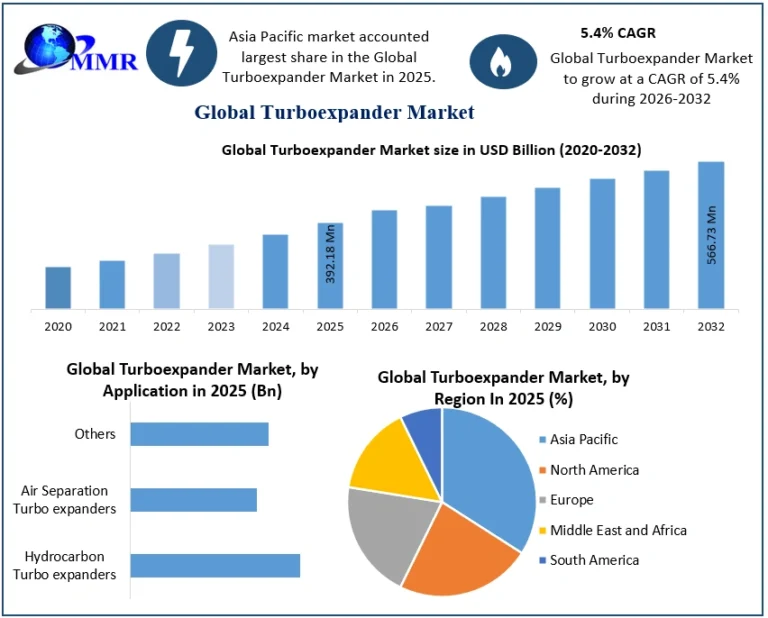
- Market valued at USD 392.18 Million in 2025
- Projected to reach USD 566.73 Million by 2032 at a CAGR of 5.4%
- Rising adoption in LNG and industrial gas processing plants
- Increasing use of energy recovery systems in cryogenic operations
- Expanding integration with industrial automation and SCADA systems
- Growing demand for efficiency optimization in oil and gas infrastructure
Why This Matters Now
Energy efficiency has become a structural requirement in industrial gas processing. Operators are under pressure to recover energy, reduce losses, and improve process stability in high-cost cryogenic environments.
The Turboexpander Market reflects this shift. At USD 392.18 Million in 2025, it signals growing investment in energy recovery turbomachinery that converts pressure differentials into usable energy. The 5.4% CAGR through 2032 highlights rising adoption across LNG infrastructure, petrochemical plants, and industrial gas processing facilities seeking higher efficiency and lower operating costs.
Market Overview
Turboexpanders Market are critical components in cryogenic and gas processing systems, converting high-pressure gas into mechanical energy while simultaneously cooling the gas stream. This dual function makes them essential in LNG production, air separation units, and petrochemical processing.
The market’s expansion to USD 566.73 Million by 2032 reflects growing industrial focus on energy recovery and process optimization. Operators are increasingly integrating turboexpanders into automation-driven plant architectures to improve thermodynamic efficiency.
Modern turboexpander systems are being equipped with advanced monitoring sensors for vibration, temperature, rotational speed, and pressure differentials. This enables real-time performance tracking and early detection of mechanical degradation.
Integration with SCADA and distributed control systems is becoming standard in gas processing plants. This allows centralized monitoring and optimization of energy recovery processes across complex industrial systems.
Key Trends Driving Growth
Industrial automation is reshaping energy recovery systems. Turboexpanders are increasingly managed as intelligent rotating equipment rather than standalone mechanical assets.
IIoT integration is enabling continuous monitoring of operating conditions. Data from sensors is used to optimize performance and improve equipment reliability in real time.
Predictive maintenance is gaining importance in high-value turbomachinery. Early detection of bearing wear, imbalance, or efficiency loss reduces downtime and prevents catastrophic failure.
Energy recovery optimization is a key driver. Industries are focusing on maximizing usable energy output from pressure differentials in gas streams, improving overall plant efficiency.
Digital twin models are being introduced in advanced gas processing facilities. These models simulate turboexpander performance under varying load conditions to improve operational planning.
Edge computing is improving responsiveness in control systems, enabling faster adjustments in cryogenic environments where process stability is critical.
Explore detailed analysis, insights, and growth opportunities
Segment Insights
- Dominant Segment: Not explicitly disclosed in the supplied MMR report
- Fastest-Growing Segment: Not explicitly disclosed in the supplied MMR report
While segmentation is not provided, gas processing and LNG applications represent major adoption areas due to high energy recovery requirements and large-scale cryogenic infrastructure.
Air separation units and petrochemical plants are also key users, integrating turboexpanders into broader process optimization and energy efficiency systems.
Regional Growth Story
Asia-Pacific is witnessing strong growth due to rapid expansion of LNG infrastructure, industrial gas demand, and petrochemical investments. Countries with large energy import dependencies are investing in gas liquefaction and processing facilities.
North America remains a key market driven by shale gas production, LNG export facilities, and modernization of industrial gas infrastructure.
Europe is focused on energy efficiency and decarbonization, driving adoption of energy recovery systems in industrial gas processing.
Middle East countries are expanding LNG and petrochemical capacities, increasing demand for high-efficiency cryogenic systems including turboexpanders.
Japan and South Korea continue to invest in advanced gas processing systems with strong emphasis on automation and reliability.
Competitive Landscape
The Turboexpander Market is defined by specialized turbomachinery manufacturers competing on efficiency, reliability, and integration capability.
Competition is shifting from standalone equipment performance to system-level efficiency and digital integration. Vendors are increasingly offering turboexpanders integrated with monitoring systems, predictive diagnostics, and automation compatibility.
This reflects a broader shift in process industries where energy recovery systems are becoming part of intelligent plant ecosystems rather than isolated mechanical components.
Strategic partnerships between turbomachinery manufacturers and automation providers are increasing. This convergence enables tighter integration between mechanical systems and plant-wide digital control architectures.
Competitive advantage is increasingly defined by energy efficiency performance, lifecycle service offerings, and integration with SCADA, PLC, and IIoT platforms.
Recent Developments
- Deployment of sensor-enabled turboexpanders in LNG facilities
- Increasing use of predictive maintenance systems in turbomachinery
- Integration of energy recovery systems with SCADA-based plant controls
- Expansion of digital monitoring solutions in cryogenic applications
- Rising investment in LNG and industrial gas infrastructure projects
Strategic Implications
Turboexpanders are becoming strategic assets in industrial energy optimization. Their role is shifting from niche cryogenic equipment to core efficiency drivers in gas processing plants.
For operators, the focus is moving toward maximizing energy recovery while maintaining system stability under variable load conditions.
For equipment manufacturers, value creation lies in integrating digital monitoring and predictive capabilities into turbomachinery systems.
For investors, the market represents steady industrial growth driven by global energy demand and efficiency optimization requirements.
Future Outlook
As industrial gas processing systems evolve toward fully optimized, automation-driven ecosystems, turboexpanders will transition into intelligent energy recovery nodes that continuously optimize thermodynamic efficiency—separating digitally optimized LNG and gas processing leaders from traditional, low-efficiency operations.
Analyst Perspective
“Turboexpanders are increasingly becoming intelligent components within energy systems, where efficiency, monitoring, and automation integration define operational performance,” says Gaurav Deshmukh.
About Maximize Market Research:
Maximize Market Research is one of the fastest-growing market research and business consulting firms serving clients globally. Our revenue impact and focused growth-driven research initiatives make us a proud partner of majority of the Fortune 500 companies. We have a diversified portfolio and serve a variety of industries such as IT & telecom, chemical, food & beverage, aerospace & defense, healthcare and others.
Contact Maximize Market Research:
MAXIMIZE MARKET RESEARCH PVT. LTD.
⮝ 3rd Floor, Navale IT park Phase 2,
Pune Banglore Highway, Narhe
Pune, Maharashtra 411041, India.
✆ +91 9607365656
🖂 sales@maximizemarketresearch.com
