Key Highlights
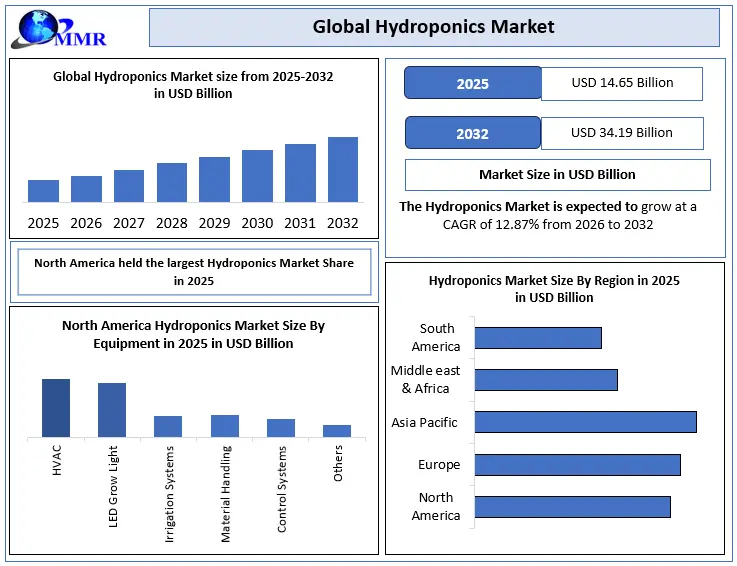
- Global market valued at USD 14.65 billion in 2025
- Forecast to reach USD 34.19 billion by 2032
- Expected CAGR of 12.87% during the forecast period
- Europe remains the dominant regional market
- Aggregate Systems hold the largest market share
- Tomato cultivation leads crop adoption
- Commercial farming continues to drive demand
- Automation and precision farming technologies improve operational efficiency
- Water conservation remains one of the industry’s strongest competitive advantages
Why This Matters Now
Food producers are facing mounting pressure from climate uncertainty, shrinking arable land, and increasing urban food demand. Hydroponic cultivation is shifting from a niche agricultural technique to an industrial production model capable of delivering consistent yields while significantly reducing water consumption.
The market’s projected expansion from USD 14.65 billion in 2025 to USD 34.19 billion by 2032 signals more than higher equipment sales. It represents accelerating capital investment in controlled-environment agriculture, creating opportunities for technology providers, greenhouse developers, nutrient manufacturers, and commercial growers seeking reliable production throughout the year.
Market Overview
The Hydroponics Market replaces traditional soil cultivation by delivering nutrient-rich water directly to plant roots inside controlled environments. The technology enables higher crop productivity, predictable harvest cycles, and efficient resource utilization while minimizing dependence on weather conditions.
Demand is increasing as urbanization limits agricultural land availability and consumers seek fresh produce throughout the year. Commercial growers are expanding hydroponic operations to improve production efficiency, reduce water usage, and shorten supply chains serving metropolitan markets.
The market is also benefiting from growing awareness of sustainable farming practices. Governments, private investors, and agricultural technology companies are directing capital toward modern farming systems that improve food security while reducing environmental impact.
Key Trends Driving Growth
Controlled-environment agriculture is becoming increasingly technology driven. Automation systems now manage irrigation, nutrient delivery, lighting, and climate control with greater precision, helping growers improve productivity while reducing labor requirements.
Water efficiency remains one of hydroponics’ strongest advantages. Compared with conventional agriculture, hydroponic systems require substantially less water, making them attractive in regions experiencing water scarcity and stricter environmental regulations.
Commercial greenhouse expansion continues to support equipment demand. Large-scale producers are investing in integrated hydroponic infrastructure capable of delivering consistent quality and year-round production for retail and food service customers.
Urban farming is also gaining momentum. Hydroponic installations inside cities reduce transportation requirements, improve product freshness, and strengthen local food supply resilience.
Technology innovation continues to improve operational economics through better sensors, monitoring software, nutrient management, and automated environmental controls, making commercial deployment increasingly attractive.
Download a Detailed Sample Report Before Making Business Decisions
Segment Insights
- Dominant Segment: Aggregate Systems remain the leading system type due to their widespread commercial adoption and efficient crop support capabilities.
- Fastest-Growing Segment: The report identifies increasing investment across advanced hydroponic system technologies as growers modernize facilities with automation and precision cultivation.
- Dominant Crop: Tomatoes account for the largest market share because of their strong commercial demand, consistent yields, and suitability for hydroponic cultivation.
- Commercial farming represents the primary end-user category as producers prioritize productivity, quality consistency, and year-round harvesting.
- Controlled nutrient management continues to improve crop quality while reducing waste and optimizing resource utilization.
Regional Growth Story
Europe leads the global Hydroponics Market through widespread adoption of controlled-environment agriculture, advanced greenhouse infrastructure, and strong sustainability initiatives. Commercial growers across the region continue investing in technologies that improve production efficiency while reducing environmental impact.
North America remains an important market as indoor farming expands to address changing consumer preferences and strengthen local food production. Investment in precision agriculture technologies supports continued modernization across commercial farming operations.
Asia-Pacific is emerging as a significant growth region, supported by rapid urbanization, increasing food demand, and government interest in improving agricultural productivity. Countries including China, India, Japan, and South Korea are expanding investments in controlled farming systems that maximize production within limited agricultural land.
Growing populations and resource constraints continue encouraging hydroponic adoption across both developed and emerging economies, particularly where water conservation and food security have become strategic priorities.
Competitive Landscape
Competition is increasingly centered on technology integration rather than equipment alone. Manufacturers are differentiating through automation, environmental monitoring, nutrient optimization, and complete cultivation solutions designed for commercial-scale operations.
Investment across greenhouse infrastructure, digital agriculture platforms, and precision farming technologies signals an industry moving toward integrated production ecosystems. Companies capable of combining hardware, software, and crop management expertise are strengthening their competitive positioning while creating long-term customer relationships.
As commercial installations expand, suppliers with scalable solutions and reliable technical support are expected to benefit from recurring demand for system upgrades, maintenance, and operational optimization.
Technology partnerships and continuous product innovation also indicate a market increasingly focused on improving productivity rather than competing solely on equipment pricing.
Recent Developments
- Increased commercial investment in controlled-environment agriculture.
- Growing adoption of automated nutrient delivery and climate control systems.
- Expansion of precision agriculture technologies within hydroponic facilities.
- Rising focus on sustainable farming practices and efficient water utilization.
- Continued development of integrated greenhouse cultivation solutions.
Strategic Implications
Hydroponics is evolving into a strategic agricultural investment rather than a specialty cultivation method. Equipment manufacturers, technology developers, greenhouse operators, and agricultural suppliers all stand to benefit from expanding commercial deployment.
Procurement leaders should prioritize integrated systems that improve operational efficiency and reduce long-term production costs. Investors may find opportunities among businesses offering automation technologies, digital monitoring platforms, nutrient management systems, and greenhouse infrastructure.
For agricultural producers, hydroponics offers greater production predictability, improved resource efficiency, and reduced exposure to climate-related disruptions. These advantages become increasingly valuable as global food demand continues to rise.
The industry’s growing emphasis on sustainability also aligns with corporate environmental objectives, strengthening hydroponics’ role within modern agricultural strategies.
Future Outlook
Hydroponic farming is expected to become an increasingly important component of global food production as commercial agriculture embraces automation, precision cultivation, and resource-efficient growing systems. Companies investing in scalable technology platforms, integrated cultivation solutions, and sustainable production capabilities will be best positioned to capture future market opportunities, while those slow to modernize risk losing competitiveness as controlled-environment agriculture becomes an industry standard.
Analyst Perspective
“Hydroponic farming is entering a new phase of commercial maturity. As technology, sustainability, and food security priorities converge, controlled-environment agriculture is becoming an essential investment for producers seeking higher productivity, consistent quality, and long-term operational resilience,” — Ankita Kagawade
About Maximize Market Research
Maximize Market Research Pvt. Ltd. (MMR) is a global market research and consulting company that provides reliable, data-focused, and practical business insights. The firm serves a wide range of industries, including healthcare, pharmaceuticals, technology, automotive, electronics, chemicals, personal care, and consumer goods. Through market forecasts, competitive analysis, strategic consulting, and industry impact assessments, MMR helps organizations understand changing market conditions, identify growth opportunities, and make informed business decisions for long-term success.
Contact Us
2nd Floor, Navale IT Park Phase 3
Pune Banglore Highway, Narhe
Pune, Maharashtra 411041, India
+91 9607365656
sales@maximizemarketresearch.com
