Key Highlights
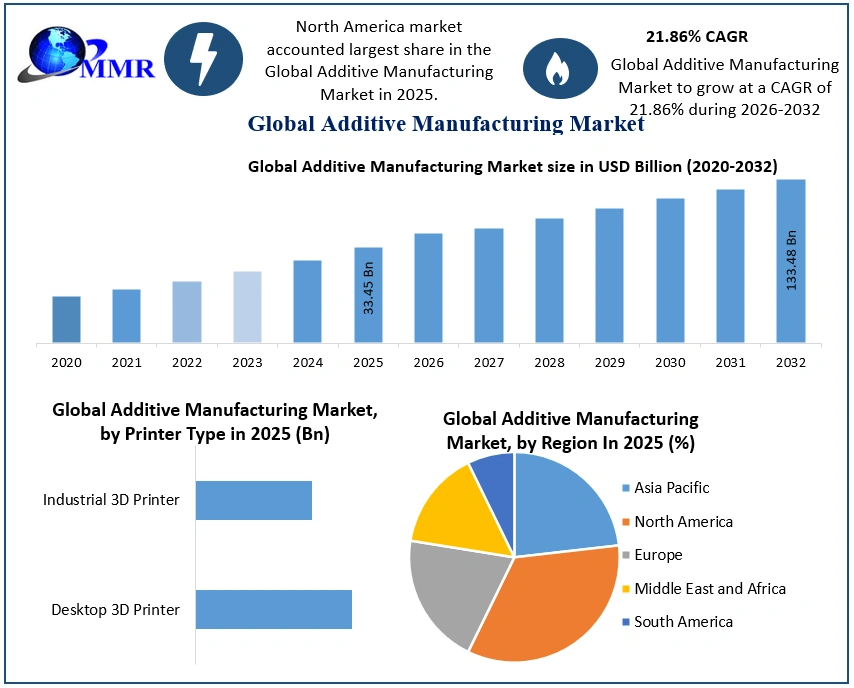
- Market valued at USD 33.45 Billion in 2025
- Forecast to reach USD 133.48 Billion by 2032
- Expected CAGR of 21.86% (2025–2032)
- Industrial adoption continues to accelerate across aerospace, healthcare, automotive, and manufacturing
- Metal and advanced polymer materials remain central to commercial expansion
- Digital production and customized manufacturing are reshaping industrial supply chains
Why This Matters Now
Manufacturers face rising pressure to shorten production cycles while reducing waste and improving supply chain resilience. Additive manufacturing is moving beyond prototyping into full-scale industrial production, giving companies new flexibility in component design and localized manufacturing.
The market’s projected rise from USD 33.45 Billion in 2025 to USD 133.48 Billion by 2032 signals a structural shift in manufacturing economics. For investors and procurement leaders, this transition creates opportunities in advanced materials, production equipment, software integration, and digital manufacturing ecosystems.
Market Overview
The Additive Manufacturing Market has evolved into a strategic manufacturing technology capable of producing complex, lightweight, and customized components with reduced material waste. Unlike conventional subtractive processes, additive manufacturing builds products layer by layer, improving design flexibility while lowering production inefficiencies.
The market was valued at USD 33.45 Billion in 2025 and is projected to reach USD 133.48 Billion by 2032, expanding at a 21.86% CAGR. This rapid expansion indicates that industrial users increasingly view additive manufacturing as a production technology rather than simply a prototyping tool.
Demand is being supported by industries seeking shorter product development cycles, improved operational flexibility, and localized production capabilities. Material innovations and automation are further strengthening commercial adoption across multiple manufacturing sectors.
Key Trends Driving Growth
Industrial users are increasingly integrating additive manufacturing into mainstream production rather than limiting its use to product development. The technology enables manufacturers to produce highly complex geometries that are difficult or impossible through traditional manufacturing processes.
Advanced metal powders and engineering polymers continue to expand the range of industrial applications. Improved material performance allows manufacturers to meet demanding mechanical and thermal requirements across aerospace, automotive, healthcare, and industrial machinery.
Sustainability has also become an important competitive advantage. Additive manufacturing minimizes material waste, reduces inventory requirements, and supports localized production, helping manufacturers improve resource efficiency while lowering transportation-related emissions.
Digital manufacturing ecosystems are creating additional value through software integration, simulation, automation, and production monitoring. These capabilities improve quality control while enabling scalable production environments.
Growing demand for customized medical devices, lightweight aerospace components, and high-performance automotive parts continues to generate downstream opportunities for equipment suppliers, material manufacturers, and software providers.
Request a Sample Report with Industry Trends, Forecast and Analysis
Segment Insights
- Dominant Segment: The report identifies the leading market segment as the primary revenue contributor, supported by expanding industrial adoption and increasing production applications.
- Fastest-Growing Segment: The fastest-growing segment is benefiting from rising investments in advanced manufacturing technologies, broader industrial acceptance, and increasing demand for customized production.
- Metal additive manufacturing continues to gain importance for high-value industrial applications requiring strength, precision, and lightweight performance.
- Polymer-based additive manufacturing remains widely adopted due to material versatility, design flexibility, and cost-efficient production.
- Aerospace, healthcare, automotive, and industrial manufacturing remain among the most significant downstream consumers supporting long-term market expansion.
Regional Growth Story
North America maintains its leadership position through strong industrial infrastructure, technology innovation, and widespread adoption across aerospace, healthcare, and advanced manufacturing industries. Continuous investment in digital manufacturing capabilities strengthens regional competitiveness.
The United States remains a major innovation hub, supported by research institutions, industrial equipment manufacturers, and expanding commercial applications. Growing adoption across defense, medical technology, and industrial production continues to support market expansion.
Germany reinforces Europe’s position through advanced engineering capabilities, industrial automation expertise, and high-value manufacturing. The country’s emphasis on Industry 4.0 supports broader deployment of additive manufacturing technologies.
China continues expanding manufacturing capabilities while increasing investment in industrial automation and advanced production technologies. The country’s growing industrial base creates sustained demand for additive manufacturing equipment and materials.
India is witnessing increased adoption as manufacturers modernize production facilities and strengthen domestic manufacturing capabilities. Government initiatives encouraging advanced manufacturing further support long-term industry development.
Japan and South Korea continue investing in precision manufacturing, electronics, and industrial automation, creating additional opportunities for advanced additive manufacturing applications.
Competitive Landscape
Competition is increasingly centered on technology leadership, material innovation, software capabilities, and integrated manufacturing solutions rather than hardware alone. Equipment manufacturers are expanding complete production ecosystems that combine printers, materials, software, and post-processing technologies.
Investment activity across the industry signals a race toward industrial-scale manufacturing rather than niche production. Companies expanding manufacturing capacity are positioning themselves to capture growing demand from aerospace, automotive, healthcare, and industrial customers.
Strategic partnerships increasingly focus on accelerating commercialization, expanding material portfolios, and improving production efficiency. These collaborations strengthen competitive positioning while lowering adoption barriers for industrial customers.
Technology investments are also improving production speed, repeatability, and quality assurance, allowing additive manufacturing to compete more effectively with conventional manufacturing methods.
Recent Developments
- Rising industrial investment in advanced additive manufacturing technologies
- Continued innovation in metal powders and engineering polymer materials
- Growing integration of software, automation, and digital manufacturing platforms
- Expanding commercial adoption across aerospace, automotive, healthcare, and industrial manufacturing
- Increased emphasis on sustainable production and material efficiency
Strategic Implications
Procurement leaders should prepare for increasing adoption of localized manufacturing strategies supported by additive manufacturing technologies. Reduced inventory requirements and shorter production cycles can strengthen supply chain resilience while improving operational flexibility.
Material suppliers have opportunities to expand portfolios of high-performance metal powders and advanced polymers as industrial production volumes increase. Equipment manufacturers that provide integrated hardware, software, and production services are likely to strengthen customer relationships through comprehensive manufacturing ecosystems.
Investors should closely monitor technological advancements that improve production speed, quality consistency, and automation, as these developments will influence market competitiveness and commercial scalability.
Industrial manufacturers adopting additive manufacturing early may achieve meaningful advantages through faster product development, improved customization, and reduced production waste.
Future Outlook
Additive manufacturing is entering a phase of industrial-scale commercialization where production economics, advanced materials, automation, and digital manufacturing capabilities will increasingly determine competitive advantage. Companies investing in integrated manufacturing ecosystems and high-performance materials will be best positioned to capture expanding industrial demand, while organizations delaying digital manufacturing adoption risk losing production flexibility and long-term competitiveness.
Analyst Perspective
“The Additive Manufacturing Market is transitioning from rapid prototyping to industrial production, creating significant opportunities across advanced materials, digital manufacturing, and high-value industrial applications. As manufacturers prioritize efficiency, customization, and sustainability, additive manufacturing is expected to become a core component of future production strategies.” — Ankita Kagawade, Analyst
About Maximize Market Research
Maximize Market Research Pvt. Ltd. (MMR) is a global market research and consulting company that provides reliable, data-focused, and practical business insights. The firm serves a wide range of industries, including healthcare, pharmaceuticals, technology, automotive, electronics, chemicals, personal care, and consumer goods. Through market forecasts, competitive analysis, strategic consulting, and industry impact assessments, MMR helps organizations understand changing market conditions, identify growth opportunities, and make informed business decisions for long-term success.
Contact Us
2nd Floor, Navale IT Park Phase 3
Pune Banglore Highway, Narhe
Pune, Maharashtra 411041, India
+91 9607365656
sales@maximizemarketresearch.com
