Key Highlights
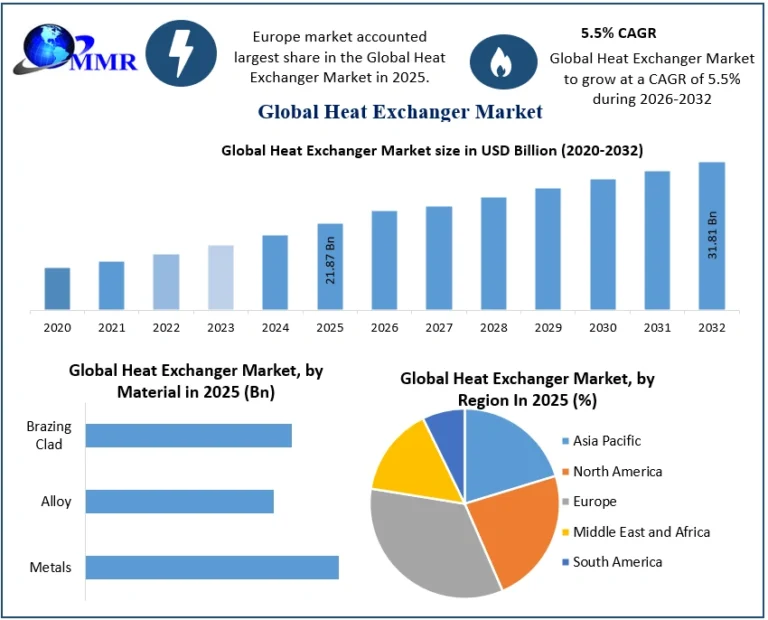
- Heat Exchanger Market valued at USD 21.87 Billion in 2025
- Expected to reach USD 31.81 Billion by 2032
- Forecast CAGR stands at 5.5% (2025–2032)
- Industrial energy efficiency remains a major investment priority
- Smart manufacturing increases demand for optimized thermal management
- Process industries continue expanding modernization initiatives
- Digital monitoring and predictive maintenance improve equipment reliability
- Manufacturing investments support long-term market expansion
Why This Matters Now
Manufacturing executives face simultaneous pressure to lower operating costs, improve plant utilization, reduce emissions, and increase production flexibility. Thermal management directly affects production stability, equipment lifespan, and overall process efficiency.
Industry 4.0 investments are changing how industrial plants monitor and manage heat transfer systems. Connected equipment, industrial IoT platforms, AI-driven diagnostics, and predictive maintenance enable operators to identify performance degradation before failures occur. As factories digitize operations, heat exchangers become increasingly integrated into broader automation architectures instead of functioning as isolated mechanical assets.
Market Overview
The Heat Exchanger Market remain fundamental components across chemical processing, oil and gas, power generation, food processing, pharmaceuticals, HVAC, and numerous manufacturing industries. Their ability to improve thermal efficiency supports both productivity gains and sustainability objectives.
The market’s projected increase from USD 21.87 Billion in 2025 to USD 31.81 Billion by 2032 represents more than market expansion. It reflects continued investment in industrial modernization as manufacturers prioritize operational efficiency, energy conservation, and reliable production infrastructure.
Growing demand for efficient process control also aligns with broader industrial automation strategies. Modern manufacturing facilities increasingly require equipment capable of integrating with digital monitoring platforms, enabling continuous operational visibility and smarter maintenance planning.
Key Trends Driving Growth
Industrial energy efficiency has become a board-level priority across manufacturing sectors. Heat recovery systems and optimized thermal management reduce energy consumption while supporting corporate sustainability goals.
Smart factory deployment continues accelerating. Industrial IoT sensors now enable real-time monitoring of operating temperatures, pressure variations, equipment health, and overall system efficiency. This improves asset utilization while minimizing unexpected production interruptions.
Predictive maintenance is becoming standard practice. Instead of relying on scheduled maintenance cycles, manufacturers increasingly use operational data to predict equipment degradation, reducing maintenance costs and improving production continuity.
Artificial intelligence is gradually supporting thermal optimization by analyzing historical operating conditions and identifying efficiency improvements. Combined with edge computing, these technologies allow faster operational decision-making within manufacturing environments.
Digital twins are also emerging as valuable tools for plant optimization. Virtual simulation enables engineers to evaluate equipment performance before implementing operational changes, reducing commissioning risks and improving long-term system efficiency.
Meanwhile, industrial cybersecurity continues gaining importance as more thermal management systems connect to operational technology networks. Secure connectivity is becoming an essential requirement for modern manufacturing environments.
Download a Sample Report with Comprehensive Market Intelligence
Segment Insights
- Dominant Segment: Information not specified in the supplied report.
- Fastest-Growing Segment: Information not specified in the supplied report.
- Industrial applications continue benefiting from process optimization initiatives.
- Automation-enabled monitoring enhances equipment reliability.
- Energy-efficient solutions support long-term manufacturing investments.
Regional Growth Story
Industrial expansion across Asia-Pacific continues supporting long-term demand for heat exchangers. Manufacturing investments, infrastructure development, and expanding process industries strengthen regional opportunities.
North America remains focused on plant modernization, operational efficiency, and digital manufacturing transformation. Manufacturers increasingly deploy connected equipment to improve productivity while reducing operating costs.
Germany continues emphasizing Industry 4.0 implementation through advanced industrial automation and smart factory investments. Heat exchangers play a critical role within digitally connected production environments that prioritize energy efficiency and precision manufacturing.
China continues expanding industrial production capacity while investing heavily in manufacturing modernization and advanced industrial technologies. Japan and South Korea maintain strong positions through high-value manufacturing, engineering excellence, and continuous process innovation.
India’s industrial growth and expanding manufacturing ecosystem also support increasing adoption of modern thermal management equipment across multiple industries.
Competitive Landscape
Competition is increasingly shifting beyond manufacturing capacity toward technology leadership and lifecycle value.
Equipment suppliers are differentiating themselves through digital capabilities that improve operational intelligence rather than simply increasing thermal performance. Integration with industrial IoT platforms, predictive maintenance software, and plant-wide monitoring systems enables manufacturers to deliver measurable operational improvements.
Automation compatibility has become another competitive advantage. Heat exchanger providers that support seamless integration with PLC, DCS, SCADA, and manufacturing execution systems position themselves more effectively within digitally connected factories.
The competitive environment also reflects broader industrial digitization. Companies capable of combining mechanical engineering expertise with software-driven operational intelligence are likely to strengthen their ecosystem positioning as manufacturers continue investing in smart production facilities.
Recent Developments
- Continued industrial modernization supports equipment replacement demand.
- Manufacturing investments accelerate adoption of energy-efficient technologies.
- Industry 4.0 initiatives increase deployment of digitally connected equipment.
- Industrial IoT integration expands operational visibility.
- Predictive maintenance technologies improve equipment lifecycle management.
Strategic Implications
Manufacturers increasingly evaluate thermal equipment based on total operational value rather than initial acquisition cost. Reliability, digital connectivity, predictive maintenance capability, and energy efficiency now influence purchasing decisions alongside traditional performance metrics.
System integrators benefit from expanding opportunities to combine mechanical equipment with automation software, industrial networking, and data analytics. This creates additional value beyond equipment installation by supporting continuous operational optimization.
Technology investors also see opportunities as industrial digitization expands across process industries. Companies capable of combining industrial hardware with software-enabled intelligence may capture greater long-term market value.
Operations leaders must increasingly align thermal management investments with broader digital transformation strategies. Equipment selection now affects production resilience, sustainability performance, workforce productivity, and long-term competitiveness.
Future Outlook
The next phase of market growth will be defined less by equipment replacement and more by intelligent manufacturing integration. Heat exchangers are becoming connected assets within digitally managed production environments where predictive maintenance, AI-assisted optimization, industrial IoT, and real-time operational visibility determine manufacturing competitiveness. The factories that integrate thermal management into Industry 4.0 ecosystems will establish lasting productivity advantages, while facilities relying on conventional infrastructure risk falling behind in the race toward autonomous industrial operations.
Analyst Perspective
“The Heat Exchanger Market continues to evolve alongside global industrial modernization. Growing emphasis on energy efficiency, manufacturing productivity, and digital industrial transformation is creating sustained opportunities for advanced thermal management solutions across multiple industries.” — Gaurav Deshmukh, Analyst, Maximize Market Research
About Maximize Market Research
Maximize Market Research Pvt. Ltd. (MMR) is a global market research and consulting company that provides reliable, data-focused, and practical business insights. The firm serves a wide range of industries, including healthcare, pharmaceuticals, technology, automotive, electronics, chemicals, personal care, and consumer goods. Through market forecasts, competitive analysis, strategic consulting, and industry impact assessments, MMR helps organizations understand changing market conditions, identify growth opportunities, and make informed business decisions for long-term success.
Contact Us
2nd Floor, Navale IT Park Phase 3
Pune Banglore Highway, Narhe
Pune, Maharashtra 411041, India
+91 9607365656
sales@maximizemarketresearch.com
