Key Highlights
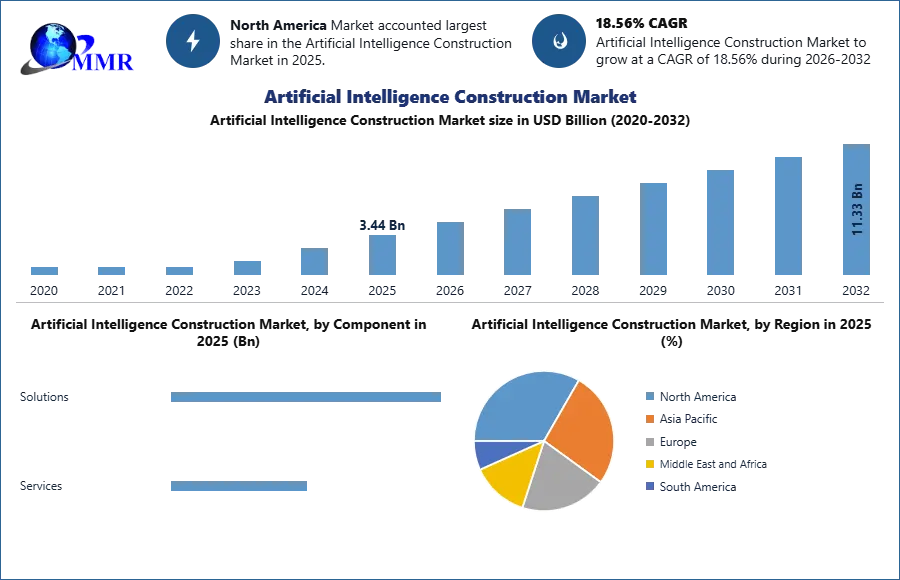
- Artificial Intelligence Construction Market was valued at USD 3.44 Billion in 2025.
- The market is expected to reach USD 11.33 Billion by 2032.
- The market is projected to expand at a CAGR of 18.56% during the forecast period.
- AI is accelerating automation across project planning, scheduling, cost estimation, and site management.
- Cloud-enabled construction platforms are improving collaboration across distributed project teams.
- Predictive analytics is reducing project delays and operational risks.
- Digital transformation is becoming a strategic priority across global construction enterprises.
Why This Matters Now
Construction is entering a technology cycle that will redefine productivity, profitability, and competitive advantage. Artificial intelligence is moving beyond pilot projects and becoming embedded in everyday construction workflows, giving contractors, developers, infrastructure firms, and technology vendors new tools to improve project delivery while controlling costs.
The Artificial Intelligence Construction Market, valued at USD 3.44 Billion in 2025, is projected to reach USD 11.33 Billion by 2032, growing at a CAGR of 18.56%. That growth signals far more than software adoption. It reflects a structural shift toward intelligent construction ecosystems where AI supports planning, risk management, quality assurance, workforce optimization, and real-time decision-making.
Market Overview
The Artificial Intelligence Construction Market has historically struggled with fragmented workflows, labor shortages, scheduling inefficiencies, and cost overruns. Artificial intelligence is changing that equation by introducing predictive intelligence across every stage of project execution.
AI-enabled platforms combine machine learning, computer vision, cloud computing, and advanced analytics to process large volumes of project data in real time. Construction firms are increasingly integrating these technologies into project management systems, Building Information Modeling (BIM), equipment monitoring, and digital collaboration platforms.
This transition aligns with broader enterprise digital transformation initiatives, where software platforms increasingly connect field operations, engineering teams, procurement, and executive management through unified cloud environments.
Key Trends Driving Growth
Artificial intelligence adoption is expanding from isolated automation tools into enterprise-wide operational platforms. Construction organizations increasingly rely on AI to improve scheduling accuracy, optimize resource allocation, detect project risks earlier, and strengthen operational visibility across complex infrastructure projects.
Cloud migration continues to support this evolution. Cloud-based construction software enables distributed project teams to access real-time project information while improving collaboration between contractors, architects, engineers, and owners.
Machine learning is enhancing predictive maintenance for heavy equipment while reducing unexpected downtime. Computer vision technologies improve safety monitoring by identifying hazards on construction sites before incidents occur.
Generative AI is also emerging as a productivity tool, helping project managers automate documentation, generate reports, streamline communications, and improve knowledge management across large construction portfolios.
Automation remains another defining trend. Intelligent workflows reduce repetitive administrative work, allowing skilled professionals to focus on higher-value engineering and project management activities.
Request Your Sample Copy for Strategic Market Research Insights
Segment Insights
- Dominant Segment: The report identifies the leading market segment driving current revenue generation within the Artificial Intelligence Construction Market.
- Fastest-Growing Segment: The report highlights the fastest-expanding segment expected to accelerate future market growth as AI adoption broadens across construction applications.
- AI-powered project management platforms continue to gain enterprise attention because they improve scheduling accuracy, budget forecasting, and resource planning.
- Predictive analytics solutions help organizations identify potential delays, optimize procurement decisions, and improve project execution through data-driven insights.
- Cloud-based deployment models support scalable implementation across geographically distributed construction operations.
Regional Growth Story
North America remains a major center for artificial intelligence deployment across the construction industry. Strong technology ecosystems, enterprise software adoption, cloud infrastructure, and continuous investment in digital construction platforms position the region as an innovation leader.
The United States continues to invest heavily in digital infrastructure modernization, encouraging wider adoption of AI-enabled construction technologies for commercial, industrial, and public infrastructure projects.
Asia-Pacific is rapidly increasing investment in smart infrastructure, digital engineering, and intelligent construction technologies. China, India, Japan, and South Korea continue expanding technology capabilities that support automation, AI integration, and next-generation construction management.
Europe is strengthening digital construction through sustainability initiatives, advanced engineering practices, and increasing adoption of AI-enabled project planning. Germany and the United Kingdom continue emphasizing digital transformation while supporting modernization across infrastructure development.
Across global markets, governments and enterprises increasingly recognize that digital construction technologies are becoming essential for improving productivity, project transparency, and long-term infrastructure resilience.
Competitive Landscape
Competition is shifting from standalone software products toward integrated construction intelligence platforms. Technology providers are increasingly competing on ecosystem strength rather than individual applications.
Companies investing in artificial intelligence capabilities are building comprehensive platforms that combine predictive analytics, cloud collaboration, digital twins, machine learning, and workflow automation. This signals a broader transition toward platform-based construction technology ecosystems capable of supporting end-to-end project lifecycle management.
Partnerships between software vendors, cloud providers, engineering firms, and construction companies are accelerating enterprise AI adoption. These collaborations enable faster deployment, deeper data integration, and improved interoperability across construction operations.
Technology leadership increasingly depends on delivering scalable AI platforms capable of supporting enterprise modernization rather than isolated automation features. Vendors that successfully combine AI with cloud-native architectures and data-driven decision support are strengthening customer retention and expanding long-term competitive positioning.
As digital construction matures, pricing power is expected to favor platform providers capable of delivering measurable improvements in productivity, operational efficiency, and project predictability.
Recent Developments
- Enterprise construction firms continue expanding AI integration across project management workflows.
- Cloud-enabled collaboration platforms are improving project visibility and operational coordination.
- Machine learning applications are strengthening predictive analytics for scheduling and cost management.
- Intelligent automation is reducing manual administrative processes across construction operations.
- Digital construction platforms continue evolving through greater integration with engineering and project management ecosystems.
Strategic Implications
Construction executives increasingly view artificial intelligence as a business transformation initiative rather than an isolated technology investment.
For CIOs, AI enables enterprise-wide digital modernization through integrated cloud platforms and intelligent data management.
For CTOs, scalable AI architectures create opportunities to automate workflows while supporting continuous innovation across engineering and construction operations.
Technology investors see growing demand for construction software platforms that combine artificial intelligence, predictive analytics, automation, and cloud computing into unified enterprise solutions.
Construction companies adopting AI early are better positioned to improve operational efficiency, reduce project uncertainty, strengthen customer relationships, and increase profitability through data-driven decision-making.
Future Outlook
Artificial intelligence is becoming the digital foundation of next-generation construction. As cloud computing, machine learning, automation, predictive analytics, and intelligent project management converge, competitive advantage will increasingly depend on an organization’s ability to transform construction data into real-time business intelligence. The companies that embed AI across every stage of project delivery will define the industry’s next generation of digital leaders, while those delaying transformation risk falling permanently behind.
Analyst Perspective
“Artificial intelligence is transforming construction from a reactive industry into a predictive, data-driven business model. Organizations investing in AI-powered platforms today are creating the operational agility, efficiency, and digital capabilities that will shape the future of global construction.” — Yash Ghosalkar, Analyst
About Maximize Market Research
Maximize Market Research Pvt. Ltd. (MMR) is a global market research and consulting company that provides reliable, data-focused, and practical business insights. The firm serves a wide range of industries, including healthcare, pharmaceuticals, technology, automotive, electronics, chemicals, personal care, and consumer goods. Through market forecasts, competitive analysis, strategic consulting, and industry impact assessments, MMR helps organizations understand changing market conditions, identify growth opportunities, and make informed business decisions for long-term success.
Contact Us
2nd Floor, Navale IT Park Phase 3
Pune Banglore Highway, Narhe
Pune, Maharashtra 411041, India
+91 9607365656
sales@maximizemarketresearch.com
