Key Highlights
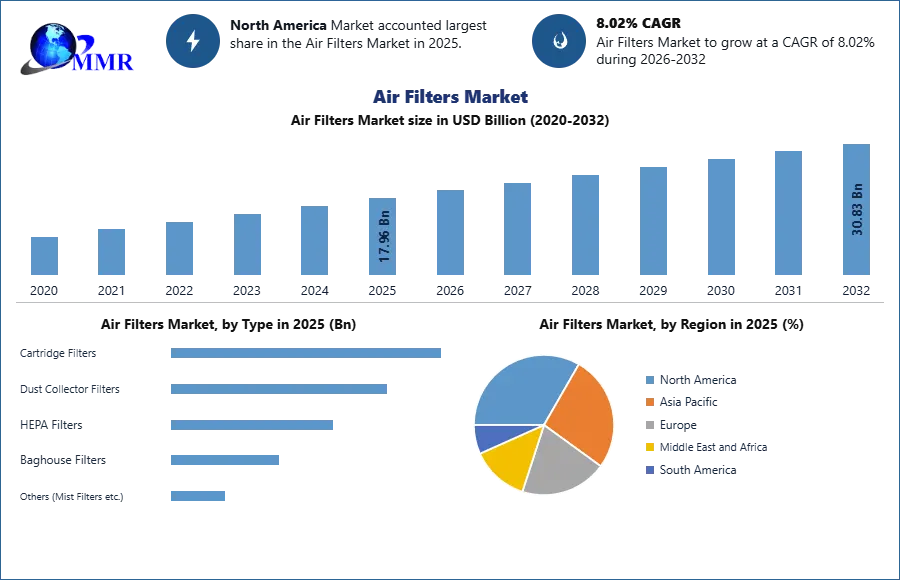
The global Air Filters Market size reached USD 17.96 Billion in 2025 and is projected to achieve a valuation of USD 30.83 Billion by 2032.
Market revenue is expanding at a documented CAGR of 8.02% over the forecast period from 2026 to 2032.
North America maintained its position as the dominant regional market over the preceding five years, driven by early adoption of IoT-enabled filtration.
The European industrial air filtration market was valued at USD 4.1 Billion in 2022 and is on track to hit USD 8.4 Billion by 2032, with Germany holding the leading share.
Global supply chains face structural realignments due to a 30% increase in energy-intensive synthetic fiber production overheads and 400% maritime freight surcharges linked to geopolitical friction.
Corporate consolidation is intensifying, highlighted by Daikin Industries spending over $6.5 billion to acquire more than 20 companies, including Chilldyne and DDC Solutions for AI infrastructure cooling.
Why This Matters Now
Industrial manufacturing environments are undergoing a massive transformation driven by the intersection of strict regulatory mandates and deep technological upgrades. Micro-contamination threatens the operational integrity of high-tech production lines, making automated air filtration a mission-critical component of plant infrastructure. For modern electronics manufacturing, pharmaceutical formulation, and precision automotive assembly, single particulate anomalies can cause immediate line stoppages and millions of dollars in lost yield.
Furthermore, the integration of advanced filtration infrastructure has shifted from a passive compliance routine to an active strategy for process optimization. Plant managers use intelligent air handling systems to protect both delicate robotic equipment and specialized human workforces from hazardous airborne particulates. As automated factories operate at higher densities and speeds, heat dissipation and particulate management become primary variables in maintaining baseline machine reliability.
The immediate business priority centers on maintaining consistent uptime while navigating unpredictable external supply shocks. Manufacturers must adopt filtration systems that offer prolonged product lifespans and reduced operational footprints to offset rising utility and material overheads. Decision-makers are prioritizing equipment that directly interfaces with unified plant communications to turn environmental variables into actionable operational data.
Market Overview
The fundamental purpose of industrial Air Filters Market revolves around the continuous extraction of hazardous airborne particles, dust, pollen, mold spores, bacteria, viruses, and volatile organic compounds from industrial workspaces. These mechanical and electrostatic devices utilize specialized filter media to isolate and capture pollutants on the upstream side before clean air recirculates. Modern configurations utilize pleated filter structures to increase total surface area, lowering overall system resistance and maintaining optimal pressure differentials across the plant floor.
Expanding industrial footprints, fast-paced urbanization, and stricter regulatory frameworks across mature economies provide the primary momentum for market expansion. Industrial operators face strict Occupational Safety and Health Administration regulations alongside comparable international directives designed to enforce safe working environments. Clean air protocols mandate the implementation of high-efficiency particulate air filtration across any manufacturing sector emitting volatile waste streams or particulate matter.
Simultaneously, the market is navigating significant external disruption as global energy realities alter the underlying cost structure of raw filtration materials. Synthetic fiber manufacturing overheads have risen by 30% due to surging crude prices, while maritime freight surcharges have spiked by 400%, forcing major industrial suppliers to restructure logistics networks. Market participants are responding by establishing near-shored production hubs and engineering alternative bio-based media to preserve long-term operational resilience.
Key Trends Driving Growth
The most significant operational shift in the market is the rapid transition toward intelligent, sustainable filtration infrastructure that integrates with modern automation setups. Industrial IoT adoption allows operators to embed smart sensors directly into filter housings to gather real-time data regarding airflow velocities, particulate density, and structural wear. This transition changes routine maintenance from a standard calendar schedule into a precise, predictive maintenance strategy driven by data.
Energy efficiency metrics represent another critical catalyst forcing plant upgrades across capital-intensive industries. Advanced filter designs focus heavily on minimizing pressure drop, allowing automated air handling units to operate with significantly lower electrical consumption. This reduction in continuous power usage directly lowers total operational costs while helping manufacturing facilities meet corporate sustainability mandates.
Material innovations also continue to reshape the competitive landscape as companies transition toward reusable, washable, and biodegradable media options. The deployment of advanced nanofiber coatings and electrostatic precipitation systems enables higher particulate retention without increasing the physical thickness of the filter. These developments extend individual component lifespans, decrease replacement frequency, and minimize secondary industrial waste streams.
Get a free sample:https://www.maximizemarketresearch.com/request-sample/196750/
Segment Insights
Dominant Regional Segment (North America): Held the largest market share over the preceding five-year period, supported by widespread adoption of smart, energy-efficient filtration and embedded IoT systems across commercial and industrial operations.
Fastest-Growing Regional Segment (Asia-Pacific): Driven by rapid industrialization, expanding automotive production across China, India, and South Korea, and a domestic indoor air purification segment growing at a CAGR above 4%.
HEPA Filters Segment: Engineered to isolate ultra-fine particles as small as 0.3 microns with a verified verification rate of 99.97% or higher, evaluated via strict polystyrene latex and dispersed oil particulate testing protocols.
Dust Collectors Segment: Critical for heavy industrial process optimization, using cyclonic separation, mechanical filtration, and electrostatic precipitation to enforce environmental compliance and protect automation hardware.
Cartridge and Baghouse Filters Segments: Constructed from specialized materials including cellulose, polyester, polypropylene, and fiberglass to handle diverse fluid and gas streams across volatile process environments.
Regional Growth Story
The North American theater continues to command the global market landscape due to a mature ecosystem of technology providers and stringent environmental standards. Industrial automation buyers throughout the United States are prioritizing the modernization of legacy heating, ventilation, and air conditioning infrastructures with smart, connected filtration modules. This continuous demand has sustained a regional market compound annual growth rate of 9%, driven by the heavy integration of operational technology and cloud-connected factory analytics.
In Europe, market expansion is heavily anchored by rigid air quality directives and the widespread adoption of smart factory methodologies. Germany leads the European territory, leveraging its dense manufacturing base and emphasis on eco-friendly industrial equipment. The broader European industrial air filtration market reflects this long-term trend, climbing from a baseline valuation of USD 4.1 Billion in 2022 toward an anticipated target of USD 8.4 Billion by 2032.
The Asia-Pacific region represents the primary engine for volume growth, spurred by massive capital investments in automotive and semiconductor fabrication plants. China stands as the single largest regional market here, responding directly to urban expansion and the urgent need to mitigate declining outdoor air quality metrics. Increasing vehicle production and consumer demand across India and South Korea add further momentum, forcing local manufacturers to implement cleaner production environments.
Competitive Landscape
The global market shows high concentration among a select group of heavily capitalized multinational engineering firms executing aggressive consolidation strategies. Daikin Industries maintains its dominant global position in climate control and specialized filtration through an expansive mergers and acquisitions playbook. The company spent over $6.5 billion to absorb more than 20 distinct businesses, focusing heavily on integrating advanced liquid and air cooling capabilities for high-density artificial intelligence infrastructure.
Concurrently, Stockholm-headquartered Camfil has scaled its operations to roughly 6,000 employees worldwide, capturing significant market share with net annual sales exceeding $1.35 billion. The company continues to target European consolidation to reinforce its specialized cleanroom and high-efficiency filtration portfolio. Other dominant players, such as MANN+HUMMEL, Parker Hannifin Corporation, and Cummins, are leveraging wide distribution networks to scale their proprietary nanofiber and electrostatic technologies globally.
These competitive actions signal an industry-wide pivot away from standalone hardware components toward integrated environmental control ecosystems. Technology leaders are building cross-functional platforms where air purification hardware links directly to programmable logic controllers and distributed control systems. This positioning allows these companies to lock in long-term enterprise service contracts anchored by continuous predictive maintenance software.
Recent Developments
Daikin Industries acquired Anh Nguyen in Vietnam to expand its industrial air solutions footprint across fast-growing Southeast Asian manufacturing corridors.
Daikin completed strategic acquisitions of Chilldyne and DDC Solutions, introducing liquid-and-air cooling mechanics designed for data centers and AI processing infrastructure.
Industry leaders altered high-performance filter media production lines to incorporate circular bio-based materials, mitigating ongoing supply chain blockades.
Automation providers introduced localized pressure-drop monitoring nodes that feed data directly into centralized SCADA platforms for automated workspace safety reporting.
Advanced manufacturing facilities in Germany deployed updated washable filter configurations to comply with updated industrial waste reduction laws.
Strategic Implications
For manufacturing executives and plant engineers, investment in modernized air filtration is no longer an optional utility expense but an essential element of process stability. Operating a modern facility without automated, high-efficiency filtration exposes precision instrumentation to premature degradation and mechanical drift. Integrating smart filtration nodes into a plant’s primary automation architecture allows operations teams to achieve true predictive maintenance, replacing filters based on accurate pressure-drop data rather than arbitrary dates.
This strategic migration directly protects automated assets, machinery vision systems, and robotic cells from tracking errors caused by ambient particulate accumulation. Furthermore, clean industrial air profiles directly improve labor productivity metrics by reducing health-related absences and maintaining comfortable working conditions. Organizations that incorporate environmental control metrics into their enterprise resource planning platforms position themselves to meet modern ESG reporting mandates seamlessly.
Future Outlook
The market will continue to evolve alongside the wider expansion of autonomous industrial operations and dark factories. Future facility designs will rely on self-optimizing air handling networks that automatically adjust airflow volumes based on live manufacturing outputs and internal air quality indexes. These installations will utilize digital twin models to simulate particulate distribution patterns, allowing systems to mitigate contamination risks before they impact production lines.
Ultimately, environmental control will integrate fully into standard operational technology frameworks, treating clean air as a continuous, metered industrial asset. Facilities that view filtration as an active component of machine health will unlock higher equipment efficiencies and superior manufacturing yields. The divide across the manufacturing landscape will widen between proactive operators leveraging connected, data-driven filtration ecosystems and reactive laggards burdened by unmonitored contamination risks and unpredictable line stoppages.
Analyst Perspective
“The global air filtration landscape is experiencing a deep technological pivot as smart factory initiatives redefine traditional plant infrastructure requirements,” notes Gaurav Deshmukh, Lead Analyst at Maximize Market Research. “Modern air handling systems are transitioning away from passive, mechanical containment modules into connected, intelligent nodes within the broader industrial internet of things framework. Organizations that integrate real-time filtration metrics into their core automation strategies will successfully insulate their production lines from contamination-induced downtime while capturing clear energy efficiency gains.”
About Maximize Market Research
Maximize Market Research Pvt. Ltd. (MMR) is a global market research and consulting company that provides reliable, data-focused, and practical business insights. The firm serves a wide range of industries, including healthcare, pharmaceuticals, technology, automotive, electronics, chemicals, personal care, and consumer goods. Through market forecasts, competitive analysis, strategic consulting, and industry impact assessments, MMR helps organizations understand changing market conditions, identify growth opportunities, and make informed business decisions for long-term success.
2nd Floor, Navale IT Park Phase 3
Pune Banglore Highway, Narhe
Pune, Maharashtra 411041, India
+91 9607365656
sales@maximizemarketresearch.com
