Key Highlights
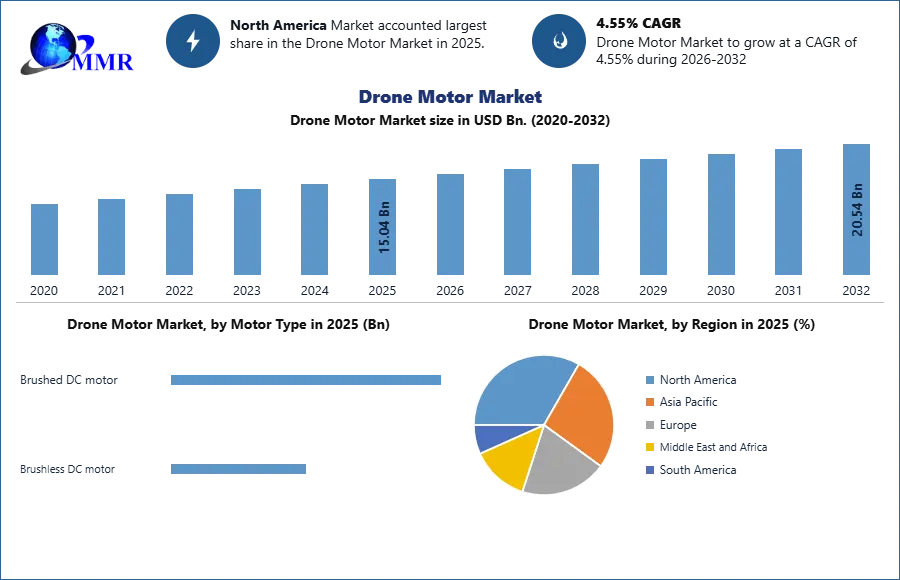
Market valuation expands from USD 15.04 Billion in 2025 to USD 20.54 Billion by 2032, maintaining a consistent CAGR of 4.57%.
Brushless DC (BLDC) motors dominate the market share, driven by a 1,000-hour operational lifespan and low maintenance parameters.
Rotary-wing platforms remain the dominant drone type, utilized heavily for stability and industrial maneuverability.
Heavy-lift motors exceeding 100 W capacity lead the power segment to support industrial LiDAR and cargo payloads.
The agricultural sector represents a massive application growth vector via precision crop spraying and field monitoring.
Severe airspace regulatory constraints and a shortage of certified pilots act as the primary market bottlenecks.
Asia Pacific is positioned as a highly dynamic growth theater, backed by manufacturing incentives like India’s PLI scheme.
Why This Matters Now
The convergence of industrial robotics and aerial mobility is shifting from simple remote-controlled operations to fully autonomous plant ecosystems. Manufacturers and logistics operators face acute labor shortages and rising demands for operational efficiency, pushing them to integrate autonomous aerial systems directly into their manufacturing execution systems (MES) and factory workflows. The drone motor serves as the foundational actuation component determining the reliability, payload capacity, and lifecycle costs of these industrial assets.
What changed is the performance ceiling of electric propulsion. The shift from low-cost brushed components to highly engineered brushless DC (BLDC) and hybrid architectures allows drones to operate as predictable, long-cycle industrial machines. For automation engineers and technology investors, this transition transforms aerial robotics from an isolated inspection tool into a permanent layer of enterprise operational technology (OT). Companies mastering these propulsion systems gain a direct competitive advantage in automated material handling, continuous facility surveillance, and real-time digital twin updates.
Market Overview
The global Drone Motor Market achieved a valuation of USD 15.04 Billion in 2025 and is projected to expand to USD 20.54 Billion by 2032, demonstrating a CAGR of 4.57%. This trajectory is bound tightly to the modernization of factory environments, infrastructure monitoring, and advanced tactical logistics. As industrial operations scale their digitization efforts, the demand for precise, high-torque propulsion units has intensified.
The weight of the drone motor, thrust-to-weight ratio, total efficiency, torque, and pole count are the core criteria governing engineering selection. These variables dictate whether an aerial unit can safely execute industrial tasks such as close-quarter factory inspection or multi-kilogram material transport. However, severe regulatory limitations from agencies like the Federal Aviation Administration (FAA)—which enforces strict Remote ID tracking and restricted night flight waivers—limit unrestricted deployment. Out of over 4,000 night waiver applications submitted to the FAA between 2017 and 2021, only 1,200 were granted, with 2,300 denied, illustrating the regulatory hurdles that slow down continuous commercial scaling. Furthermore, a global deficit of certified drone operators presents safety concerns for high-value industrial hardware, restricting immediate hardware procurement.
Key Trends Driving Growth
The integration of BLDC motors into LiDAR-equipped drones represents a major technological leap within industrial automation. In these setups, electronic commutations are handled via permanent magnets and three Hall Effect magnetic sensors, eliminating physical brush friction. Beyond raw propulsion, these high-efficiency BLDC motors drive the precise positional lasers required for real-time digital twin mapping and infrastructure surveying. These industrial motors achieve operational lifespans exceeding 1,000 hours, matching the predictive maintenance schedules expected by factory managers.
Simultaneously, the industry is embracing naked bottom motor designs to aggressively shave weight. Eliminating structural metal from the motor base reduces unit weight by roughly 2 grams, an engineering shift developed in racing environments that has transitioned directly into commercial multi-rotor units to maximize flight times. In parallel, heavy-payload requirements have fueled the development of bidirectional hybrid systems. Currawong Engineering’s Cortex HF50 Series, a two-stroke hybrid heavy-fuel UAV drone motor system, illustrates this trend. It enables bidirectional power flow between the battery system and the engine to support self-starting, in-air restarts, and power boosts during peak flight loads.
Get a free sample:https://www.maximizemarketresearch.com/request-sample/186383/
Segment Insights
Brushless DC (BLDC) Motors (Dominant Segment & Fastest-Growing Segment): Holding the clear majority of market share in 2025, BLDC systems outpace brushed models due to their minimized maintenance needs and extreme velocity capabilities. While brushed variations are restricted to lower performance brackets, brushless configurations routinely operate at speeds between 150 to 200 km/h, offering superior thermal management and structural longevity.
Rotary-Wing Platforms (Dominant Segment): Multirotor configurations command the drone type landscape because of their operational stability, ease of vertical take-off and landing (VTOL), and stationary hovering capabilities within confined industrial corridors.
Above 100 W Power Capacity (Dominant Segment): Driven by heavy-lift industrial mandates, motors exceeding 100 W dominate the power segment, as they provide the essential thrust required to carry industrial LiDAR scanners, bulky environment sensors, and logistics cargo.
Military (Dominant Segment by Revenue): The defense sector accounted for the largest overall revenue share in 2025. This position is supported by massive defense allocations, such as the United States military expenditure reaching $877 billion in 2025, alongside a 9% increase in Russian military spending recorded between 2021 and 2022.
Agriculture (Fastest-Growing Application Segment): Precision agriculture is rapidly adopting high-capacity motors to power automated crop monitoring, multispectral field analysis, and high-volume chemical spraying setups.
Regional Growth Story
North America retained the largest regional market share in 2025, supported by a dense ecosystem of tier-one manufacturers, suppliers, and distributors such as 3D Robotics and Textron. The region’s dominance is reinforced by extensive military investments and a high concentration of commercial logistics pilots. Tethered drone technologies are seeing widespread deployment across North American infrastructure projects, offering continuous, non-stop flight times and elevated payload stabilities by running power directly through a ground-linked cable.
Concurrently, the Asia Pacific region is expanding rapidly. The region’s commercial expansion is driven by a surge in digital media production and educational drone adoption. On the industrial manufacturing side, targeted government incentives are shifting the global production hub eastward. India’s Production Linked Incentive (PLI) scheme, enacted alongside the liberalized Drone Rules of 2021, aims to stimulate super-normal growth in domestic component fabrication. This initiative has directed over INR 5,000 crore of fresh investment into the localized drone and component manufacturing space over a three-year window. The business impact is clear: the country’s annual manufacturing sales turnover is projected to jump from INR 60 crore in 2020-21 up to more than INR 900 crore, generating over 10,000 direct manufacturing jobs and accelerating regional drone hub status.
Competitive Landscape
The competitive landscape is transitioning from generic manufacturing to application-specific component engineering. Companies are no longer just fighting on component price; they are competing on system integration, power-to-weight ratios, and reliability ratings that align with strict industrial standards. This shift signals a broader maturation of the autonomous industrial operations ecosystem, where drone components must match the reliability criteria of standard factory automation hardware like PLCs and SCADA networks.
The rise of specialized hybrid systems, like those from Currawong Engineering, reveals that technology leadership belongs to firms resolving the battery range bottleneck. By blending internal combustion energy density with electric motor responsiveness, these players are capturing the high-margin industrial and military segments. Meanwhile, component standardization remains a core battleground. Providers are designing modular BLDC motors that allow fast, hot-swappable replacement during field crashes, directly minimizing operational downtime for commercial operators.
Recent Developments
Currawong Engineering deployed its Cortex HF50 Series Hybrid powertrain, proving the market viability of bidirectional energy management between onboard batteries and heavy-fuel internal combustion engines.
The Indian Central Government implemented its strategic PLI manufacturing scheme, injecting INR 5,000 crore into local aerospace component production facilities to build out domestic supply chains.
Motor manufacturers broadly integrated three Hall Effect magnetic sensors into standardized commercial BLDC lines, bringing precise electronic commutation to mid-tier industrial drone lines.
Engineering teams completed the transition to naked bottom frame structures across major commercial quadcopter lines, establishing a lower baseline weight standard for industrial multi-rotors.
Strategic Implications
For plant managers and logistics directors, the evolution of drone propulsion means aerial assets can now be treated as reliable, predictable machinery. The 1,000-hour maintenance lifecycle of modern BLDC motors allows operations teams to synchronize drone service intervals with existing factory line maintenance windows. This minimizes unexpected downtime and allows for seamless scheduling within broader manufacturing execution systems.
System integrators must pivot toward supporting high-power, heavy-lift architectures exceeding 100 W. As industrial buyers demand the integration of heavy LiDAR scanners and thermal imaging arrays into their digital twin workflows, custom motor configuration becomes a core project requirement. Integrators who can pair these heavy-lift motors with robust edge-computing and automated charging pads will capture the market for automated facility inspection.
Future Outlook
Looking forward, the global market will increasingly separate along lines of propulsion efficiency and power management sophistication. We expect deep integration between drone telemetry and enterprise predictive maintenance platforms, utilizing data from internal motor sensors to flag coil degradation or bearing wear before a field failure occurs. The transition to advanced hybrid power topologies will unlock long-range linear inspection tasks across pipelines, utility grids, and sprawling industrial complexes that were previously impossible with pure battery formats. The defining factor for future manufacturing success will rest on a company’s ability to treat aerial robotics not as standalone novelties, but as interconnected, high-uptime kinetic nodes within the broader smart factory network. The future belongs to those who successfully embed autonomous aerial actuation into their core operational architecture, leaving legacy operators isolated by static, ground-bound infrastructure.
Analyst Perspective
“The true inflection point for the global drone motor market lies in the industrialization of the hardware,” states Gaurav Deshmukh, Lead Analyst at Maximize Market Research. “By engineering brushless motors capable of cross-system bidirectional power flow and multi-thousand-hour operational lifecycles, the industry is successfully converting consumer-grade toys into rugged, high-reliability industrial assets. This shift changes the calculation for factory automation buyers worldwide.”
About Maximize Market Research
Maximize Market Research Pvt. Ltd. (MMR) is a global market research and consulting company that provides reliable, data-focused, and practical business insights. The firm serves a wide range of industries, including healthcare, pharmaceuticals, technology, automotive, electronics, chemicals, personal care, and consumer goods. Through market forecasts, competitive analysis, strategic consulting, and industry impact assessments, MMR helps organizations understand changing market conditions, identify growth opportunities, and make informed business decisions for long-term success.
2nd Floor, Navale IT Park Phase 3
Pune Banglore Highway, Narhe
Pune, Maharashtra 411041, India
+91 9607365656
sales@maximizemarketresearch.com
