Key Highlights
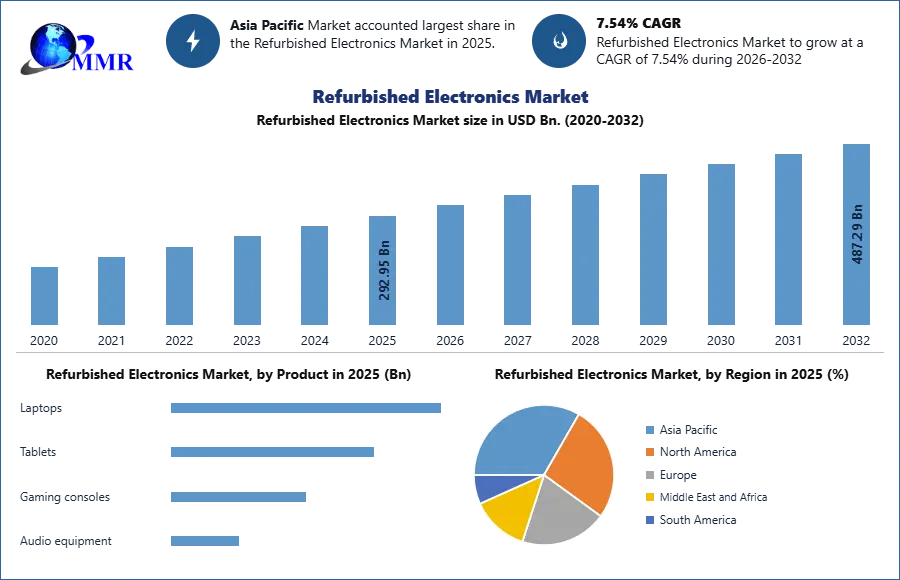
Market valuation reached USD 292.95 Billion in 2025 and is projected to hit USD 487.29 Billion by 2032.
Compound Annual Growth Rate (CAGR) is established at 7.54% over the 2025–2032 forecast horizon.
Corporate IT, enterprise servers, and edge computing nodes form the dominant market segment by asset value.
Industrial IoT sensors and certified legacy control modules constitute the fastest-growing market segment.
North America maintains the highest market share, while Asia-Pacific records the rapid industrial adoption pace.
Evolving electronic waste mandates and corporate sustainability frameworks force industrial operators to standardize on certified renewed hardware.
Why This Matters Now Escalating procurement costs for next-generation silicon and extended lead times for industrial control components are forcing a fundamental restructuring of manufacturing capital expenditure. Corporate operations leaders can no longer wait 26 to 52 weeks for greenfield automation components when factory floor downtime costs thousands of dollars per minute. The integration of high-performance refurbished electronics allows industrial enterprises to preserve capital, maintain legacy operations, and accelerate digital twin deployments without overhauling existing operational technology infrastructure.
Market Overview The global Refurbished Electronics Market is transitioning from a consumer-centric secondary marketplace into a strategic supply-chain hedge for enterprise IT and smart manufacturing ecosystems. Valued at USD 292.95 Billion in 2025, the industry is scaling efficiently to reach USD 487.29 Billion by 2032, sustaining a steady CAGR of 7.54%. This expansion reflects a systemic shift in how organizations manage asset lifecycles under volatile economic conditions and stringent environmental, social, and governance (ESG) reporting requirements.
What changed is the institutionalization of the secondary electronics supply chain. Previously characterized by fragmented, uncertified local vendors, the market now features original equipment manufacturers (OEMs) and specialized enterprise reconditioners offering rigorous testing, firmware updates, and multi-year warranties. This structural upgrade mitigates the operational risks historically associated with non-new hardware, giving plant managers and chief technology officers the confidence to deploy renewed infrastructure in mission-critical environments.
Key Trends Driving Growth The rapid convergence of Industry 4.0 applications and corporate circular economy initiatives serves as the primary growth engine for this market. Modern production facilities are deploying secondary data center servers and enterprise networking gear to process large volumes of information generated by industrial IoT networks. By utilizing certified refurbished high-performance computing assets, companies reduce the capital required to build out localized edge computing frameworks.
Furthermore, component obsolescence in the automation sector drives steady demand for reconditioned legacy hardware. As automation OEMs transition support to newer product lines, manufacturers running stable, validated lines rely on refurbished programmable logic controllers (PLCs), human-machine interfaces (HMIs), and distributed control system (DCS) components to avoid forced, multi-million-dollar system upgrades. This dynamic protects operational continuity while extending the amortized life of existing industrial machinery.
Get a free sample:https://www.maximizemarketresearch.com/request-sample/209405/
Segment Insights
Enterprise Computing and Networking Infrastructure (Dominant Segment): Large-scale data center servers, switches, and corporate IT hardware command the largest share of market revenue. This dominance stems from the brief lifecycle optimization schedules of hyper-scale cloud providers, which release vast quantities of high-specification, functional hardware into secondary markets at a fraction of initial costs.
Industrial Automation and IoT Components (Fastest-Growing Segment): Reconditioned sensors, legacy PLCs, SCADA workstations, and robotic controller modules exhibit the highest growth rate. Accelerated adoption is driven by manufacturing plants seeking immediate spare parts availability to counter supply chain bottlenecks and minimize operational downtime.
Regional Growth Story North America represents the largest market share, driven by a dense concentration of corporate data centers, advanced manufacturing facilities, and strict electronic waste compliance frameworks in the United States. Enterprise buyers in this region aggressively leverage certified refurbished IT assets to balance tech-stack modernization against rigid annual capital budgets. This corporate adoption pattern stabilizes secondary market pricing and standardizes quality assurance protocols globally.
Meanwhile, the Asia-Pacific region is expanding at the fastest rate through 2032. Massive investments in smart factory modernization across China, India, Japan, and South Korea stimulate high demand for affordable computing and automation hardware. Secondary electronic procurement allows mid-tier manufacturing enterprises in these developing industrial hubs to digitize production floors rapidly, bypassing the prohibitive upfront costs associated with entirely new automation deployments.
Competitive Landscape The competitive environment is shifting away from independent liquidators toward formalized OEM-backed programs and certified enterprise asset disposition (ITAD) specialists. Major technology conglomerates are establishing dedicated refurbishment segments to retain relationship control over secondary asset lifecycles, capture residual value, and meet corporate carbon-reduction mandates. This evolution signals that hardware availability and lifecycle management have become core components of long-term technology leadership.
For system integrators and industrial technology buyers, this corporate positioning provides standardized performance metrics. The proliferation of certified refurbishment processes ensures that secondary hardware meets precise diagnostic benchmarks, includes updated firmware patches, and aligns with modern industrial cybersecurity frameworks. As a result, the barrier between new and renewed hardware is dissolving, altering procurement strategies across the global automation sector.
Recent Developments
Global IT asset disposition providers expanded specialized testing facilities to handle advanced edge computing and industrial networking hardware.
Industrial automation distributors launched dedicated legacy-component certification programs to guarantee the compatibility and security of refurbished PLCs.
Enterprise hardware vendors integrated blockchain-based tracking systems to provide verifiable asset histories, ensuring transparent component provenance for secondary buyers.
Multi-vendor service providers established hybrid maintenance contracts that blend new hardware deployments with certified refurbished backup components to optimize factory uptime.
Strategic Implications For manufacturing executives and plant managers, the expansion of the refurbished electronics market offers a practical tool for capital optimization. Instead of allocating scarce capital to continuous, incremental hardware replacements, procurement teams can source certified refurbished assets for non-core systems. This methodology frees up capital for strategic investments in high-value software solutions, such as AI-driven predictive maintenance platforms, digital twin simulations, and advanced manufacturing execution systems (MES).
Operationally, integrating certified refurbished components into the supply chain enhances corporate resilience. Maintaining a strategic inventory of reconditioned legacy control modules protects automated assembly lines against sudden component obsolescence and macro supply disruptions. This strategy ensures that unexpected hardware failures can be resolved within hours using verified components, rather than waiting months for newly manufactured alternatives.
Future Outlook The trajectory of the Refurbished Electronics Market points toward deep integration into regular enterprise procurement channels. As corporate sustainability targets align with strict financial metrics, the adoption of renewed hardware will cease to be an emergency fallback and will become a standard operating procedure. This shift will alter the manufacturing landscape, defining how industrial networks are scaled, maintained, and decommissioned.
Ultimately, the market evolution will create a distinct operational divide based on capital flexibility and infrastructure agility. Future industrial leaders will leverage certified refurbished hardware to build resilient, cost-effective, and circular digital factories, while laggards will overextend capital budgets on redundant new components, leaving themselves vulnerable to supply chain volatility and prolonged operational downtime.
Analyst Perspective “The rapid expansion of the Refurbished Electronics Market marks a structural shift in industrial asset management,” states Gaurav Deshmukh, Lead Analyst at Maximize Market Research. “Manufacturers are discovering that capital efficiency and Industry 4.0 digitization are not mutually exclusive. By integrating certified, high-quality reconditioned computing and control infrastructure, smart enterprises are optimizing their capital expenditure, cutting lead times, and building resilient factory floors capable of weathering unpredictable supply shocks.”
About Maximize Market Research
Maximize Market Research Pvt. Ltd. (MMR) is a global market research and consulting company that provides reliable, data-focused, and practical business insights. The firm serves a wide range of industries, including healthcare, pharmaceuticals, technology, automotive, electronics, chemicals, personal care, and consumer goods. Through market forecasts, competitive analysis, strategic consulting, and industry impact assessments, MMR helps organizations understand changing market conditions, identify growth opportunities, and make informed business decisions for long-term success.
2nd Floor, Navale IT Park Phase 3
Pune Banglore Highway, Narhe
Pune, Maharashtra 411041, India
+91 9607365656
sales@maximizemarketresearch.com
