Key Highlights
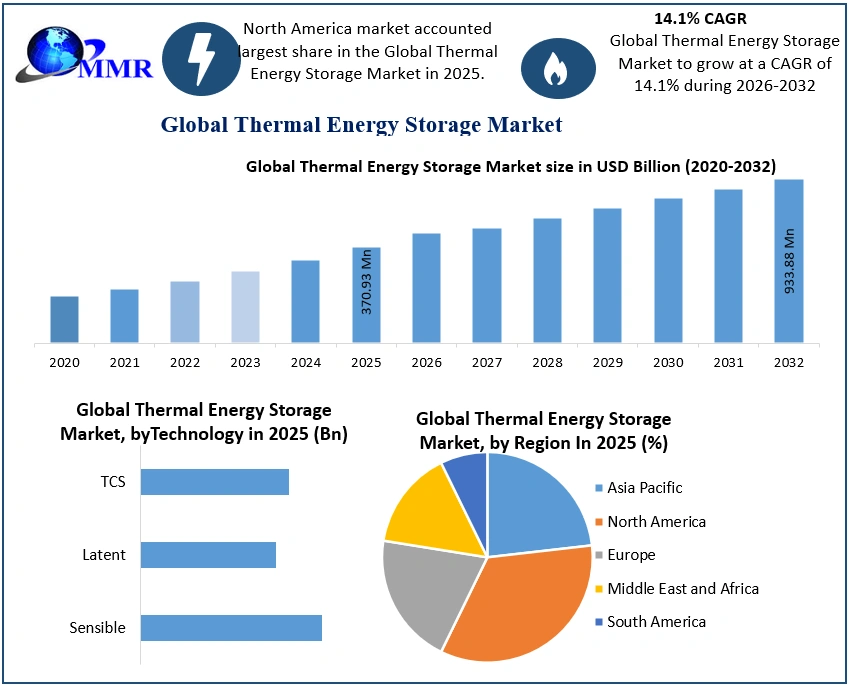
- The Thermal Energy Storage Market was valued at USD 370.93 Million in 2025, reflecting growing investment in flexible and sustainable energy infrastructure.
- The market is expected to reach USD 933.88 Million by 2032, expanding at a CAGR of 14.1% from 2025 to 2032, highlighting the increasing role of thermal storage in the global energy transition.
- Renewable energy integration continues accelerating demand for thermal storage technologies.
- Utilities are investing in flexible energy infrastructure to improve grid reliability.
- Industrial decarbonization strategies are creating new deployment opportunities.
- Digital energy management and smart grid initiatives are strengthening long-term market prospects.
Why This Matters Now
Renewable electricity generation is expanding rapidly, but reliable energy delivery increasingly depends on technologies capable of storing energy beyond periods of production. Thermal energy storage is becoming a strategic solution for balancing renewable generation, improving grid flexibility, and reducing dependence on conventional power sources.
The Thermal Energy Storage Market, valued at USD 370.93 Million in 2025, is projected to reach USD 933.88 Million by 2032, growing at a CAGR of 14.1%. That growth represents more than increasing equipment demand—it signals a structural transformation in how utilities, industries, and governments approach long-duration energy management and low-carbon infrastructure investment.
Market Overview
Thermal energy storage has become a critical component of modern energy systems by enabling the storage of heat or cold for later use. As renewable energy deployment accelerates, storage technologies are increasingly supporting electricity generation, district heating, industrial processes, and commercial energy management.
The market’s expansion reflects rising demand for flexible energy infrastructure capable of improving operational efficiency while supporting decarbonization objectives. Thermal storage helps optimize renewable energy utilization by reducing energy waste and improving system reliability across electricity and heating networks.
Governments and utilities are increasingly incorporating thermal storage into broader energy transition strategies as they modernize infrastructure, diversify generation portfolios, and improve energy security.
Key Trends Driving Growth
Renewable energy integration remains the strongest catalyst for market growth. Expanding solar and wind generation increases the need for technologies capable of storing excess energy and delivering it when demand rises or renewable output declines.
Grid modernization initiatives are creating additional opportunities for thermal storage deployment. Utilities increasingly require flexible infrastructure that supports intelligent energy management, improves grid stability, and enhances system resilience during periods of fluctuating electricity demand.
Industrial decarbonization is also reshaping investment priorities. Manufacturing facilities are adopting thermal storage technologies to improve energy efficiency, reduce fuel consumption, and support long-term sustainability strategies.
District heating and cooling infrastructure continues expanding across major economies pursuing energy efficiency improvements. Thermal storage enables operators to optimize heating networks while reducing operational costs and improving renewable energy utilization.
Digitalization is further enhancing system performance. Intelligent monitoring, predictive maintenance, and advanced control platforms allow operators to maximize storage efficiency while integrating thermal assets with broader smart energy systems.
𝐃𝐨𝐰𝐧𝐥𝐨𝐚𝐝 𝐏𝐃𝐅 𝐁𝐫𝐨𝐜𝐡𝐮𝐫𝐞 @https://www.maximizemarketresearch.com/request-sample/15053/
Segment Insights
- Dominant Segment: The report identifies the dominant segment based on its leading contribution to the Thermal Energy Storage Market during the forecast period.
- Fastest-Growing Segment: The report identifies the fastest-growing segment driven by increasing renewable integration and expanding infrastructure investments.
- Thermal storage supports renewable energy balancing and flexible power system operation.
- Industrial applications continue creating significant long-term deployment opportunities.
- Smart energy management systems enhance storage efficiency and operational performance.
Regional Growth Story
Leading energy markets continue investing in technologies that improve flexibility while supporting carbon reduction and energy security objectives.
The United States is strengthening grid modernization and renewable energy deployment through investments in advanced storage technologies that improve electricity reliability and operational resilience.
Germany continues prioritizing energy transition initiatives that integrate renewable generation with efficient heating infrastructure and thermal storage solutions. The country’s focus on industrial decarbonization further strengthens long-term market opportunities.
China is expanding renewable energy infrastructure while investing in technologies that improve energy system flexibility. Thermal storage complements large-scale renewable deployment by supporting more efficient energy management.
India is increasing renewable energy investments alongside expanding electricity infrastructure. Thermal energy storage contributes to national objectives focused on sustainable development, improved energy efficiency, and reliable power delivery.
Japan, South Korea, and the United Kingdom continue investing in low-carbon infrastructure, advanced storage technologies, and digital energy systems that strengthen grid resilience and long-term energy security.
Competitive Landscape
Competition is increasingly moving beyond standalone storage equipment toward integrated energy solutions. Companies are differentiating through engineering expertise, thermal storage innovation, digital energy management, and comprehensive infrastructure services.
This shift indicates growing customer demand for complete energy optimization platforms rather than individual storage products. Utilities and industrial operators increasingly evaluate suppliers based on lifecycle value, system integration capabilities, operational efficiency, and long-term reliability.
Technology providers capable of combining thermal storage with renewable generation, smart grids, and digital monitoring solutions are strengthening their competitive positioning as the global energy sector moves toward integrated low-carbon infrastructure.
Recent Developments
- Continued investments supporting renewable energy storage infrastructure.
- Expansion of grid modernization initiatives integrating thermal storage technologies.
- Growing adoption of thermal storage across industrial energy management applications.
- Increasing deployment of digital monitoring and intelligent energy optimization platforms.
- Rising infrastructure investments supporting flexible and resilient energy systems.
Strategic Implications
For utilities, thermal energy storage represents a strategic investment that improves renewable energy utilization, strengthens grid reliability, and enhances operational flexibility. As electricity systems become increasingly decentralized, storage technologies play a larger role in maintaining stable power delivery.
Infrastructure investors benefit from growing public and private capital directed toward clean energy infrastructure and long-duration storage technologies. Industrial organizations also gain opportunities to improve energy efficiency while supporting corporate carbon reduction objectives.
For policymakers, thermal storage contributes directly to renewable energy adoption, emissions reduction, and energy security by improving the performance of integrated energy systems without requiring additional conventional generation capacity.
Future Outlook
The next phase of the global energy transition will be defined by how effectively renewable generation is integrated with intelligent storage technologies capable of delivering reliable, flexible, and efficient energy systems. Thermal energy storage will increasingly become a strategic infrastructure asset supporting utilities, industries, and governments pursuing long-term decarbonization goals.
Organizations that integrate thermal storage with renewable energy, digital energy management, and modern grid infrastructure will lead the next generation of energy systems, while those delaying investment risk falling behind in an increasingly flexible, storage-driven, and low-carbon energy economy.
Analyst Perspective
“Thermal energy storage is evolving from a complementary technology into a strategic enabler of the global energy transition. Utilities and industrial organizations that combine thermal storage with renewable energy and digital grid modernization will be better positioned to improve resilience, optimize energy efficiency, and achieve long-term sustainability objectives.” — Neha Nalawade
About Maximize Market Research
Maximize Market Research Pvt. Ltd. (MMR) is a global market research and consulting company that provides reliable, data-focused, and practical business insights. The firm serves a wide range of industries, including healthcare, pharmaceuticals, technology, automotive, electronics, chemicals, personal care, and consumer goods. Through market forecasts, competitive analysis, strategic consulting, and industry impact assessments, MMR helps organizations understand changing market conditions, identify growth opportunities, and make informed business decisions for long-term success.
2nd Floor, Navale IT Park Phase 3
Pune Banglore Highway, Narhe
Pune, Maharashtra 411041, India
+91 9607365656
sales@maximizemarketresearch.com
