Key Highlights
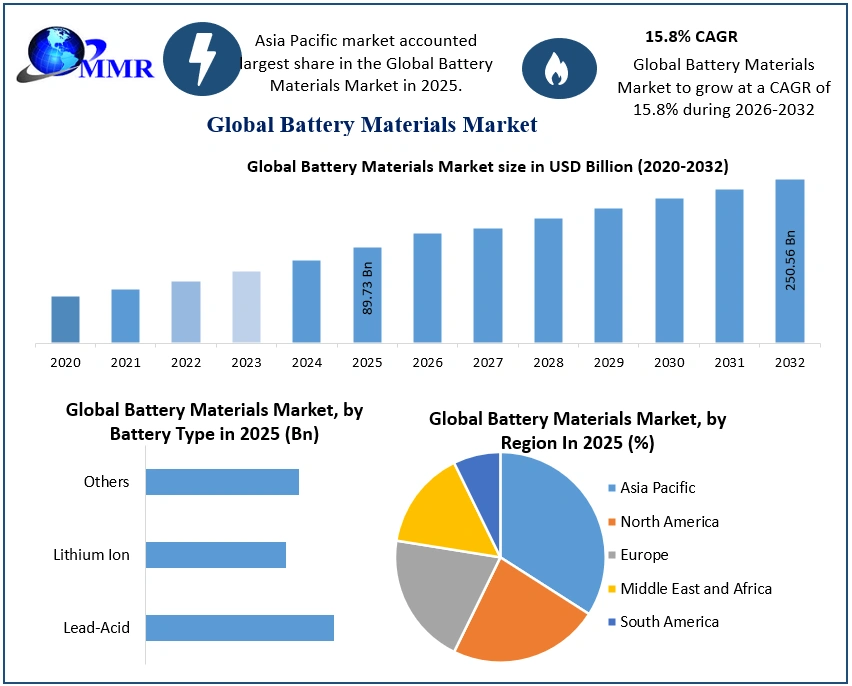
- The Battery Materials Market was valued at USD 89.73 Billion in 2025.
- The market is projected to reach nearly USD 250.56 Billion by 2032, expanding at a 15.8% CAGR from 2026 to 2032.
- Battery materials have become a strategic foundation for electric mobility, renewable energy integration, and grid-scale energy storage.
- Governments are strengthening domestic battery supply chains to improve energy security and reduce dependence on imported critical minerals.
- Investments in battery manufacturing capacity are accelerating across major global economies.
Why This Matters Now
The global energy transition has entered a phase where battery supply chains are becoming as strategically important as power generation itself. Utilities, automakers, renewable developers, industrial manufacturers, and policymakers are competing for access to critical battery materials that determine the pace of electrification and clean energy deployment.
The Battery Materials Market, valued at USD 89.73 Billion in 2025, is expected to reach nearly USD 250.56 Billion by 2032, growing at a 15.8% CAGR. That expansion signals more than rising material demand. It represents a structural transformation in global energy infrastructure as battery manufacturing becomes central to transportation, electricity storage, industrial decarbonization, and national energy security strategies.
Market Overview
Battery materials have evolved from a specialized manufacturing input into a strategic industrial asset. Growing deployment of electric vehicles, utility-scale battery energy storage systems, distributed energy resources, and renewable power projects has significantly increased the importance of resilient battery material supply chains.
Governments are responding with industrial policies aimed at expanding domestic battery manufacturing while securing long-term access to critical raw materials. The result is a new investment cycle that extends beyond mining into refining, processing, advanced materials production, recycling, and integrated battery manufacturing ecosystems.
Rapid technological innovation is also reshaping market dynamics. Manufacturers continue improving battery chemistry, production efficiency, and material utilization while reducing costs to support broader electrification objectives.
Key Trends Driving Growth
Electrification remains the strongest growth catalyst across the battery materials industry. Electric vehicle production continues expanding globally, increasing demand for high-performance battery materials capable of delivering greater energy density, safety, and lifecycle performance.
Renewable energy deployment is creating another major demand source. As solar and wind capacity grows, utilities require battery energy storage systems to stabilize electricity networks, manage intermittency, and improve grid flexibility. This is strengthening investment throughout the battery materials value chain.
Grid modernization initiatives are also accelerating. Utilities increasingly deploy advanced storage technologies to improve transmission efficiency, enhance grid resilience, and support distributed renewable generation.
Governments are simultaneously prioritizing energy security by encouraging domestic battery supply chains through manufacturing incentives, industrial investment programs, and strategic resource development. These initiatives reduce supply chain vulnerabilities while supporting long-term decarbonization objectives.
Battery recycling has also become an important strategic priority. Circular economy initiatives are encouraging recovery of valuable materials while improving resource efficiency and reducing dependence on primary extraction.
𝐃𝐨𝐰𝐧𝐥𝐨𝐚𝐝 𝐏𝐃𝐅 𝐁𝐫𝐨𝐜𝐡𝐮𝐫𝐞 @https://www.maximizemarketresearch.com/request-sample/31309/
Segment Insights
- Dominant Segment: As identified in the Maximize Market Research report.
- Fastest-Growing Segment: As identified in the Maximize Market Research report.
- Material innovation continues improving battery performance, charging capability, operational safety, and production efficiency.
- Manufacturers increasingly prioritize sustainable sourcing, recycling integration, and advanced material processing technologies.
- Investment is expanding across the entire battery value chain, from raw materials to advanced cell manufacturing.
Regional Growth Story
The United States continues strengthening domestic battery manufacturing through investments in clean energy infrastructure, electric vehicle production, and large-scale battery storage deployment. Supply chain localization has become a strategic priority to enhance energy security and industrial competitiveness.
China remains a global manufacturing leader with extensive investments across battery materials processing, battery cell production, electric vehicle manufacturing, and renewable energy deployment. Its integrated industrial ecosystem continues supporting large-scale production and technology development.
Germany is expanding battery manufacturing capacity to strengthen Europe’s automotive transition while supporting renewable energy integration and industrial decarbonization. The country’s focus on sustainable manufacturing aligns with broader European energy transition objectives.
India is rapidly increasing investments in battery manufacturing, electric mobility, renewable power expansion, and domestic energy storage infrastructure. These developments are creating new opportunities across battery material processing and supply chain development.
Japan and South Korea continue advancing battery technology through research, manufacturing expertise, and global partnerships that support innovation in advanced battery chemistries and high-performance materials.
The United Kingdom is also strengthening battery manufacturing capabilities alongside renewable energy deployment and electrification strategies to improve long-term industrial competitiveness.
Competitive Landscape
Competition is shifting from material production alone toward integrated battery ecosystems that combine mining, processing, advanced manufacturing, recycling, and technology development. Companies capable of controlling multiple stages of the supply chain are improving resilience while reducing exposure to raw material volatility.
Strategic partnerships between battery manufacturers, automotive companies, mining organizations, and energy developers indicate increasing vertical integration throughout the industry. These collaborations improve supply certainty, accelerate innovation, and strengthen long-term investment planning.
Technology leadership is becoming equally important. Manufacturers investing in higher-performance materials, sustainable production methods, advanced recycling, and next-generation battery chemistries are improving cost competitiveness while supporting global decarbonization objectives.
As utility-scale storage deployment expands alongside electric mobility, competitive advantage will increasingly depend on reliable material supply, manufacturing scale, technological innovation, and sustainability performance.
Recent Developments
- Continued expansion of battery manufacturing capacity worldwide.
- Rising investments in battery recycling and circular economy initiatives.
- Increased government support for domestic battery supply chains.
- Growing deployment of utility-scale battery energy storage systems.
- Stronger integration between renewable energy projects and battery storage infrastructure.
Strategic Implications
Battery materials are becoming strategic infrastructure rather than industrial commodities. Every major investment in electric mobility, renewable power generation, grid modernization, and industrial electrification increases demand for secure and sustainable battery material supply.
For investors, this creates opportunities across mining, processing, advanced manufacturing, recycling, and energy storage technologies. For utilities, stronger battery supply chains improve grid flexibility and renewable integration. For policymakers, domestic battery ecosystems strengthen energy independence while supporting climate objectives and industrial competitiveness.
Businesses capable of combining technology innovation with resilient sourcing strategies will be positioned to capture long-term value as battery deployment accelerates across multiple sectors.
Future Outlook
The next stage of market development will be defined by integrated battery ecosystems where material innovation, manufacturing scale, recycling, and digital supply chain management become equally important competitive advantages.
As electrification expands across transportation, utilities, and industrial operations, battery materials will increasingly determine the speed of the global energy transition. Companies that secure resilient supply chains, invest in advanced materials, and align production with sustainability goals will define the industry’s next generation of leaders, while those that remain dependent on fragmented supply networks risk losing strategic relevance in the world’s rapidly evolving clean energy economy.
Analyst Perspective
“Battery materials are no longer simply manufacturing inputs—they have become strategic assets shaping energy security, electrification, and industrial competitiveness. Organizations investing in resilient supply chains, advanced material technologies, and sustainable production will be best positioned to lead the next phase of the global energy transition,” says Neha Nalawade, Analyst, Maximize Market Research.
About Maximize Market Research
Maximize Market Research Pvt. Ltd. (MMR) is a global market research and consulting company that provides reliable, data-focused, and practical business insights. The firm serves a wide range of industries, including healthcare, pharmaceuticals, technology, automotive, electronics, chemicals, personal care, and consumer goods. Through market forecasts, competitive analysis, strategic consulting, and industry impact assessments, MMR helps organizations understand changing market conditions, identify growth opportunities, and make informed business decisions for long-term success.
2nd Floor, Navale IT Park Phase 3
Pune Banglore Highway, Narhe
Pune, Maharashtra 411041, India
+91 9607365656
sales@maximizemarketresearch.com
