Key Highlights
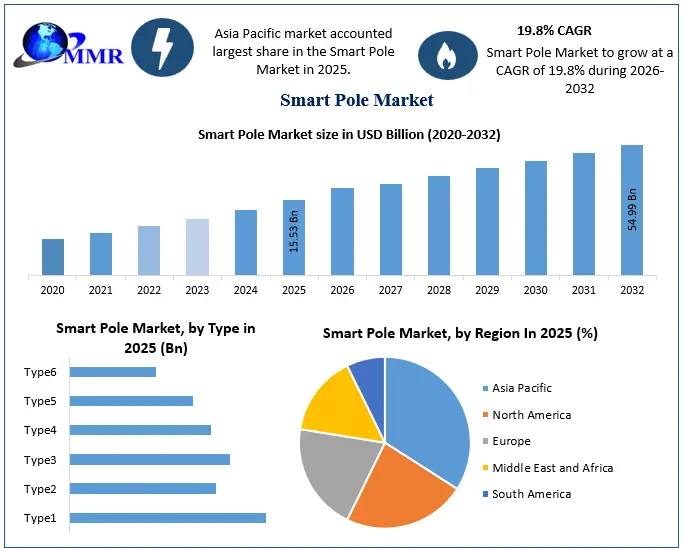
- The Smart Pole Market was valued at USD 15.53 Billion in 2025.
- The market is expected to reach nearly USD 54.99 Billion by 2032, expanding at a 19.8% CAGR from 2026 to 2032.
- Smart poles are evolving into multi-functional infrastructure supporting lighting, communications, energy management, surveillance, and connected mobility.
- Utilities and municipalities are integrating smart poles into broader grid modernization and smart city strategies.
- Digital infrastructure investments are accelerating deployment across major urban economies.
Why This Matters Now
Cities are no longer investing in standalone street lighting. They are building intelligent urban infrastructure capable of supporting energy efficiency, digital connectivity, public safety, and future mobility from a single platform. Smart poles have become strategic assets that connect utilities, telecommunications, transportation, and municipal services.
The Smart Pole Market, valued at USD 15.53 Billion in 2025, is projected to reach nearly USD 54.99 Billion by 2032, growing at a 19.8% CAGR. That rapid expansion represents more than infrastructure spending. It reflects how governments, utilities, and private investors are transforming traditional public infrastructure into digital networks that improve operational efficiency while supporting long-term energy transition goals.
Market Overview
Urban infrastructure is undergoing one of its most significant transformations in decades. Population growth, digitalization, electrification, and sustainability targets are forcing cities to modernize public assets that were originally designed only for illumination. Smart poles now combine lighting with communication systems, environmental monitoring, surveillance, traffic management, public connectivity, and intelligent energy management.
Utilities increasingly view smart poles as distributed digital assets capable of supporting smart grid operations and improving electricity network visibility. Municipal authorities see opportunities to consolidate multiple urban services into a single infrastructure platform while reducing maintenance costs and improving service delivery.
The market’s projected growth reflects expanding investment in connected infrastructure that enhances resilience, supports renewable energy integration, and improves urban energy efficiency without requiring extensive new construction.
Key Trends Driving Growth
Grid modernization is becoming one of the strongest growth drivers. Utilities are deploying intelligent infrastructure that enables real-time monitoring, automated asset management, and improved electricity distribution. Smart poles support these objectives by serving as connected nodes across urban energy networks.
Electrification is also expanding deployment opportunities. As electric vehicle adoption increases, municipalities are exploring infrastructure capable of supporting charging systems alongside intelligent lighting and communications, maximizing the value of existing public assets.
Renewable energy integration continues encouraging investment in digital energy infrastructure. Smart poles can support distributed energy resources, intelligent lighting controls, and energy-efficient operations that complement broader decarbonization strategies.
Digital transformation is reshaping city planning. Internet of Things technologies, artificial intelligence, cloud-based monitoring, and edge computing enable municipalities to collect operational data that improves traffic management, environmental monitoring, and infrastructure performance.
Governments worldwide continue promoting smart city initiatives through infrastructure investment programs and regulatory frameworks supporting energy efficiency, digital connectivity, and sustainable urban development. These policies are accelerating deployment across both developed and emerging economies.
𝐃𝐨𝐰𝐧𝐥𝐨𝐚𝐝 𝐏𝐃𝐅 𝐁𝐫𝐨𝐜𝐡𝐮𝐫𝐞 @https://www.maximizemarketresearch.com/request-sample/33495/
Segment Insights
- Dominant Segment: As identified in the Maximize Market Research report.
- Fastest-Growing Segment: As identified in the Maximize Market Research report.
- Smart poles increasingly combine lighting, communications, surveillance, environmental monitoring, and digital utility applications.
- Advanced software platforms improve operational efficiency through centralized monitoring and predictive maintenance.
- Integration with smart grid technologies continues expanding functionality across municipal infrastructure.
Regional Growth Story
The United States remains a major market as utilities and municipalities accelerate investments in grid modernization, digital infrastructure, and intelligent transportation systems. Smart pole deployment supports broader objectives involving energy efficiency, public safety, and connected urban services.
Germany continues advancing smart infrastructure through energy transition initiatives, sustainable urban development, and intelligent utility investments. Smart poles complement renewable energy integration and digital municipal operations while improving infrastructure efficiency.
China is rapidly expanding smart city programs supported by large-scale investments in digital infrastructure, telecommunications, and urban modernization. Smart poles are increasingly deployed as integrated platforms supporting connected city services and intelligent energy management.
India is strengthening investments in urban infrastructure through smart city initiatives, digital governance, and energy-efficient public infrastructure. Growing urbanization continues creating opportunities for intelligent lighting and connected utility solutions.
Japan and South Korea remain leaders in digital innovation, telecommunications, and advanced urban infrastructure. Their continued emphasis on automation, connected mobility, and intelligent public services supports further smart pole deployment.
The United Kingdom is integrating smart poles into broader infrastructure modernization programs focused on sustainability, energy efficiency, and digital public services while strengthening urban resilience.
Competitive Landscape
Competition is moving beyond hardware manufacturing toward integrated digital infrastructure ecosystems. Companies capable of combining lighting technology, communications equipment, software platforms, IoT integration, and energy management solutions are strengthening their market positions.
Strategic partnerships among utilities, telecommunications providers, technology companies, infrastructure developers, and municipalities indicate that smart poles are becoming shared infrastructure supporting multiple public and commercial services simultaneously. This collaborative approach improves project economics while accelerating deployment.
Technology leadership increasingly depends on interoperability, cybersecurity, software intelligence, and lifecycle services rather than lighting performance alone. Vendors investing in scalable digital platforms and integrated infrastructure solutions are improving long-term competitiveness.
As cities pursue carbon reduction and digital transformation simultaneously, organizations capable of delivering intelligent infrastructure that supports both objectives will shape future market leadership.
Recent Developments
- Expansion of smart city infrastructure investment programs.
- Increased deployment of intelligent LED lighting and connected utility platforms.
- Growing integration of IoT sensors, communications equipment, and digital monitoring technologies.
- Rising investments in grid modernization and urban digital infrastructure.
- Stronger collaboration among utilities, municipalities, and technology providers.
Strategic Implications
Smart poles are rapidly becoming foundational infrastructure supporting digital cities and intelligent energy systems. Every deployment strengthens connectivity, improves energy efficiency, enhances public services, and creates new opportunities for integrated urban management.
For utilities, smart poles improve grid visibility and enable more intelligent energy distribution. For municipalities, they reduce infrastructure duplication while supporting multiple public services through a single platform. Investors benefit from expanding opportunities across software, communications, digital infrastructure, and energy management technologies.
Organizations that combine hardware innovation with digital intelligence, cybersecurity, and integrated infrastructure services will capture greater long-term value as cities increasingly demand multifunctional infrastructure rather than standalone equipment.
Future Outlook
The next phase of market development will be defined by intelligent urban ecosystems where smart poles function as distributed digital infrastructure supporting utilities, telecommunications, transportation, renewable energy integration, and public services through interconnected platforms.
As cities compete to become more sustainable, resilient, and digitally connected, organizations that invest early in scalable smart infrastructure ecosystems will establish the next generation of urban infrastructure leadership, while those relying on conventional public assets will struggle to meet the demands of increasingly connected and energy-efficient cities.
Analyst Perspective
“Smart poles are evolving into strategic infrastructure assets that connect digital cities with modern energy systems. Organizations investing in intelligent infrastructure, grid modernization, and integrated urban platforms will be best positioned to create long-term value as cities accelerate digital transformation and sustainability initiatives,” says Neha Nalawade, Analyst, Maximize Market Research.
About Maximize Market Research
Maximize Market Research Pvt. Ltd. (MMR) is a global market research and consulting company that provides reliable, data-focused, and practical business insights. The firm serves a wide range of industries, including healthcare, pharmaceuticals, technology, automotive, electronics, chemicals, personal care, and consumer goods. Through market forecasts, competitive analysis, strategic consulting, and industry impact assessments, MMR helps organizations understand changing market conditions, identify growth opportunities, and make informed business decisions for long-term success.
2nd Floor, Navale IT Park Phase 3
Pune Banglore Highway, Narhe
Pune, Maharashtra 411041, India
+91 9607365656
sales@maximizemarketresearch.com
