Key Highlights
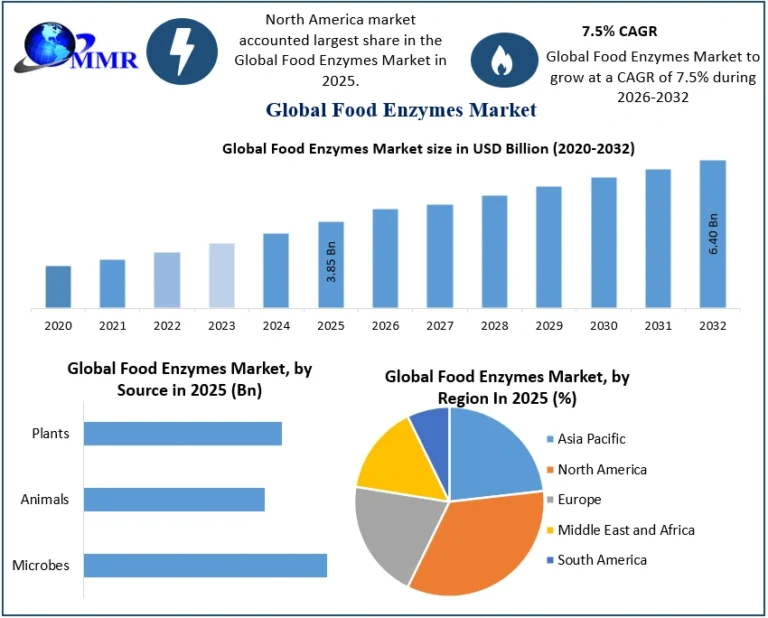
- The market reached USD 3.85 billion in 2025, highlighting the growing role of enzymes across food manufacturing.
- Revenue is forecast to reach USD 6.40 billion by 2032, indicating expanding commercial adoption across multiple food categories.
- A 7.5% CAGR demonstrates sustained investment in biotechnology-driven food production.
- Microbial enzymes remain the industry’s largest source due to production efficiency and scalability.
- Beverage applications are expected to deliver the strongest growth during the forecast period.
- North America leads the global market, supported by strong processed food demand and technological advancement.
- Asia-Pacific continues expanding through urbanization, rising disposable income, and increasing consumption of ready-to-eat foods.
Why This Matters Now
Consumers increasingly expect food that is healthier, more natural, and produced with fewer chemical interventions. Manufacturers face growing pressure to improve product quality while maintaining operational efficiency.
Food enzymes address both challenges simultaneously. They improve production yields, enhance taste and texture, extend freshness, and reduce reliance on conventional chemical processing methods, making them an increasingly strategic component of modern food manufacturing.
Market Overview
Food enzymes Market Size have become essential processing aids across beverages, dairy products, bakery applications, and processed foods. Their ability to improve production efficiency while supporting product quality continues driving adoption throughout the food industry.
Growing demand for processed and convenience foods, particularly across rapidly urbanizing economies, is strengthening market expansion. Rising disposable incomes and changing lifestyles continue increasing consumption of packaged and ready-to-eat food products that rely on enzyme-assisted processing.
Advances in biotechnology are further accelerating market development. Modern microbial engineering and fermentation technologies continue improving enzyme production efficiency while enabling broader commercial applications.
Key Trends Driving Growth
Demand for canned and processed foods continues rising, particularly across Asia, where expanding middle-class populations and busier lifestyles increase consumption of packaged food products. This creates sustained demand for enzyme-based production technologies that improve product freshness and manufacturing performance.
Biotechnology innovation remains a major competitive driver. Companies increasingly invest in research and development to improve enzyme efficiency, production methods, and commercial scalability. The collaboration between AB Enzymes and Genedata illustrates the industry’s growing emphasis on advanced biotechnology capabilities.
Health and wellness trends continue encouraging manufacturers to replace traditional chemical processing methods with enzyme-based alternatives. Enzymes enable more natural processing while supporting improvements in taste, appearance, texture, and production yield.
Regulatory developments also continue influencing market strategy. European food enzyme safety regulations have increased industry attention toward enzyme applications, particularly those involving genetically modified microorganisms, encouraging greater compliance and product validation.
The report does not identify measurable data regarding e-commerce penetration or dedicated sustainability initiatives within the Food Enzymes Market. Rather than speculate, these areas remain outside the scope of the available research.
Explore detailed analysis, insights, and growth opportunities
Segment Insights
- Dominant Segment: Microbial Source accounted for 63% of the market share in 2025, supported by lower production costs, greater stability, fermentation-based manufacturing, and easier process modification.
- Plant- and animal-derived enzymes continue serving important applications but remain secondary to microbial production.
- Fastest-Growing Segment: Beverage Applications, projected to grow at a CAGR of 8.5%, driven by increasing demand for healthier beverages and the use of enzymes such as pectinases, cellulases, and xylanases to improve extraction efficiency and product quality.
- Dairy, bakery, and processed food applications continue expanding as manufacturers seek greater production efficiency and enhanced product characteristics.
Regional Growth Story
North America accounted for 35% of the global market in 2025, making it the industry’s largest regional market. Strong processed food consumption across the United States and Canada, combined with continued investment in food ingredient technologies, supports regional leadership.
Asia-Pacific is forecast to grow at 6% CAGR during the forecast period. Urbanization, population growth, rising disposable incomes, and increasing demand for convenience foods continue expanding opportunities throughout China, India, and other regional markets.
Europe remains strategically important due to regulatory oversight and significant market share, with evolving food enzyme safety standards continuing to influence product development and commercialization strategies.
Competitive Landscape
Competition is increasingly centered on biotechnology capability rather than product availability alone. Companies are strengthening research partnerships, investing in microbial innovation, and expanding enzyme portfolios to improve production performance across multiple food categories.
Leading participants including Novozymes, DuPont, F. Hoffmann-La Roche Ltd., AB Enzymes, Koninklijke DSM N.V., Chr. Hansen Holding A/S, BASF SE, Amano Enzymes Inc., and Biocatalysts continue competing through technology development and specialized enzyme solutions.
The industry’s recent biotechnology collaborations indicate that innovation speed is becoming a primary competitive advantage. Over the next 12–24 months, companies capable of accelerating research commercialization and delivering application-specific enzyme solutions are likely to strengthen market positioning, while slower innovators may face increasing competitive pressure.
Recent Developments
- Biotechnology investment continues accelerating across enzyme manufacturing to improve production efficiency.
- AB Enzymes expanded its technology capabilities through collaboration with Genedata, strengthening research and development support for advanced enzyme innovation.
- European regulatory attention surrounding food enzyme safety continues encouraging stronger compliance and product validation across the industry.
Strategic Implications
Food manufacturers increasingly view enzymes as productivity tools rather than specialty ingredients. Companies investing in biotechnology, microbial fermentation, and advanced research capabilities are positioned to improve production efficiency while meeting growing consumer demand for naturally processed foods.
For investors and ingredient suppliers, competitive advantage will increasingly depend on innovation pipelines, regulatory readiness, and application-specific expertise rather than manufacturing scale alone.
Future Outlook
The Food Enzymes Market is expected to maintain steady expansion as biotechnology innovation, processed food consumption, and demand for healthier food production continue supporting commercial adoption across global food manufacturing. Companies that accelerate enzyme innovation and regulatory compliance will strengthen their competitive position, while businesses that delay investment in biotechnology risk falling behind as food production becomes increasingly science-driven.
Analyst Perspective
“Food enzymes are becoming strategic production assets rather than supporting ingredients. As biotechnology advances and consumer expectations evolve, companies investing in enzyme innovation will be better positioned to improve efficiency, product quality, and long-term competitiveness,” — Siddhi Dole, Analyst
About Maximize Market Research
Maximize Market Research Pvt. Ltd. (MMR) is a global market research and consulting company that provides reliable, data-focused, and practical business insights. The firm serves a wide range of industries, including healthcare, pharmaceuticals, technology, automotive, electronics, chemicals, personal care, and consumer goods. Through market forecasts, competitive analysis, strategic consulting, and industry impact assessments, MMR helps organizations understand changing market conditions, identify growth opportunities, and make informed business decisions for long-term success.
Contact Us :
2nd Floor, Navale IT Park Phase 3
Pune Banglore Highway, Narhe
Pune, Maharashtra 411041, India
+91 9607365656
sales@maximizemarketresearch.com
