Key Highlights
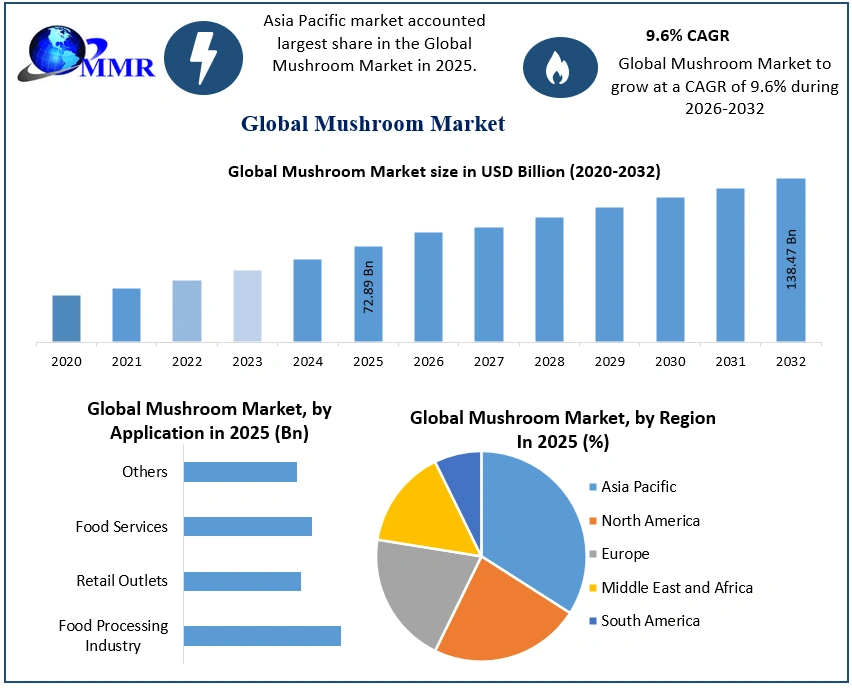
- Mushroom Market size reached USD 72.89 Billion in 2025 and is projected to hit USD 138.47 Billion by 2032, expanding at a CAGR of 9.6%.
- Growth signals structural shift in FMCG toward plant-based and functional nutrition categories.
- Demand is accelerating across food processing, foodservice, and retail consumption channels.
- Mushrooms are increasingly positioned as protein-rich, low-fat, and clean-label food inputs.
- Supply chain expansion is aligning with controlled cultivation and year-round production systems.
Why This Matters Now
Retail shelves are being rewritten in real time. Traditional protein categories are losing share as plant-based alternatives move from niche to mainstream.
The Mushroom Market’s rise to USD 138.47 Billion by 2032 signals more than category growth—it reflects a reallocation of consumer spending toward functional nutrition. At 9.6% CAGR, mushrooms are no longer a side ingredient; they are becoming a core FMCG input across packaged foods, ready meals, and foodservice menus.
For manufacturers, this shifts procurement strategy from commodity sourcing to nutrition-led formulation.
Market Overview
The Mushroom Market is expanding within a broader FMCG transformation driven by dietary diversification and sustainability priorities. The segment spans fresh, processed, and value-added mushroom products used across household consumption and industrial food processing.
The USD 72.89 Billion valuation in 2025 highlights strong baseline demand, supported by rising urban consumption and increasing integration of mushrooms into mainstream diets. The projected expansion to USD 138.47 Billion by 2032 indicates sustained structural demand rather than cyclical growth.
This trajectory is reinforced by growing incorporation of mushrooms into meat substitutes, snacks, soups, sauces, and ready-to-eat meals. The category is transitioning from agricultural commodity to functional food ingredient.
Key Trends Driving Growth
Health-driven consumption is the primary force reshaping demand. Consumers are actively shifting toward nutrient-dense, low-calorie foods that support immunity, digestion, and overall wellness. Mushrooms fit directly into this consumption logic due to their natural nutritional composition.
Clean-label demand is intensifying across FMCG categories. Manufacturers are reducing artificial additives, and mushrooms are increasingly used as natural flavor enhancers and texture builders.
Sustainability is another structural driver. Mushroom cultivation requires relatively lower land and water inputs compared to conventional protein sources, making it attractive in ESG-aligned food production strategies.
Food innovation pipelines are expanding mushroom usage in hybrid meat products and plant-based formulations. This is increasing penetration across processed food categories and institutional foodservice.
E-commerce penetration is also improving category visibility, enabling packaged mushroom products and value-added variants to reach broader consumer bases beyond traditional retail networks.
Get a free sample:https://www.maximizemarketresearch.com/request-sample/26848/
Segment Insights
The report outlines segmentation across multiple dimensions of the Mushroom Market; however, detailed segment-level dominance and growth hierarchy are not specified in the provided dataset.
- Dominant Segment: Not specified in the supplied report data
- Fastest-Growing Segment: Not specified in the supplied report data
Despite the absence of explicit segment ranking, market behavior indicates increasing traction for value-added and processed mushroom formats due to convenience-driven consumption patterns in urban FMCG ecosystems.
Regional Growth Story
The Mushroom Market demonstrates geographically diverse consumption patterns shaped by dietary habits, culinary traditions, and retail infrastructure maturity.
Urbanized economies are witnessing higher adoption rates due to packaged food penetration and functional nutrition awareness. In contrast, traditional consumption regions continue to drive baseline demand through fresh mushroom usage in household cooking and foodservice channels.
What is structurally changing is not geography alone, but distribution efficiency. Cold chain expansion and organized retail penetration are enabling mushrooms to move from local agricultural products to globally traded FMCG goods.
This shift is reducing dependency on seasonal supply cycles and improving year-round availability, strengthening demand consistency across regions.
Competitive Landscape
The competitive environment is defined by capacity expansion, product diversification, and supply chain integration. Market participants are increasingly focused on controlled cultivation technologies, automated farming systems, and standardized quality output.
Strategic investments are moving toward value-added mushroom products rather than raw production alone. This includes processed food applications, extracts, and functional ingredient formulations.
The competitive signal is clear: scale alone is no longer sufficient. Players that integrate downstream food processing capabilities are positioning themselves closer to FMCG revenue pools, while traditional growers risk margin compression.
Over the next 12–24 months, consolidation pressure is expected to intensify as larger food companies integrate mushroom supply chains to stabilize input costs and secure functional ingredient access.
Recent Developments
- Expansion of controlled environment farming systems to stabilize yield consistency.
- Increased product development in mushroom-based meat alternatives and hybrid protein foods.
- Rising investment in cold-chain logistics to support perishable mushroom distribution.
- Growth in packaged and ready-to-cook mushroom product formats for urban consumers.
- Expansion of functional ingredient applications in nutraceutical-aligned food categories.
Strategic Implications
For FMCG companies, mushrooms are shifting from ingredient procurement to product strategy. The category now influences formulation design, nutritional labeling, and clean-label positioning.
Food manufacturers are under pressure to reduce synthetic additives, and mushrooms provide a natural substitute for flavor enhancement and texture modification. This is reshaping R&D priorities across packaged food categories.
Retailers are also adjusting shelf space allocation toward high-turnover, health-oriented products. Mushroom-based SKUs are increasingly positioned alongside functional foods rather than traditional produce.
For agricultural producers, the strategic priority is moving toward controlled cultivation systems that ensure consistency, scalability, and integration with food processing industries.
Future Outlook
The Mushroom Market is entering a phase where demand growth is less about consumption expansion and more about functional integration into mainstream food systems.
At 9.6% CAGR through 2032, the category is expected to deepen its presence across FMCG portfolios, particularly in plant-based and clean-label food innovation pipelines.
The winners will be companies that integrate cultivation with processing and branded food product development. The losers will remain confined to low-margin raw supply roles with limited pricing power.
Analyst Perspective
“Growth in the Mushroom Market reflects a structural shift in how FMCG companies define nutrition, sustainability, and ingredient functionality. The category is moving into core product architecture rather than remaining a peripheral food item.”
— Siddhi Dole, Analyst
About Maximize Market Research
Maximize Market Research Pvt. Ltd. (MMR) is a global market research and consulting company that provides reliable, data-focused, and practical business insights. The firm serves a wide range of industries, including healthcare, pharmaceuticals, technology, automotive, electronics, chemicals, personal care, and consumer goods. Through market forecasts, competitive analysis, strategic consulting, and industry impact assessments, MMR helps organizations understand changing market conditions, identify growth opportunities, and make informed business decisions for long-term success.
2nd Floor, Navale IT Park Phase 3
Pune Banglore Highway, Narhe
Pune, Maharashtra 411041, India
+91 9607365656
sales@maximizemarketresearch.com
