Key Highlights
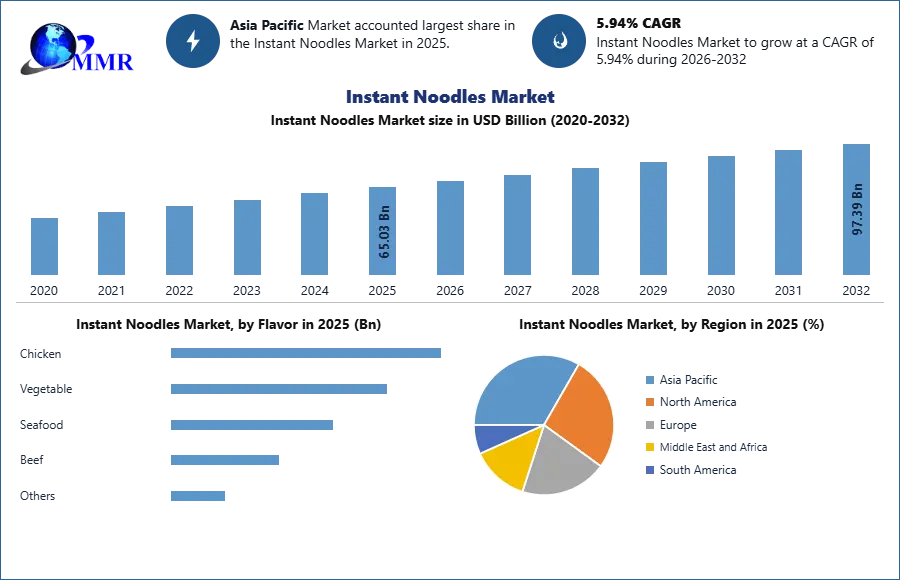
Valuation Milestone: The global instant noodles market size achieved a valuation of USD 61.38 Billion in 2024 and is projected to reach USD 97.39 Billion by 2032.
Sustained Velocity: Total category revenue is expanding at a Compound Annual Growth Rate (CAGR) of 5.94% over the 2025–2032 forecast matrix.
Primary Catalyst: Accelerated adoption of a micro-meal culture combined with fast-paced urban lifestyles is turning convenience items into core daily staples.
Formulation Evolution: Heavy institutional investments in air-dried, low-sodium, whole-grain, and functional nutrition variants are transforming the processed food landscape.
Geographic Focus: The Asia-Pacific territory maintains an absolute volume stronghold, accounting for over 60% of total industry revenue in 2025.
Why This Matters Now
FMCG brands, processing conglomerates, and grocery retail networks face immediate margin dilution if they treat the convenience food shelf as a static value segment. Fast-moving urban demographics are actively replacing traditional scratch cooking with sophisticated micro-meals, permanently altering high-volume food retail. The global instant noodles market size reached USD 61.38 Billion in 2024 and is on an uninterrupted trajectory to hit USD 97.39 Billion by 2032. This rapid growth indicates that quick-preparation comfort foods have transitioned from occasional snacks to primary dietary pillars.
For corporate category managers, the commercial reality requires an immediate operational pivot into high-margin segments. Consumers are demanding healthier ingredient profiles, cleaner labels, and authentic international flavor profiles, leaving basic wheat-and-sodium formulations exposed to private-label price competition. Brands that fail to integrate gourmet varieties, alternative grains, and functional nutrition parameters into their convenience lines over the next 12 months will surrender high-velocity retail space to fast-moving regional innovators.
Market Overview
The macroeconomic matrix of the Instant Noodles Market Size reveals an asset class scaling efficiently toward its USD 97.39 Billion target by 2032. Moving at a 5.94% CAGR, the physical volume moving through international supply loops reflects a highly resilient consumer sector. This steady upward climb is backed by aggressive expansions in quick-commerce apps, direct-to-consumer grocery platforms, and deep retail store infrastructure in emerging markets.
However, manufacturing units face intense pressure to reformulate as strict food safety regulations and high public health awareness reshape purchasing behaviors. Concerns regarding elevated sodium metrics, processed preservatives, and artificial additives are forcing major brands to reinvent their legacy production processes. Companies are successfully navigating these challenges by altering their base inputs and utilizing advanced low-oil or non-fried processing lines. These investments preserve processing profit margins while keeping the final product highly attractive to modern, health-conscious consumers.
Key Trends Driving Growth
Micro-Meal Consumption Surge: Consumers are shifting from light snacking to using instant noodle bowls as complete, single-serve lunch and dinner replacements.
Asian-Inspired Flavor Globalization: Growing international curiosity regarding authentic Japanese ramen, Korean ramyeon, and Thai-style spice profiles is fueling Western sales volume.
Clean-Label Nutrient Fortification: Processing plants are adding real vegetables, whole grains, and protein-fortified wheat alternatives to satisfy strict clean-label demands.
Quick-Commerce Logistics Integration: App-based grocery delivery systems and optimized digital supply chains are increasing product availability across suburban and rural markets.
𝐃𝐨𝐰𝐧𝐥𝐨𝐚𝐝 𝐏𝐃𝐅 𝐁𝐫𝐨𝐜𝐡𝐮𝐫𝐞 @ https://www.maximizemarketresearch.com/request-sample/221243/
Segment Insights
Wheat-Based Instant Noodles [Dominant Ingredient Segment]: This base material commands the highest global volume share, fueled by its low raw material cost structure, long shelf-life metrics, and deep historical acceptance across major manufacturing lines.
Rice-Based and Oats Formulations [Fastest-Growing Ingredient Segment]: Alternative grain segments are expanding at rapid growth rates due to surging consumer requests for verified gluten-free bases and functional dietary nutrition.
Chicken-Flavored Variants [Dominant Flavor Segment]: This classic formulation retains the largest global revenue share, representing a universally accepted flavor base that crosses age groups and regional markets.
Fried Noodle Formats [Dominant Format Segment]: Traditional flash-fried blocks maintain high production volume dominance because they deliver fast rehydration times and excellent flavor absorption.
Packet Packaging [Dominant Packaging Segment]: Traditional bag packaging retains the majority of the market volume, supported by bulk-purchase family trends and low unit pricing metrics.
Cup/Bowl Packaging [Fastest-Growing Packaging Segment]: Cup formats are growing at the fastest pace, capturing premium retail price points by offering true on-the-go utility without requiring extra kitchen utensils.
Regional Growth Story
The Asia-Pacific region maintains absolute commercial dominance, commanding a clear market share of over 60% in 2025. This geographical leadership is anchored by massive population hubs where noodles serve as a daily dietary staple. China remains the single largest national market on earth, controlling over half of the global volume through rising disposable incomes and deep urban integration. Concurrently, nations like Indonesia, Vietnam, India, and Japan are driving massive production volume through localized spice adaptations and convenient product packaging.
Simultaneously, North America and Europe are transforming into highly profitable markets for premium products. Driven by multicultural consumer preferences and hectic professional schedules, the United States is seeing a major spike in high-end ramen sales. European regional channels are experiencing similar growth patterns, where clean-label demands and natural ingredient profiles are opening up premium price positions across mainstream supermarkets.
Competitive Landscape
The corporate structure of the global instant noodles industry features intense market competition among dominant multi-national corporations. Major enterprises, including Nestlé SA, Nissin Foods Holdings, and PT Indofood Sukses Makmur Tbk, are using active brand extension strategies to secure retail placements. Rival firms are shifting away from simple price wars, choosing instead to compete on brand credibility, origin verification, and functional wellness credentials.
Over the next 12 to 24 months, these competitive patterns point toward significant changes in corporate portfolios. Industry frontrunners are scaling up investments in premium sub-brands to capture younger buyer demographics like Gen Z and Millennials, who prioritize authentic culinary experiences. For traditional mid-market suppliers, this means that holding onto basic, undifferentiated products will lead to margin erosion. To protect long-term revenue streams, secondary market players must either acquire niche regional flavor brands or quickly modify their production facilities to handle non-fried, health-focused formulations.
Recent Developments
Packaging Reductions: Leading global brands introduced innovative cup noodle formats designed to be prepared in home mugs, reducing plastic packaging volume by 83% and lowering freight carbon footprints.
Asset Modernization Investments: Mainstream processing plants upgraded their infrastructure to include automated, non-fried processing lines that dry noodle blocks via high-velocity hot air instead of traditional oil frying.
Strategic Cultural Collaborations: Global manufacturers launched limited-edition flavor packs tied directly to streaming entertainment platforms and pop-culture icons, increasing consumer trial rates among younger demographics.
Strategic Implications
Corporate procurement managers must address the financial threats posed by volatile agricultural raw materials. Relying exclusively on spot-market grain purchases leaves processing units exposed to sudden price swings in wheat, rice, and packaging materials. Sourcing teams should establish long-term, indexed contract matrices with trusted global agricultural suppliers to ensure stable production costs.
For product development divisions, the strategic goal centers on accelerating high-margin premium projects. Category engineers should incorporate real dehydrated vegetables, lean protein packets, and low-sodium seasoning bases to move out of the low-price value tier. Furthermore, marketing teams should optimize their digital shelf presence on quick-commerce apps to capture impulsive single-person household purchasing habits.
Future Outlook
The coming years will separate innovative market leaders who successfully upgrade their manufacturing lines to deliver premium, clean-label, non-fried convenience meals, from slow-moving traditional brands whose profits will be squeezed by rising raw material costs and shifting public health regulations.
Analyst Perspective
“The expansion of the global instant noodles market to an anticipated USD 97.39 Billion by 2032 highlights a permanent structural shift in consumer eating patterns. We are seeing the traditional snack food evolve into a high-margin, functional micro-meal. Brands that quickly adapt their portfolios to offer premium, health-oriented, and regionally customized options will capture the highest market returns as global convenience demand accelerates.”
— Siddhi Dole, Research Analyst, Maximize Market Research
About Maximize Market Research
Maximize Market Research Pvt. Ltd. (MMR) is a global market research and consulting company that provides reliable, data-focused, and practical business insights. The firm serves a wide range of industries, including healthcare, pharmaceuticals, technology, automotive, electronics, chemicals, personal care, and consumer goods. Through market forecasts, competitive analysis, strategic consulting, and industry impact assessments, MMR helps organizations understand changing market conditions, identify growth opportunities, and make informed business decisions for long-term success.
2nd Floor, Navale IT Park Phase 3
Pune Banglore Highway, Narhe
Pune, Maharashtra 411041, India
+91 9607365656
sales@maximizemarketresearch.com
