Key Highlights
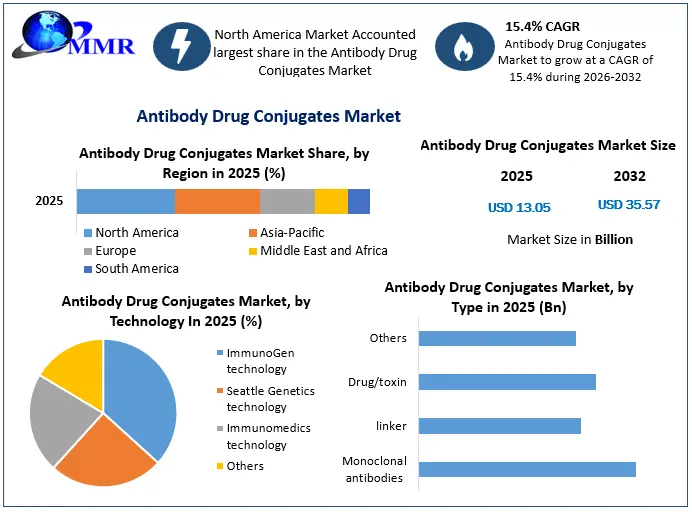
- The Antibody Drug Conjugates Market was valued at USD 13.05 Billion in 2025.
- The market is projected to reach USD 35.57 Billion by 2032, expanding at a CAGR of 15.4% from 2026 to 2032.
- Increasing global cancer incidence is accelerating demand for targeted oncology therapies.
- Precision medicine continues to reshape treatment pathways across healthcare systems.
- Pharmaceutical and biotechnology companies are strengthening ADC pipelines through innovation and strategic collaborations.
- Regulatory approvals and expanding reimbursement support broader commercial adoption.
- North America remains the leading regional market, while Asia-Pacific is witnessing rapid expansion.
Why This Matters Now
Cancer care is entering a new competitive phase where targeted therapies are replacing conventional treatment approaches for many patient populations. Healthcare providers, pharmaceutical companies, investors, and regulators are focusing on therapies capable of improving clinical outcomes while reducing systemic toxicity.
Antibody drug conjugates (ADCs) have emerged as one of the fastest-growing areas within oncology because they combine the targeting capability of monoclonal antibodies with highly potent cytotoxic agents. As healthcare systems prioritize precision medicine and value-based care, ADCs are moving from niche treatments toward broader clinical adoption across multiple cancer indications.
Market Overview
The Antibody Drug Conjugates Market reached USD 13.05 Billion in 2025 and is forecast to grow to USD 35.57 Billion by 2032, registering a 15.4% CAGR during the forecast period.
The market is benefiting from continued advances in antibody engineering, linker chemistry, and payload technologies that enhance treatment precision while minimizing damage to healthy tissues. Pharmaceutical manufacturers are increasing investments across discovery, clinical development, and commercialization as the number of oncology candidates continues to expand.
Growing awareness of personalized medicine is also changing treatment decisions. Physicians increasingly rely on biomarker-driven diagnostics to identify patients who are most likely to benefit from targeted therapies, improving treatment effectiveness and supporting wider adoption of ADC-based medicines.
Hospitals and cancer centers are simultaneously investing in specialized oncology infrastructure capable of supporting advanced biologic therapies, strengthening market demand across developed healthcare systems.
Key Trends Driving Growth
Precision oncology has become one of the strongest growth engines for the market. Rather than treating broad patient populations with conventional chemotherapy, clinicians increasingly select therapies tailored to specific tumor characteristics. ADCs fit naturally within this approach by delivering potent drugs directly to cancer cells.
Biopharmaceutical innovation continues to accelerate. Companies are developing next-generation linker technologies designed to improve drug stability and increase therapeutic effectiveness while reducing adverse effects. These innovations are expanding opportunities across solid tumors and hematological malignancies.
Artificial intelligence is beginning to influence oncology drug development by supporting target identification, biomarker discovery, clinical trial optimization, and patient selection. Digital technologies are shortening development timelines and improving clinical decision-making across the pharmaceutical value chain.
Companion diagnostics are becoming increasingly important alongside targeted therapies. More accurate diagnostic testing allows physicians to identify eligible patients, improving treatment success rates and supporting reimbursement discussions with healthcare payers.
Healthcare expenditure on cancer care continues to increase across major economies as governments and private healthcare providers respond to rising disease burden. This investment supports wider availability of advanced biologic therapies despite their premium pricing.
Regulatory agencies are also creating opportunities through accelerated approval pathways for innovative oncology treatments addressing unmet medical needs. Faster regulatory decisions enable pharmaceutical companies to commercialize breakthrough therapies earlier while expanding treatment options for patients.
Download a Sample Report Featuring Key Market Drivers and Challenges
Segment Insights
- Dominant Segment: The report identifies the leading market segment based on its comprehensive market assessment.
- Fastest-Growing Segment: The report highlights the fastest-expanding segment driven by increasing treatment demand and ongoing technological innovation.
- Growing adoption across multiple oncology indications is broadening the commercial potential of antibody drug conjugates.
- Continuous innovation in antibody engineering, linker technology, and payload development is improving product differentiation and supporting future pipeline expansion.
Regional Growth Story
North America continues to lead the global Antibody Drug Conjugates Market due to advanced healthcare infrastructure, strong pharmaceutical research capabilities, high healthcare spending, and rapid adoption of innovative oncology therapies. Favorable reimbursement frameworks and ongoing investment in biotechnology further strengthen regional leadership.
Germany and the United Kingdom remain important European markets supported by established oncology care networks, precision medicine initiatives, and growing access to advanced biologic treatments. Regulatory support and expanding clinical research continue to encourage innovation across the region.
China is rapidly expanding its oncology ecosystem through increased healthcare investment, domestic biopharmaceutical development, and greater patient access to innovative therapies. Local manufacturers are becoming increasingly active participants in the global ADC landscape.
Japan continues to emphasize advanced cancer treatment supported by its aging population, sophisticated healthcare system, and strong pharmaceutical industry. The country’s focus on innovative medicines is creating additional opportunities for targeted oncology therapies.
India is gradually strengthening its oncology infrastructure through increasing healthcare investment, expanding specialty hospitals, and improving cancer awareness. Growing demand for advanced treatments is expected to create long-term market opportunities despite affordability challenges.
South Korea continues to invest in biotechnology innovation, precision medicine, and digital healthcare capabilities. Strong clinical research activity and supportive healthcare policies position the country as an important contributor to future market growth.
Competitive Landscape
Competition is increasingly shifting from product launches alone toward platform innovation. Companies are investing across antibody discovery, linker chemistry, payload technologies, manufacturing capabilities, and biomarker development to strengthen long-term competitive positioning.
Strategic collaborations between pharmaceutical companies and biotechnology innovators are becoming more common as organizations seek to accelerate pipeline development while reducing research risk. These partnerships also expand access to specialized technologies that improve treatment effectiveness.
Regulatory approvals carry significance beyond individual products. Each approval validates technology platforms, increases physician confidence, strengthens reimbursement discussions, and encourages additional investment across the broader ADC ecosystem.
Acquisitions and licensing agreements indicate continued confidence in targeted oncology as one of the pharmaceutical industry’s highest-growth therapeutic areas. Companies with diversified pipelines and scalable manufacturing capabilities are expected to strengthen their competitive advantage.
Recent Developments
- Continued expansion of antibody drug conjugate research pipelines across major pharmaceutical companies.
- Increasing investment in next-generation ADC technologies with improved safety and therapeutic performance.
- Growing strategic collaborations between biotechnology innovators and global pharmaceutical manufacturers.
- Regulatory progress supporting commercialization of innovative oncology therapies.
- Rising integration of precision diagnostics into targeted cancer treatment pathways.
Strategic Implications
Healthcare providers are preparing for broader integration of antibody drug conjugates into routine oncology practice. Success will increasingly depend on diagnostic capabilities, multidisciplinary treatment planning, and specialized clinical expertise.
For pharmaceutical companies, competitive differentiation will rely on technology platforms rather than individual products. Superior linker technologies, novel payloads, optimized antibodies, and efficient manufacturing processes will determine long-term leadership.
Healthcare payers are expected to place greater emphasis on value-based reimbursement models that demonstrate improved patient outcomes relative to treatment costs. Real-world clinical evidence will become increasingly important during reimbursement negotiations.
Investors continue to view antibody drug conjugates as one of the most attractive segments within oncology because of expanding clinical applications, strong innovation pipelines, and growing commercial opportunities across global healthcare markets.
Future Outlook
The Antibody Drug Conjugates Market is entering a period of sustained expansion driven by precision oncology, biotechnology innovation, advanced diagnostics, and increasing global demand for targeted cancer therapies. Continued regulatory support, expanding clinical evidence, and stronger healthcare infrastructure will accelerate adoption across both developed and emerging markets. Organizations that combine scientific innovation, scalable manufacturing, strategic partnerships, and precision medicine capabilities will define the next generation of oncology leadership, while slower adopters risk losing competitive relevance.
Analyst Perspective
“The Antibody Drug Conjugates Market is entering a transformative growth phase as precision oncology reshapes global cancer treatment. Continuous innovation in targeted therapeutics, expanding clinical applications, and increasing investment across pharmaceutical and biotechnology sectors are expected to create significant long-term opportunities for healthcare providers, manufacturers, and investors.” — Komal Patil, Analyst
About Maximize Market Research
Maximize Market Research Pvt. Ltd. (MMR) is a global market research and consulting company that provides reliable, data-focused, and practical business insights. The firm serves a wide range of industries, including healthcare, pharmaceuticals, technology, automotive, electronics, chemicals, personal care, and consumer goods. Through market forecasts, competitive analysis, strategic consulting, and industry impact assessments, MMR helps organizations understand changing market conditions, identify growth opportunities, and make informed business decisions for long-term success.
Contact Us
2nd Floor, Navale IT Park Phase 3
Pune Banglore Highway, Narhe
Pune, Maharashtra 411041, India
+91 9607365656
sales@maximizemarketresearch.com
