Key Highlights
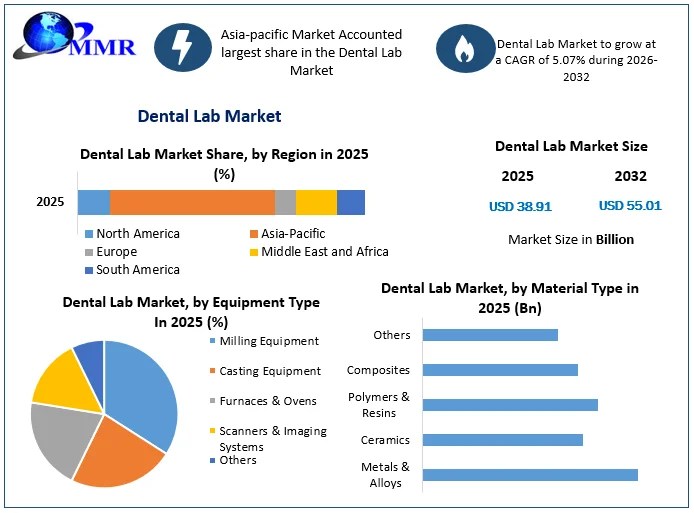
- Dental Lab Market stood at USD 38.91 billion in 2025.
- Market value is forecast to reach USD 55.01 billion by 2032.
- CAGR is projected at 5.07% during 2026–2032.
- Asia Pacific accounted for the largest market share in 2025.
- Digital dentistry and CAD/CAM workflows are redefining laboratory productivity.
- Rising cosmetic dentistry demand is expanding high-value restoration services.
- Aging populations continue to increase demand for prosthetics, implants, and restorative treatments.
- Strategic acquisitions and AI-enabled workflow innovations are accelerating competitive differentiation.
Why This Matters Now
Dental laboratories are becoming technology-driven manufacturing centers rather than traditional production facilities. Automation, artificial intelligence, digital scanning, and additive manufacturing are reducing turnaround times while improving restoration accuracy. At the same time, demographic shifts and increasing aesthetic awareness are expanding patient volumes. Laboratories capable of integrating digital workflows, advanced materials, and scalable production are positioned to capture a larger share of future demand as dental practices increasingly outsource specialized restorative work.
Market Overview
The Dental Lab Market includes laboratories producing crowns, bridges, dentures, orthodontic appliances, implants, veneers, and customized dental restorations for clinics and hospitals. Growth is supported by rising oral disease prevalence, increasing tooth loss among aging populations, and stronger consumer spending on cosmetic dentistry.
The market is experiencing structural transformation through digital dentistry. Traditional manual fabrication is steadily giving way to CAD/CAM systems, intraoral scanning, virtual treatment planning, and 3D printing. These technologies reduce production errors, shorten delivery cycles, and enable laboratories to manufacture highly customized restorations at scale.
Demand fundamentals remain favorable. Growing elderly populations require more restorative procedures, while younger consumers increasingly seek cosmetic improvements including veneers, aligners, and implant-supported restorations. Simultaneously, dental tourism and outsourcing are strengthening regional laboratory networks, particularly across Asia Pacific.
The supply side is also evolving. Laboratories investing in digital equipment, premium ceramic materials, and automated manufacturing are improving operational efficiency while responding to increasing demand for precision and consistency.
Key Trends Driving Growth
Digital workflow integration represents the industry’s most significant transformation. CAD/CAM platforms, AI-assisted treatment planning, virtual simulations, and automated design software reduce manual intervention while improving manufacturing accuracy. These technologies allow laboratories to process larger case volumes without proportionally increasing labor costs.
Artificial intelligence is beginning to automate margin detection, bite alignment, and bridge design, helping laboratories reduce production time and improve consistency. The commercial introduction of AI-enabled dental systems reflects increasing software integration across laboratory operations.
Demand for cosmetic dentistry continues to reshape product portfolios. Greater awareness of dental aesthetics through social media and celebrity influence is increasing demand for veneers, orthodontic aligners, and premium ceramic restorations. Laboratories offering customized aesthetic solutions benefit from higher-value cases.
Sustainability is emerging as an operational priority. Laboratories are evaluating environmentally responsible materials and manufacturing practices that reduce production waste while improving material utilization, particularly in ceramic and resin processing.
Advanced ceramic production is also expanding. Higher investment in zirconia manufacturing and premium restorative materials supports growing demand for durable, aesthetically superior restorations that closely replicate natural teeth.
Explore detailed analysis, insights, and growth opportunities
Segment Insights
Dominant Segment: Dental Prosthetics
Dental prosthetics remain the largest product category because restorative procedures continue to represent the highest treatment volume globally. Crowns, bridges, and dentures address widespread tooth loss associated with aging populations and periodontal disease.
For laboratories, prosthetics generate stable, recurring demand from general dentistry while creating opportunities to differentiate through premium ceramic materials, digital manufacturing, and customized aesthetic solutions. This segment benefits directly from increased restorative procedures and continuous improvements in fabrication technology.
Fastest-Growing Segment: CAD/CAM Systems and 3D Printing Solutions
Digital production technologies are expanding faster than conventional manufacturing methods. CAD/CAM systems simplify restoration design while reducing production errors and shortening delivery timelines. Three-dimensional printing further enhances laboratory efficiency by enabling rapid production of customized models, surgical guides, orthodontic appliances, and temporary restorations.
Business impact extends beyond productivity gains. Digital workflows improve laboratory scalability, reduce material waste, and strengthen relationships with dental clinics seeking faster treatment completion.
Additional Segment Insights
Dental implants continue gaining momentum as patients increasingly prefer permanent tooth replacement over removable prosthetics. Advances in implantology and digital planning improve clinical outcomes while expanding laboratory service opportunities.
Orthodontics is benefiting from rising consumer preference for clear aligners and aesthetic treatments. Increased adult orthodontic adoption creates sustained demand for customized appliances produced through digital manufacturing.
From a materials perspective, ceramics remain central to premium restorations because they combine durability with natural aesthetics. Metals and alloys continue to support implant frameworks and structural applications requiring high strength and biocompatibility. Meanwhile, polymers, resins, and composite materials are becoming increasingly important as digital manufacturing technologies expand.
Regional Growth Story
Asia Pacific leads the global Dental Lab Market, accounting for 35.20% of market share in 2025. Regional leadership reflects strong dental tourism, expanding laboratory infrastructure, growing outsourcing activity, and rapid adoption of digital manufacturing technologies. Rising elderly populations further increase restorative treatment demand, strengthening long-term market fundamentals.
North America remains an innovation-driven market where advanced digital technologies, premium restorative procedures, and continuous product launches support laboratory modernization. Investment in AI-enabled workflows and FDA-cleared implant solutions reinforces technology leadership.
Europe continues to benefit from established dental manufacturing capabilities and strong expertise in premium restorative materials. Companies across Germany, Switzerland, Austria, and Finland maintain competitive advantages through innovation in ceramics, CAD/CAM technologies, and precision manufacturing.
Emerging markets across Latin America, the Middle East, and Africa present gradual expansion opportunities as healthcare access improves and awareness of restorative dentistry increases. Growth remains closely linked to investments in dental infrastructure and laboratory modernization.
Competitive Landscape
Competition increasingly centers on digital capability rather than production scale alone. Leading manufacturers are strengthening competitive positioning through software innovation, advanced materials, acquisitions, and manufacturing expansion.
Technology providers such as 3Shape are embedding artificial intelligence into laboratory workflows, enabling automation that reduces manual processing while improving consistency. Material specialists including Ivoclar Vivadent and Kuraray Noritake Dental are expanding premium ceramic portfolios and production capacity to meet increasing demand for high-performance restorations.
Strategic partnerships are improving interoperability between milling systems and restorative materials, reducing barriers to digital adoption. Meanwhile, acquisitions such as SprintRay’s integration of EnvisionTEC’s dental portfolio demonstrate ongoing consolidation within dental 3D printing, allowing companies to expand intellectual property, manufacturing capabilities, and customer reach.
The competitive landscape increasingly rewards organizations capable of integrating software, materials, and manufacturing into comprehensive digital ecosystems rather than competing solely on laboratory capacity.
Recent Developments
- May 2026: ROE Dental Laboratory commercially launched the FDA-cleared Passivity Plus titanium coping for full-arch implant restorations, reducing mechanical complications in implant-supported prosthetics.
- February 2026: 3Shape introduced Dental System 2025 featuring AI-powered bite alignment, automated margin detection, and bridge design automation to improve laboratory productivity.
- October 2025: Ivoclar Vivadent launched IPS e.max Ceram Art, expanding premium restoration customization through ready-to-use stain, glaze, and structure pastes.
- October 2025: Ivoclar and vhf camfacture AG expanded technical validation, allowing specialized IPS e.max CAD materials to be processed on vhf milling platforms.
- September 2025: SprintRay acquired EnvisionTEC’s dental product portfolio, significantly expanding its dental 3D printing technologies and intellectual property assets.
- June 2025: Kuraray Noritake Dental announced production capacity expansion for advanced ceramic materials at its Miyoshi manufacturing facility to support growing global laboratory demand.
Future Outlook
According to analyst perspective by Komal Patil, laboratories that combine AI-enabled digital workflows, advanced restorative materials, and scalable automated production will capture the greatest competitive advantage as restorative and cosmetic dentistry become increasingly technology-driven worldwide.
Analyst Perspective – Komal Patil
According to Komal Patil, the Dental Lab Market is entering a technology-led transformation where competitive advantage will increasingly depend on digital manufacturing capabilities rather than production capacity alone. The convergence of CAD/CAM systems, artificial intelligence, and 3D printing is enabling laboratories to deliver faster turnaround times, greater precision, and highly customized restorations while improving operational efficiency.
About Maximize Market Research
Maximize Market Research Pvt. Ltd. (MMR) is a global market research and consulting company that provides reliable, data-focused, and practical business insights. The firm serves a wide range of industries, including healthcare, pharmaceuticals, technology, automotive, electronics, chemicals, personal care, and consumer goods. Through market forecasts, competitive analysis, strategic consulting, and industry impact assessments, MMR helps organizations understand changing market conditions, identify growth opportunities, and make informed business decisions for long-term success.
Contact Us :
2nd Floor, Navale IT Park Phase 3
Pune Banglore Highway, Narhe
Pune, Maharashtra 411041, India
+91 9607365656
sales@maximizemarketresearch.com
