Key Highlights
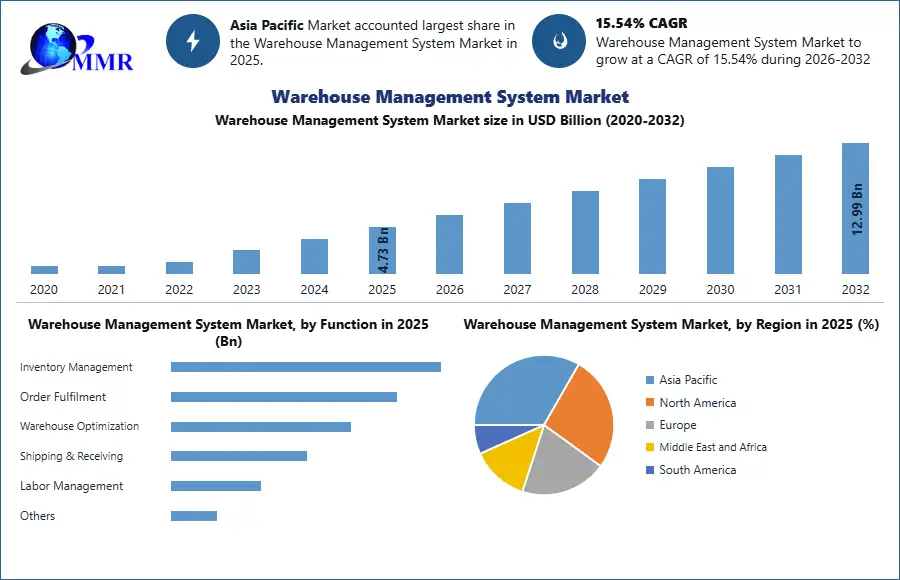
- Warehouse Management System Market valued at US$ 4.73 Bn in 2025
- Expected to reach US$ 12.99 Bn by 2032
- Forecast CAGR of 15.54%
- Cloud deployment continues reshaping enterprise warehouse operations
- AI-driven automation improves inventory accuracy and fulfillment efficiency
- Asia Pacific expected to hold the largest market share by 2032
- Growing enterprise investments in digital supply chains support long-term demand
Why This Matters Now
Warehouses have shifted from cost centers to strategic technology hubs. AI, cloud computing, automation, and real-time inventory intelligence are becoming essential as companies seek faster deliveries, resilient supply chains, and higher operational efficiency.
The Warehouse Management System Market Size, valued at US$ 4.73 billion in 2025, is projected to reach US$ 12.99 billion by 2032, growing at a 15.54% CAGR. That growth signals more than software spending—it reflects a structural transformation in how global enterprises manage inventory, labor, fulfillment, and customer expectations.
Market Overview
Digital commerce, omnichannel retail, manufacturing modernization, and increasingly complex supply chains are forcing enterprises to rethink warehouse operations. Traditional inventory systems no longer provide the visibility, scalability, or automation required to support modern distribution networks.
Warehouse management platforms now integrate inventory control, labor optimization, transportation coordination, analytics, and real-time decision-making into a unified software ecosystem. The market increasingly aligns with broader enterprise digital transformation initiatives, enabling organizations to improve productivity while reducing operational costs.
For CIOs and supply chain executives, warehouse software has become a strategic platform rather than an operational tool.
Key Trends Driving Growth
Artificial intelligence is becoming central to warehouse operations. AI-powered forecasting, intelligent slotting, predictive inventory management, and automated workflow optimization help organizations reduce fulfillment delays while improving warehouse productivity.
Cloud migration continues to reshape enterprise software deployment. Cloud-based warehouse management systems provide faster implementation, lower infrastructure costs, continuous software updates, and greater scalability for businesses operating across multiple facilities.
Automation investments are also accelerating. Organizations increasingly combine warehouse management software with robotics, automated storage systems, barcode technologies, IoT sensors, and real-time analytics to build highly responsive fulfillment centers.
Enterprise software modernization remains another major growth driver. Companies are integrating warehouse management platforms with ERP, transportation management systems, procurement software, and customer relationship management platforms to create connected supply chain ecosystems.
The continued expansion of e-commerce increases demand for rapid order fulfillment, inventory visibility, and flexible warehouse operations capable of managing seasonal demand fluctuations without sacrificing efficiency.
Access a Detailed Sample Report with Industry Analysis
Segment Insights
- Dominant Segment: The market is segmented by offering, deployment, function, end-user industry, and region.
- Fastest-Growing Segment: The report identifies segmentation across these categories, while specific fastest-growing segment details are not disclosed.
- Cloud deployment continues supporting enterprise software modernization through scalable SaaS models.
- Retail, manufacturing, logistics, and third-party logistics providers remain significant enterprise adopters.
- Integrated warehouse analytics improve operational visibility and inventory optimization.
- AI-enabled automation strengthens labor productivity and warehouse accuracy.
Regional Growth Story
Asia Pacific is expected to hold the largest market share by 2032. The region continues investing aggressively in manufacturing capacity, logistics infrastructure, digital commerce, and warehouse modernization.
China remains a major contributor through advanced manufacturing and large-scale logistics automation. India’s rapidly expanding e-commerce ecosystem continues encouraging investments in intelligent warehouse technologies to improve fulfillment efficiency.
Japan and South Korea maintain leadership in warehouse robotics and industrial automation, supporting adoption of sophisticated warehouse management solutions integrated with automated equipment.
North America continues investing heavily in cloud migration, AI-enabled supply chain software, and warehouse digitalization. The United States remains an important innovation center where enterprises prioritize software-driven productivity improvements and resilient supply chain operations.
Across Europe, Germany and the United Kingdom continue strengthening logistics modernization through enterprise software upgrades, industrial automation, and digital supply chain initiatives designed to improve competitiveness.
Competitive Landscape
Competition increasingly centers on software ecosystems rather than standalone warehouse applications. Vendors are expanding beyond inventory management by integrating artificial intelligence, cloud infrastructure, automation platforms, predictive analytics, and enterprise integration capabilities.
Major companies including Epicor Software, JDA Software, Infor, Manhattan Associates, IBM, SAP, PSI, PTC, Tecsys, Blujay Solutions, HighJump, 3PL Central, Snapfulfil, Synergy Ltd., Produmex, ERCIM, and Indigo Software compete by strengthening platform capabilities instead of competing solely on pricing.
Cloud-native architectures improve customer retention through continuous software updates and subscription-based business models. AI capabilities increasingly differentiate vendors by enabling predictive inventory planning, intelligent labor management, and operational optimization.
Partnerships with robotics providers, logistics technology firms, ERP vendors, and cloud service providers are expanding platform ecosystems. This signals a market evolving toward integrated digital supply chain platforms where interoperability becomes a critical competitive advantage.
As enterprise customers seek end-to-end visibility, software vendors capable of delivering unified warehouse, transportation, inventory, and analytics solutions are likely to strengthen their market positions.
Recent Developments
- Growing enterprise migration toward cloud-based warehouse management platforms.
- Increasing adoption of AI-powered inventory optimization and warehouse analytics.
- Rising investment in warehouse automation technologies integrated with WMS platforms.
- Expansion of enterprise digital transformation initiatives supporting software modernization.
- Strong demand from e-commerce and logistics operators for intelligent fulfillment capabilities.
- Continued platform integration with ERP and broader supply chain software ecosystems.
Strategic Implications
For enterprise leaders, warehouse technology has become a competitive differentiator rather than a back-office investment. Organizations implementing AI-enabled warehouse management systems gain improved inventory visibility, higher labor productivity, faster fulfillment, and stronger customer satisfaction.
Software vendors have an opportunity to expand recurring SaaS revenues through cloud-native platforms that integrate analytics, automation, and enterprise applications. Investors should monitor companies building complete supply chain ecosystems rather than standalone warehouse products, as integrated platforms increasingly command stronger long-term customer relationships.
For technology providers, interoperability, cybersecurity resilience, API connectivity, and AI capabilities will increasingly determine enterprise purchasing decisions.
Future Outlook
The next phase of warehouse transformation will combine artificial intelligence, cloud-native software, automation platforms, and connected enterprise ecosystems into intelligent fulfillment networks capable of making real-time operational decisions. Organizations that build AI-driven digital warehouses will define the next generation of supply chain leadership, while those delaying modernization risk falling behind as software intelligence becomes the primary source of operational advantage.
Analyst Perspective
“Warehouse management systems are evolving into intelligent operational platforms that combine cloud computing, automation, and enterprise integration to improve supply chain performance. As organizations continue investing in digital transformation, warehouse software will become increasingly central to enterprise competitiveness.” — Yash Ghosalkar, Analyst
About Maximize Market Research
Maximize Market Research Pvt. Ltd. (MMR) is a global market research and consulting company that provides reliable, data-focused, and practical business insights. The firm serves a wide range of industries, including healthcare, pharmaceuticals, technology, automotive, electronics, chemicals, personal care, and consumer goods. Through market forecasts, competitive analysis, strategic consulting, and industry impact assessments, MMR helps organizations understand changing market conditions, identify growth opportunities, and make informed business decisions for long-term success.
Contact Us
2nd Floor, Navale IT Park Phase 3
Pune Banglore Highway, Narhe
Pune, Maharashtra 411041, India
+91 9607365656
sales@maximizemarketresearch.com
