Key Highlights
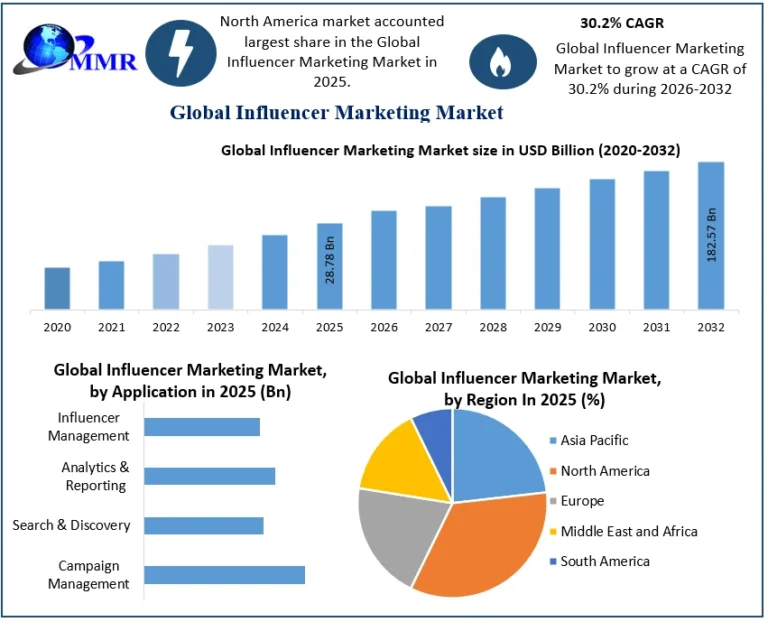
- The Influencer Marketing Market was valued at USD 28.78 Billion in 2025.
- The market is expected to reach USD 182.57 Billion by 2032.
- Revenue is projected to grow at a 30.2% CAGR during 2025–2032.
- Artificial intelligence is transforming creator discovery, campaign optimization, and audience analytics.
- Social commerce and short-form video continue to redefine digital customer acquisition strategies.
- Enterprise adoption is expanding beyond consumer brands into technology, finance, healthcare, and B2B industries.
Why This Matters Now
Marketing budgets are shifting faster than media strategies can adapt. Artificial intelligence, creator-led commerce, and platform-driven consumer engagement are changing how enterprises acquire customers, measure return on investment, and compete for digital attention.
For technology leaders, advertisers, software providers, and investors, influencer marketing has evolved from a branding experiment into a scalable digital business platform. Organizations that combine AI-powered analytics with creator ecosystems are building measurable customer engagement while reducing dependence on traditional advertising channels.
Market Overview
The Influencer Marketing Market Size reached USD 28.78 Billion in 2025 and is forecast to expand to USD 182.57 Billion by 2032, growing at a CAGR of 30.2%. The scale of this expansion signals more than advertising growth. It reflects a structural shift toward creator-led digital commerce, automated campaign management, and data-driven customer engagement.
Artificial intelligence has become central to this transformation. Enterprises increasingly rely on AI-powered platforms to identify creators, predict campaign performance, detect fraudulent engagement, personalize audience targeting, and optimize marketing spending. These capabilities are turning influencer marketing into a measurable performance channel rather than a brand-awareness initiative.
The market is also benefiting from digital transformation across industries. Enterprises are integrating influencer platforms into broader marketing technology stacks alongside customer relationship management systems, marketing automation platforms, analytics tools, and e-commerce ecosystems. This integration improves campaign visibility while supporting faster business decisions.
Key Trends Driving Growth
Artificial intelligence is becoming the operational backbone of influencer marketing. Machine learning models evaluate creator authenticity, audience demographics, engagement quality, and campaign effectiveness in real time. Generative AI is further accelerating content creation while enabling brands to scale campaigns across multiple digital channels.
Social commerce continues to strengthen the commercial value of creator partnerships. Consumers increasingly discover, evaluate, and purchase products directly through social media platforms, reducing the distance between marketing exposure and transaction completion. This convergence is encouraging enterprises to allocate larger portions of digital advertising budgets to creator-driven campaigns.
Marketing automation is another major growth driver. Cloud-based influencer platforms simplify campaign management, contract administration, performance reporting, compliance monitoring, and payment workflows. SaaS deployment models enable organizations of all sizes to execute global campaigns with greater operational efficiency.
Data analytics is becoming equally important. Enterprises demand measurable business outcomes, including customer acquisition costs, conversion rates, lifetime value, and return on advertising investment. AI-powered dashboards are replacing traditional engagement metrics with business-focused performance indicators that support executive decision-making.
Growing regulatory attention around advertising transparency is also reshaping the market. Brands are investing in compliance tools that improve disclosure management, campaign governance, and creator accountability, strengthening trust across digital ecosystems.
Request a Sample Report for Strategic Business Intelligence
Segment Insights
- Dominant Segment: The report identifies the leading market segment as the primary revenue contributor, reflecting broad enterprise adoption and mature commercial deployment across digital marketing strategies.
- Fastest-Growing Segment: The report highlights the fastest-growing segment as benefiting from increasing AI integration, evolving consumer engagement models, and expanding digital platform adoption.
- AI-enabled campaign management platforms are improving campaign precision through automated creator discovery, audience segmentation, and predictive performance analysis.
- Enterprise adoption is expanding as organizations integrate influencer marketing into broader digital transformation and customer experience initiatives.
- Social commerce continues to increase the commercial effectiveness of influencer campaigns by shortening the customer purchase journey.
Regional Growth Story
North America maintains a leading position due to advanced digital advertising ecosystems, widespread enterprise technology adoption, mature creator economies, and significant investments in marketing technology. Large brands continue integrating AI, automation, and analytics into customer engagement strategies, strengthening the region’s competitive advantage.
Asia-Pacific represents one of the most dynamic opportunities as digital consumption, mobile-first commerce, and creator ecosystems continue expanding. Countries including China and India are experiencing strong adoption driven by large digital populations, increasing social commerce activity, and rapid growth in online consumer spending.
Europe is emphasizing responsible digital advertising through evolving regulatory frameworks and greater transparency requirements. Technology investments in Germany and the United Kingdom continue supporting enterprise adoption of AI-enabled marketing platforms.
Japan and South Korea remain important innovation centers, combining advanced digital infrastructure with highly engaged social media audiences. These markets continue influencing platform innovation, creator monetization strategies, and digital content development.
Competitive Landscape
Competition is moving beyond influencer databases toward intelligent marketing ecosystems. Technology providers are investing in artificial intelligence, automation, advanced analytics, and platform integration to differentiate their offerings.
The industry’s competitive direction signals a broader shift toward platform economics. Companies that combine creator management, campaign automation, commerce integration, customer analytics, and AI capabilities are building comprehensive marketing ecosystems rather than standalone advertising tools.
Platform expansion also strengthens pricing power. As enterprises seek integrated software environments instead of fragmented marketing solutions, vendors offering scalable SaaS platforms gain stronger customer retention and recurring revenue opportunities.
The market is also witnessing greater emphasis on fraud detection, campaign transparency, measurement accuracy, and regulatory compliance. These capabilities are becoming strategic differentiators as enterprise customers prioritize trusted digital partnerships and measurable business outcomes.
Competition increasingly centers on ecosystem leadership rather than individual campaign execution. Vendors capable of connecting brands, creators, commerce platforms, analytics providers, and enterprise software systems are likely to shape the next phase of market development.
Recent Developments
- AI-powered creator discovery continues improving campaign targeting and operational efficiency.
- Marketing platforms are expanding automation capabilities across campaign management workflows.
- Social commerce integration is strengthening direct purchasing experiences.
- Advanced analytics solutions are delivering deeper campaign performance measurement.
- Enterprise software integration is improving marketing technology interoperability.
- Greater investment in transparency and compliance tools is enhancing advertiser confidence.
Strategic Implications
For enterprise technology leaders, influencer marketing is becoming a strategic business capability rather than a standalone advertising function. AI-driven campaign optimization, cloud-based marketing platforms, and advanced analytics improve marketing productivity while supporting measurable revenue generation.
Software providers have opportunities to expand platform capabilities through automation, API integration, customer intelligence, and predictive analytics. Cloud-native SaaS models also create recurring revenue streams while simplifying enterprise deployment.
Investors should view the market through the broader lens of digital transformation. The convergence of artificial intelligence, creator economies, social commerce, and enterprise software creates long-term opportunities extending beyond advertising technology alone.
Technology vendors that successfully integrate influencer marketing into customer experience platforms, CRM systems, e-commerce infrastructure, and marketing automation ecosystems will be positioned to capture expanding enterprise demand.
Future Outlook
The next phase of the Influencer Marketing Market will be defined by intelligent automation, AI-generated insights, predictive audience engagement, and increasingly integrated digital commerce ecosystems. As enterprises prioritize measurable business outcomes, influencer platforms will become core components of enterprise marketing technology stacks rather than standalone promotional tools. The competitive advantage will belong to organizations that combine artificial intelligence, creator ecosystems, and data-driven decision-making into unified digital growth platforms—while those relying on fragmented marketing approaches risk falling behind in an AI-first digital economy.
Analyst Perspective
“Artificial intelligence, advanced analytics, and the rapid evolution of creator ecosystems are fundamentally changing how enterprises approach customer engagement. Organizations that integrate influencer marketing into broader digital transformation strategies will be better positioned to achieve scalable, measurable, and long-term business growth.” — Yash Ghosalkar, Analyst
About Maximize Market Research
Maximize Market Research Pvt. Ltd. (MMR) is a global market research and consulting company that provides reliable, data-focused, and practical business insights. The firm serves a wide range of industries, including healthcare, pharmaceuticals, technology, automotive, electronics, chemicals, personal care, and consumer goods. Through market forecasts, competitive analysis, strategic consulting, and industry impact assessments, MMR helps organizations understand changing market conditions, identify growth opportunities, and make informed business decisions for long-term success.
Contact Us
2nd Floor, Navale IT Park Phase 3
Pune Banglore Highway, Narhe
Pune, Maharashtra 411041, India
+91 9607365656
sales@maximizemarketresearch.com
