The Saudi Arabia Coffee Market is undergoing a dynamic transformation as deep-rooted coffee traditions merge with modern café culture, premiumization, and ambitious economic reforms under Saudi Vision 2030. Coffee, long embedded in Saudi hospitality through traditional Arabic coffee (Gahwa), is now evolving into a high-growth consumer market driven by youth demographics, urbanization, and rising disposable incomes.
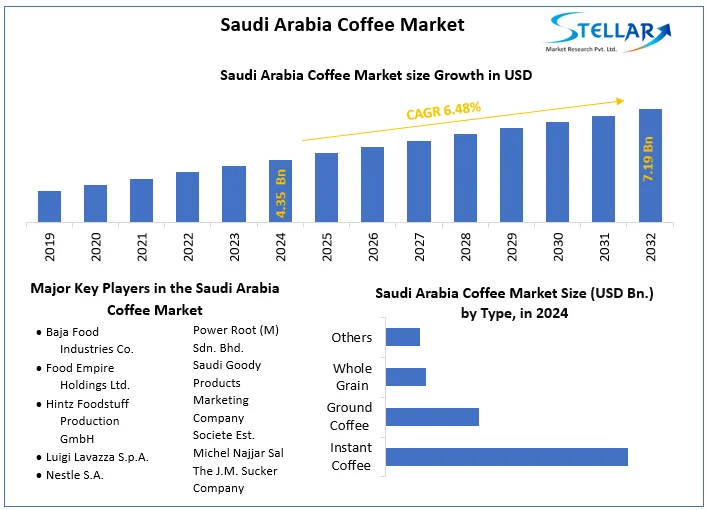
Saudi Arabia Coffee Market size was valued at US$ 4.35 Bn. in 2024. Coffee will encourage a great deal of transformation in Beverage Sector in Saudi Arabia.
As global coffee trends influence local consumption, Saudi Arabia is emerging as one of the most promising coffee markets in the Middle East, with strong growth across specialty coffee, ready-to-drink beverages, and café experiences.
A Market Bridging Heritage and Modern Consumption
Saudi Arabia’s coffee culture is unique, combining centuries-old traditions with modern consumer behavior. Traditional Arabic coffee continues to play a central role in social and cultural settings, while younger consumers are increasingly embracing espresso-based drinks, specialty brews, and international café formats.
Urban centers such as Riyadh and Jeddah are witnessing a surge in specialty cafés, artisanal roasters, and premium coffee brands. This dual consumption pattern—traditional and modern—is creating a diversified and resilient market structure.
The growing popularity of coffee as a social and lifestyle product is also driving demand for premium experiences, transforming cafés into key social hubs.
Key Market Insights
- Saudi Arabia is one of the fastest-growing coffee markets in the Middle East.
- Traditional Arabic coffee remains a strong cultural segment.
- Specialty coffee is the fastest-growing category, driven by urban youth.
- Café chains and independent coffee shops are expanding rapidly.
- Ready-to-drink (RTD) coffee is gaining traction among younger consumers.
- E-commerce and delivery platforms are enhancing accessibility.
- Sustainability and premium sourcing are emerging as key trends.
𝐃𝐨𝐰𝐧𝐥𝐨𝐚𝐝 𝐅𝐫𝐞𝐞 𝐏𝐃𝐅 𝐁𝐫𝐨𝐜𝐡𝐮𝐫𝐞: https://www.stellarmr.com/report/req_sample/Saudi-Arabia-Coffee-Market/78
Market Drivers Accelerating Growth
1. Vision 2030 and Economic Diversification
Government initiatives under Saudi Vision 2030 are promoting the growth of the food and beverage sector, including coffee retail and café culture.
2. Young and Urban Population
A large youth population with increasing exposure to global trends is driving demand for modern coffee experiences and premium products.
3. Expansion of Café Chains and Retail Networks
The rapid growth of international and local café brands is increasing accessibility and encouraging coffee consumption across urban areas.
Market Challenges and Restraints
1. High Dependence on Imports
Saudi Arabia relies heavily on imported coffee beans, making the market vulnerable to global supply chain disruptions and price fluctuations.
2. Intense Competition in Urban Markets
The rapid expansion of café chains has led to increased competition, particularly in major cities.
Technology and Sustainability Trends
Technology is playing a significant role in shaping the Saudi Arabia coffee market. Companies are leveraging mobile apps, digital payments, and delivery platforms to enhance customer convenience and engagement.
Sustainability is also gaining importance, with increasing focus on ethical sourcing, eco-friendly packaging, and responsible consumption. Consumers are becoming more conscious of the environmental and social impact of their purchases.
Additionally, traceability and transparency are emerging as key differentiators, particularly in the specialty coffee segment.
𝐃𝐨𝐰𝐧𝐥𝐨𝐚𝐝 𝐅𝐫𝐞𝐞 𝐏𝐃𝐅 𝐁𝐫𝐨𝐜𝐡𝐮𝐫𝐞: https://www.stellarmr.com/report/req_sample/Saudi-Arabia-Coffee-Market/78
Regional Insights: Riyadh and Jeddah Lead Growth
Riyadh and Jeddah are the primary hubs of coffee consumption and innovation in Saudi Arabia. These cities have a high concentration of cafés, strong consumer demand, and a growing culture of specialty coffee.
Other cities, including Dammam and Khobar, are also witnessing increased adoption, supported by urban development and rising disposable incomes.
The expansion into smaller cities presents significant growth opportunities for coffee brands.
Recent Industry Developments
- Starbucks (2025): Continued expansion in Saudi Arabia, opening new outlets and enhancing premium café experiences.
- Nestlé (2024): Introduced new coffee variants tailored to Middle Eastern taste preferences.
- Almarai (2025): Entered the ready-to-drink coffee segment, diversifying its product portfolio.
- Saudi Coffee Company (2024): Invested in local coffee production and supply chain development to reduce import dependency.
- Ministry of Environment, Water and Agriculture (2025): Launched initiatives to support domestic coffee cultivation in the Jazan region.
Competitive Landscape
The Saudi Arabia coffee market is highly competitive, with a mix of multinational corporations, regional players, and local specialty brands. Companies are focusing on premiumization, brand differentiation, and customer experience to capture market share.
International chains are expanding aggressively, while local brands are gaining traction by offering culturally relevant products and unique café experiences. Strategic partnerships, digital platforms, and product innovation are key competitive strategies.
Analyst Perspective
A senior market analyst notes:
“Saudi Arabia’s coffee market represents a compelling blend of tradition and modernity. The rapid rise of specialty coffee, supported by Vision 2030 initiatives, is creating a vibrant and competitive landscape with strong long-term growth potential.”
Future Outlook
The Saudi Arabia Coffee Market is expected to witness robust growth in the coming years, driven by increasing consumer demand, government support, and expansion of café culture. Premiumization, digital transformation, and sustainability will continue to shape the market’s evolution.
The market is also likely to see innovation in product formats, including ready-to-drink coffee and functional beverages. As competition intensifies, companies will need to focus on quality, affordability, and customer experience to succeed.
Overall, Saudi Arabia is poised to become a key growth engine in the Middle East coffee market, offering significant opportunities for global and regional players.
