Key Highlights
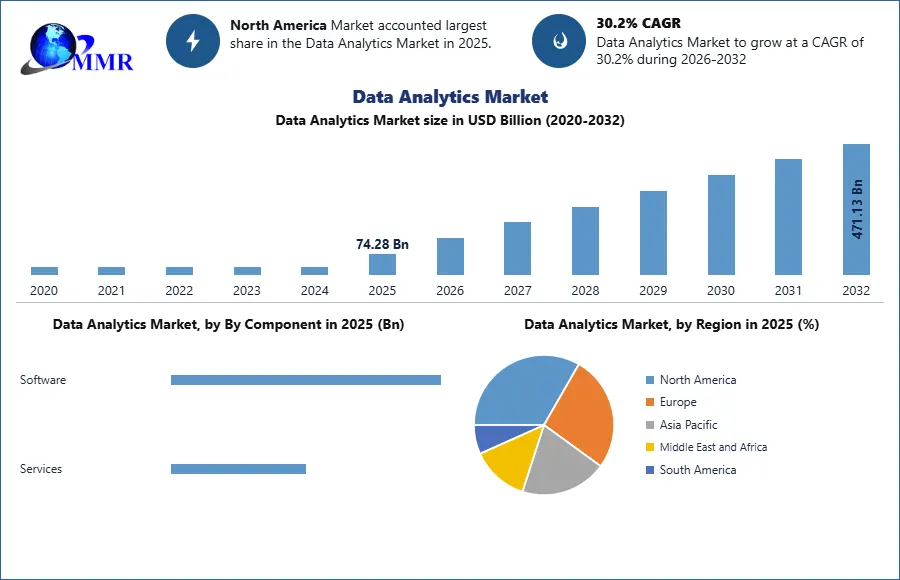
- Data Analytics Market size was valued at USD 74.28 Billion in 2025.
- The market is projected to reach USD 471.13 Billion by 2032 at a 30.2% CAGR.
- Artificial intelligence and machine learning are reshaping enterprise analytics strategies.
- Cloud deployment continues to accelerate enterprise modernization.
- Predictive analytics remains a major investment priority for organizations.
- BFSI, healthcare, government, and IT & telecom continue expanding analytics adoption.
- North America maintains market leadership through strong technology investments.
Why This Matters Now
Artificial intelligence has shifted from experimentation to enterprise infrastructure. Organizations are no longer collecting data simply for reporting—they are turning it into competitive intelligence that improves operations, customer engagement, cybersecurity, and investment decisions.
The Data Analytics Market, valued at USD 74.28 Billion in 2025 and expected to reach USD 471.13 Billion by 2032, signals that analytics has become a strategic technology investment rather than a support function. The rapid expansion reflects how enterprises are embedding analytics into every business process, from supply chain optimization to customer experience and financial planning.
Market Overview
The Data Analytics Market every enterprise is becoming a data-driven enterprise. Business leaders increasingly rely on analytics platforms to transform massive volumes of structured and unstructured information into real-time insights that improve decision-making.
Growing investments in artificial intelligence, cloud computing, enterprise software modernization, and digital transformation continue to reshape the competitive landscape. Organizations are moving beyond historical reporting toward predictive and prescriptive analytics capable of identifying opportunities before competitors react.
Cloud-native analytics platforms are reducing deployment complexity while making advanced capabilities available to organizations of every size. As businesses pursue automation and operational efficiency, analytics is evolving into a core enterprise capability rather than an optional technology investment.
Key Trends Driving Growth
Artificial intelligence has become the defining force behind modern analytics platforms. Machine learning models automate data preparation, identify hidden patterns, and generate predictive insights with greater speed and accuracy than traditional analytical methods.
Cloud migration is equally transformative. Enterprises increasingly prefer cloud-based analytics because of scalability, faster implementation, and seamless integration with SaaS applications. Hybrid cloud environments also enable organizations to balance flexibility with regulatory compliance.
Automation is changing how business intelligence operates. Modern analytics solutions reduce manual reporting while enabling executives to monitor business performance through real-time dashboards.
Cybersecurity requirements are also influencing analytics investments. Organizations require stronger governance, data quality management, and compliance capabilities as data volumes continue to expand.
The convergence of AI, cloud computing, and automation is creating analytics platforms that deliver continuous business intelligence instead of periodic reporting.
Segment Insights
- Dominant Segment: Predictive Analytics remains the leading analytics type as enterprises increasingly invest in forecasting capabilities to improve strategic planning, operational efficiency, and customer engagement.
- Fastest-Growing Segment: Cloud Deployment continues to expand rapidly as organizations accelerate digital transformation and seek scalable, flexible analytics infrastructure.
- Large enterprises continue driving significant adoption due to complex operational requirements and extensive digital transformation initiatives.
- Small and medium enterprises are increasingly adopting cloud-based analytics solutions because lower implementation costs improve accessibility.
- BFSI, healthcare, government, and IT & telecommunications remain major end-user industries where analytics supports risk management, customer intelligence, operational efficiency, and regulatory compliance.
Regional Growth Story
North America continues leading the Data Analytics Market through substantial investments in artificial intelligence, enterprise software, cloud computing, and digital infrastructure. Technology companies and large enterprises continue expanding analytics capabilities to improve competitiveness across multiple industries.
Asia-Pacific represents one of the most dynamic opportunities as digital transformation accelerates across China, India, Japan, and South Korea. Enterprises increasingly adopt cloud analytics while governments invest in digital infrastructure supporting data-driven economic growth.
Europe continues emphasizing responsible AI adoption, data governance, and regulatory compliance. Organizations across Germany and the United Kingdom increasingly integrate analytics into manufacturing, financial services, and public-sector modernization.
Emerging markets continue expanding enterprise software adoption as organizations pursue operational efficiency, automation, and digital competitiveness.
Competitive Landscape
Competition increasingly centers on platform ecosystems rather than standalone analytics software. Leading vendors are integrating artificial intelligence, automation, cloud services, and advanced visualization into unified enterprise platforms that simplify complex data environments.
Major companies including Google, Microsoft, IBM, Oracle, SAP, SAS, Tableau, Qlik, and Alteryx continue strengthening AI-powered analytics capabilities to improve enterprise decision-making. Their investments indicate that competitive differentiation increasingly depends on integrated cloud ecosystems, embedded machine learning, and seamless enterprise application connectivity rather than individual analytical features.
Platform consolidation also reflects changing customer priorities. Enterprises increasingly prefer comprehensive analytics environments capable of supporting governance, automation, predictive intelligence, and cross-functional collaboration from a single technology stack.
Recent Developments
- AI-powered analytics capabilities continue expanding across enterprise software portfolios.
- Cloud-based deployment models are becoming the preferred implementation strategy.
- Machine learning integration is improving predictive and prescriptive analytics.
- Organizations continue investing in automated business intelligence workflows.
- Enterprise demand for scalable analytics platforms continues increasing alongside digital transformation initiatives.
Strategic Implications
For CIOs, analytics has become foundational enterprise infrastructure. Investments increasingly focus on platforms that combine AI, cloud scalability, automation, and governance into unified environments supporting faster business decisions.
Technology vendors face growing pressure to simplify implementation while expanding AI capabilities. Enterprises increasingly evaluate analytics platforms based on integration, security, automation, and long-term scalability rather than visualization features alone.
Investors are likely to monitor companies capable of combining analytics with artificial intelligence, cloud ecosystems, and enterprise automation because these technologies increasingly reinforce one another across digital transformation initiatives.
For telecom operators, analytics enables network optimization, customer experience enhancement, predictive maintenance, and operational efficiency as next-generation connectivity expands.
Future Outlook
The next phase of the Data Analytics Market will be defined by autonomous analytics, generative AI, real-time decision intelligence, and cloud-native enterprise platforms that continuously optimize business operations. Organizations that successfully integrate analytics into every operational workflow will establish lasting competitive advantages, while those delaying AI-driven transformation risk falling behind as intelligent decision-making becomes the defining capability of digital leadership.
Analyst Perspective
“Data analytics is rapidly evolving from a reporting function into the intelligence engine that powers enterprise AI, automation, and digital transformation. Organizations investing early in integrated analytics platforms will be better positioned to compete in an increasingly data-driven global economy.” — Yash Ghosalkar
About Maximize Market Research
Maximize Market Research Pvt. Ltd. (MMR) is a global market research and consulting company that provides reliable, data-focused, and practical business insights. The firm serves a wide range of industries, including healthcare, pharmaceuticals, technology, automotive, electronics, chemicals, personal care, and consumer goods. Through market forecasts, competitive analysis, strategic consulting, and industry impact assessments, MMR helps organizations understand changing market conditions, identify growth opportunities, and make informed business decisions for long-term success.
2nd Floor, Navale IT Park Phase 3
Pune Banglore Highway, Narhe
Pune, Maharashtra 411041, India
+91 9607365656
sales@maximizemarketresearch.com
