Key Highlights
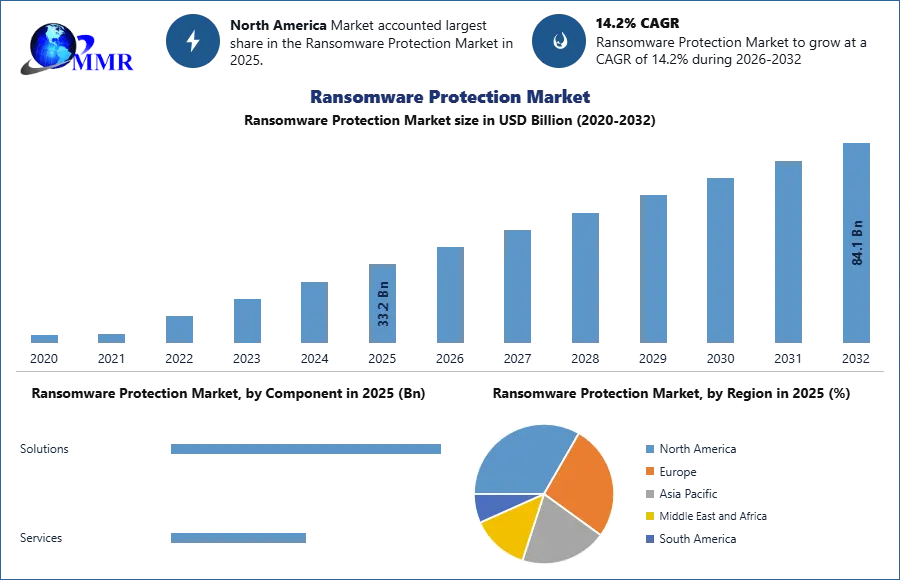
- Market size: USD 33.2 Bn in 2025, signaling accelerated enterprise cybersecurity spending amid rising ransomware intensity
- Forecast value: USD 84.1 Bn by 2032, reflecting sustained enterprise shift toward AI-powered security architectures
- CAGR: 14.2% (2026–2032), driven by cloud migration and hybrid infrastructure expansion
- Demand surge linked to enterprise digital transformation, remote operations, and API-driven ecosystems
- Increasing integration of AI and machine learning in ransomware detection and automated response systems
- Rising adoption across banking, telecom, healthcare, and government digital infrastructure
Why This Matters Now
Ransomware has shifted from isolated attacks to industrial-scale disruption targeting cloud workloads, telecom networks, and enterprise APIs. Security breaches now translate into operational shutdowns rather than data loss alone. Enterprises are re-architecting security layers to protect distributed infrastructure built on hybrid cloud and edge computing.
The USD 33.2 Bn valuation in 2025 signals a structural reset in cybersecurity budgets, not incremental spending. Organizations are no longer treating ransomware protection as an IT function but as a core business continuity mandate.
Market Overview
The Ransomware Protection Market is entering a phase of structural expansion driven by escalating cyber threats and enterprise modernization. According to the referenced research, the market is valued at USD 33.2 Bn in 2025 and is projected to reach USD 84.1 Bn by 2032, expanding at a CAGR of 14.2%.
This growth reflects a shift in enterprise architecture. Cloud-first deployments, API-based services, and remote workforce models have expanded the attack surface across industries. Telecom operators, cloud providers, and large enterprises are increasingly investing in layered security systems that combine endpoint protection, behavioral analytics, and real-time threat intelligence.
Security is converging with digital infrastructure. Ransomware protection is no longer a standalone toolset but an embedded layer across data centers, edge nodes, and SaaS platforms.
Key Trends Driving Growth
Artificial intelligence is redefining ransomware detection by enabling predictive threat identification and automated containment. Security systems are shifting from signature-based models to behavioral analytics powered by machine learning.
Cloud migration is another structural driver. As enterprises move workloads to hybrid and multi-cloud environments, security responsibility is distributed across platforms. This fragmentation increases demand for centralized ransomware protection platforms.
Telecom modernization and 5G deployment are expanding attack surfaces across network cores and edge nodes. Network virtualization and software-defined infrastructure require continuous security validation.
Zero trust architecture adoption is accelerating. Enterprises are enforcing identity-first access controls to reduce lateral movement during ransomware attacks.
Automation is reshaping incident response. Security orchestration platforms are reducing response times from hours to seconds, limiting operational downtime.
Segment Insights
- Dominant Segment: Not specified in the supplied MMR report source
- Fastest-Growing Segment: Not specified in the supplied MMR report source
Despite limited segmentation disclosure in the source material, enterprise demand is clearly concentrated around integrated ransomware protection suites that combine endpoint security, cloud workload protection, and network threat analytics. Growth is increasingly tied to platform-based cybersecurity ecosystems rather than standalone tools.
Regional Growth Story
North America leads enterprise adoption due to early cloud migration, high ransomware exposure, and mature cybersecurity infrastructure investments. The region continues to drive platform consolidation across cybersecurity vendors and managed security providers.
Asia-Pacific is emerging as a high-growth zone driven by rapid digitalization in India, China, and Southeast Asia. Expanding telecom networks, fintech ecosystems, and government digitization programs are increasing exposure to ransomware threats.
Europe is strengthening regulatory-driven cybersecurity adoption. Data protection mandates and digital sovereignty initiatives are pushing enterprises toward localized security infrastructure and compliance-first architectures.
Across all regions, enterprise IT leaders are prioritizing cyber resilience as a core digital transformation KPI rather than a compliance requirement.
Competitive Landscape
The ransomware protection ecosystem is defined by cybersecurity platforms, cloud security providers, endpoint security vendors, and managed detection and response firms competing for enterprise platform control.
Competition is shifting from product-level differentiation to ecosystem dominance. Vendors are expanding into unified security platforms that integrate threat intelligence, identity management, and cloud workload protection.
This signals consolidation pressure across the cybersecurity value chain. Enterprises are reducing vendor fragmentation to improve visibility and response coordination across hybrid environments.
Cloud providers are embedding ransomware protection into infrastructure services, tightening integration between compute, storage, and security layers. This increases switching costs and strengthens platform lock-in.
The competitive direction is clear: cybersecurity is becoming a platform economy, where AI readiness, telemetry scale, and real-time analytics determine leadership.
Recent Developments
- Increased enterprise adoption of AI-driven threat detection systems for ransomware containment
- Expansion of cloud-native security deployments across hybrid infrastructure environments
- Growing integration of endpoint protection with centralized security orchestration platforms
- Accelerated investments in zero trust frameworks across enterprise and telecom networks
- Rising deployment of automated incident response systems in large-scale IT environments
Strategic Implications
Enterprises are redefining cybersecurity procurement from tool-based buying to platform-based security architecture investment. This shift favors vendors capable of delivering integrated visibility across endpoints, cloud workloads, and network layers.
Telecom operators are embedding ransomware protection within network infrastructure to secure 5G and edge computing environments. This transforms security into a network-level service layer.
For cloud providers, ransomware protection becomes a differentiation lever in hybrid cloud adoption battles. Security capabilities increasingly influence workload migration decisions.
Investors are prioritizing cybersecurity platforms with AI-native architectures, as automation and predictive analytics become core value drivers.
The strategic inflection point is clear: cybersecurity leadership now depends on data scale, AI maturity, and ecosystem integration rather than standalone product performance.
Future Outlook
Ransomware protection will evolve into a continuously adaptive AI security layer embedded across every enterprise workload, where static defenses give way to autonomous cyber resilience systems.
Analyst Perspective
“Ransomware protection is shifting from defensive tooling to autonomous enterprise infrastructure. The market is being reshaped by AI-driven detection, cloud-native architecture, and platform consolidation,” said Yash Ghosalkar, Analyst, Maximize Market Research.
About Maximize Market Research
Maximize Market Research Pvt. Ltd. (MMR) is a global market research and consulting company that provides reliable, data-focused, and practical business insights. The firm serves a wide range of industries, including healthcare, pharmaceuticals, technology, automotive, electronics, chemicals, personal care, and consumer goods. Through market forecasts, competitive analysis, strategic consulting, and industry impact assessments, MMR helps organizations understand changing market conditions, identify growth opportunities, and make informed business decisions for long-term success.
2nd Floor, Navale IT Park Phase 3
Pune Banglore Highway, Narhe
Pune, Maharashtra 411041, India
+91 9607365656
sales@maximizemarketresearch.com
