Key Highlights
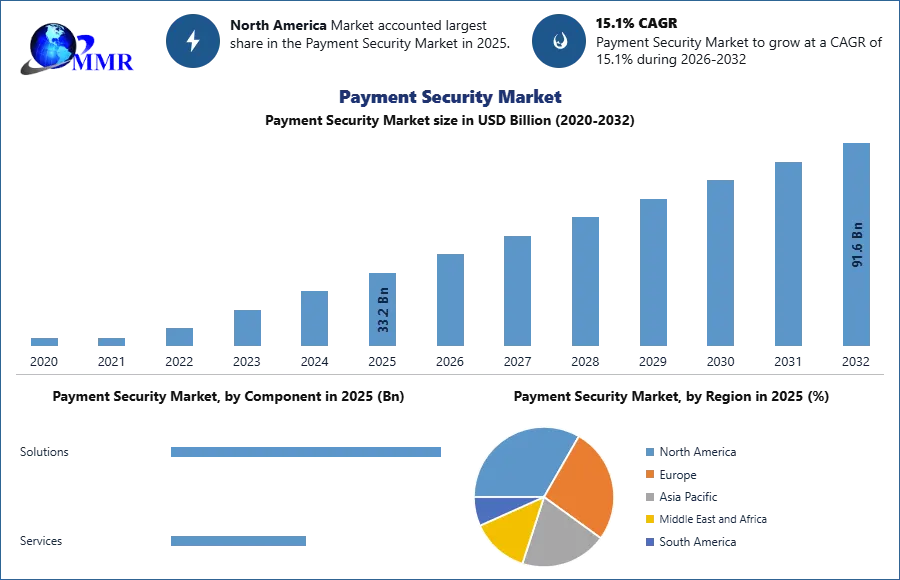
- Payment Security Market valued at USD 33.2 Billion in 2025
- Expected to reach USD 91.6 Billion by 2032 at 15.1% CAGR
- Growth driven by surge in digital payments and real-time transaction ecosystems
- AI-based fraud detection and behavioral analytics reshape security architectures
- Cloud migration of payment systems accelerates enterprise security demand
- Banking, fintech, telecom, and retail sectors drive adoption
Why This Matters Now
Digital payments are no longer a financial convenience layer. They are becoming core infrastructure for global commerce, and that shift has elevated security from a compliance function to a system-level requirement.
Payment ecosystems now operate in real time, across cloud-native architectures, mobile-first interfaces, and API-driven fintech platforms. Every transaction expands the attack surface. As a result, payment security is emerging as a strategic control point for financial institutions, telecom operators, and digital-first enterprises.
The market’s expansion to USD 91.6 Billion by 2032 signals not just rising fraud risk, but a structural redesign of how trust is engineered into digital commerce.
Market Overview
The Payment Security Market is evolving alongside rapid digitization of financial ecosystems. The market was valued at USD 33.2 Billion in 2025 and is projected to reach USD 91.6 Billion by 2032, expanding at a CAGR of 15.1%.
This growth reflects a shift from perimeter-based security models to embedded, real-time transaction protection systems. Payment environments now span cloud platforms, mobile wallets, embedded finance applications, and cross-border digital commerce networks.
For banks, fintech firms, and telecom operators, payment security is no longer a standalone layer. It is integrated directly into payment gateways, APIs, and cloud-native transaction flows. This integration is redefining operational priorities, especially around latency, fraud detection speed, and regulatory compliance.
Key Trends Driving Growth
Artificial intelligence is becoming the core engine of payment security modernization. Machine learning models now analyze transaction behavior in real time, flagging anomalies before payments clear. This reduces fraud exposure windows and improves detection precision across high-volume digital ecosystems.
Cloud migration is another structural driver. Enterprises are shifting payment infrastructure from on-premise systems to hybrid and public cloud environments. This transition expands scalability but increases exposure to API-based attacks, prompting demand for advanced cloud-native security tools.
Tokenization and encryption technologies are replacing static card credentials with dynamic identifiers. This reduces the value of stolen data and limits replay attacks in digital ecosystems.
Telecom operators are also entering the payment security value chain as mobile wallets and embedded payment systems grow across 5G networks. Network-level security integration is becoming critical for securing edge-based financial transactions.
Regulatory pressure is intensifying globally. Compliance frameworks such as PCI DSS are pushing enterprises toward continuous monitoring, auditability, and encryption-first architectures.
Segment Insights
- Dominant Segment: Not specified in the available MMR extract
- Fastest-Growing Segment: Not specified in the available MMR extract
Even without granular segmentation disclosure in the provided dataset, the market direction clearly favors AI-enabled fraud detection platforms, cloud-based security solutions, and real-time transaction monitoring systems as core adoption areas across banking and fintech ecosystems.
Regional Growth Story
North America leads early adoption due to advanced digital banking infrastructure and high penetration of card-based and real-time payment systems. Enterprises in the United States are prioritizing AI-driven fraud prevention and zero-trust architectures for payment ecosystems.
Asia Pacific is emerging as a high-velocity growth region. Rapid fintech expansion in India, China, and Southeast Asia is driving large-scale deployment of mobile payment security systems. High transaction volumes and digital wallet penetration are increasing demand for scalable fraud detection infrastructure.
Europe continues to focus on regulatory-driven adoption. Strong compliance frameworks and cross-border payment systems are accelerating investment in encryption, authentication, and secure API gateways.
Across all regions, telecom modernization and 5G expansion are increasing the complexity of payment ecosystems, especially in edge computing environments where transactions occur outside traditional banking infrastructure.
Competitive Landscape
The Payment Security Market is shaped by established cybersecurity vendors, payment network operators, and fintech infrastructure providers.
Visa Inc. is strengthening tokenization and digital authentication systems across its network, signaling a shift toward embedded security at the transaction layer rather than external fraud monitoring.
Mastercard Inc. is expanding AI-driven fraud detection capabilities and real-time decisioning tools, reinforcing its position as a platform-centric security provider rather than a pure payment processor.
IBM continues to push hybrid cloud security and enterprise-grade encryption frameworks, targeting banks and large financial institutions migrating to cloud-native payment systems.
Cisco Systems is integrating payment security into broader network security architectures, aligning fraud prevention with enterprise-wide zero-trust models.
Microsoft is embedding payment security capabilities within cloud and identity platforms, strengthening its influence in API-driven financial ecosystems.
Competitive dynamics are shifting from point solutions to platform ecosystems. Vendors are increasingly competing on integration depth, API security capabilities, and AI-driven threat intelligence. The industry is consolidating around firms that can secure payments across cloud, edge, and telecom infrastructure layers simultaneously.
Recent Developments
- Expansion of AI-based fraud detection engines across banking and fintech platforms
- Increased adoption of tokenization in digital wallet ecosystems
- Migration of payment systems to cloud-native infrastructure
- Strengthening of zero-trust security frameworks in enterprise payment networks
- Integration of payment security with telecom and 5G-enabled mobile transaction systems
Strategic Implications
Payment security is becoming a board-level priority rather than a technical compliance function. CIOs and CTOs are shifting budgets toward real-time fraud intelligence, API security, and cloud-native transaction monitoring systems.
For telecom operators, payment security is converging with network security as mobile payments scale across 5G and edge computing environments. This creates new revenue opportunities in secure transaction infrastructure services.
For cloud providers, payment security is a high-growth adjacency that strengthens platform stickiness. Secure payment APIs and embedded authentication systems are becoming core differentiators in cloud ecosystems.
Enterprises that fail to modernize payment security architectures face escalating exposure to fraud, regulatory penalties, and customer trust erosion. Security latency is now a competitive disadvantage in real-time commerce.
Future Outlook
The next phase of the Payment Security Market will be defined by autonomous fraud detection systems, AI-native transaction monitoring, and deeply embedded security across cloud, edge, and telecom infrastructures—separating digital leaders from enterprises still relying on reactive security models.
Analyst Perspective
“The Payment Security Market is shifting from perimeter defense to embedded intelligence. AI-driven transaction security and cloud-native architectures are redefining how trust is built into digital payments at scale.”
— Yash Ghosalkar, Analyst
About Maximize Market Research
Maximize Market Research Pvt. Ltd. (MMR) is a global market research and consulting company that provides reliable, data-focused, and practical business insights. The firm serves a wide range of industries, including healthcare, pharmaceuticals, technology, automotive, electronics, chemicals, personal care, and consumer goods. Through market forecasts, competitive analysis, strategic consulting, and industry impact assessments, MMR helps organizations understand changing market conditions, identify growth opportunities, and make informed business decisions for long-term success.
2nd Floor, Navale IT Park Phase 3
Pune Banglore Highway, Narhe
Pune, Maharashtra 411041, India
+91 9607365656
sales@maximizemarketresearch.com
