Key Highlights
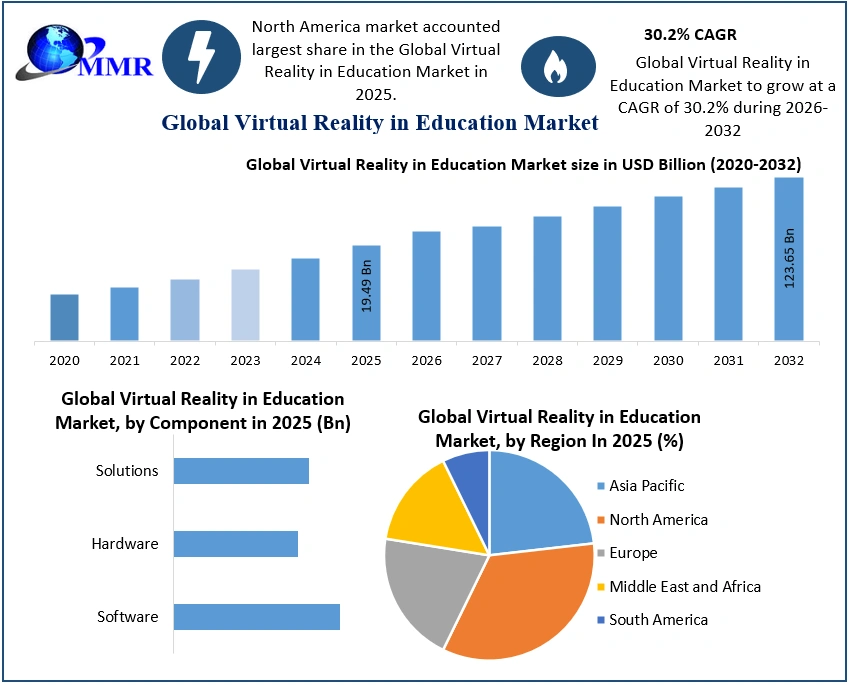
- Market valued at USD 19.49 Billion in 2025
- Expected to reach USD 123.65 Billion by 2032
- CAGR of 30.2% during 2026–2032
- Rapid integration of immersive VR tools in digital education ecosystems
- Expansion aligned with broader digital transformation in education systems
Why This Matters Now
Education systems are entering a structural shift where digital engagement is no longer optional. Institutions are under pressure to improve learning outcomes, reduce training gaps, and scale remote education infrastructure.
Virtual reality is becoming a strategic layer in this transition. It moves learning from passive consumption to simulated experience. The scale of expansion, from USD 19.49 Billion to USD 123.65 Billion, signals a shift in how governments, universities, and enterprises treat immersive learning as core infrastructure rather than experimental technology.
Market Overview
The Virtual Reality in Education Market is transitioning from pilot deployments to structured integration across academic institutions and corporate learning environments. The market is valued at USD 19.49 Billion in 2025 and is projected to reach USD 123.65 Billion by 2032, expanding at a CAGR of 30.2% during the forecast period, according to the supplied MMR report.
This growth trajectory reflects increasing institutional investment in immersive technologies that enhance comprehension, retention, and experiential learning. VR-enabled environments are being positioned as substitutes for traditional simulation labs, field training, and visual instruction modules.
The market is also being shaped by broader digital transformation in education systems, where cloud-based learning platforms, AI-enabled content delivery, and hybrid learning models are becoming standard. VR sits at the intersection of these transformations, functioning as a high-engagement interface layer for next-generation education ecosystems.
Key Trends Driving Growth
The market expansion is closely linked to structural changes in global education delivery models.
AI integration in education platforms is improving personalization of VR-based learning environments. Adaptive learning pathways are being embedded into immersive modules, allowing students to interact with dynamic content instead of static instruction.
Cloud computing adoption is enabling scalable deployment of VR content across institutions without requiring heavy local infrastructure. This shift reduces cost barriers and expands accessibility across emerging economies.
Digital transformation initiatives in universities and corporate training centers are accelerating VR adoption for simulations in medicine, engineering, aviation, and technical education. These environments reduce risk while improving real-world readiness.
Cybersecurity and data governance frameworks are becoming more relevant as VR systems generate large volumes of behavioral and performance data. Institutions are increasingly prioritizing secure learning ecosystems to manage sensitive student and operational data.
Edge computing and low-latency networks are also supporting real-time immersive experiences, particularly in geographically distributed education systems. This aligns with broader enterprise IT modernization trends across sectors.
Segment Insights
- Dominant Segment: Not specified in the supplied MMR report URL
- Fastest-Growing Segment: Not specified in the supplied MMR report URL
The absence of explicit segmentation in the provided dataset indicates a market still broadly expanding across multiple application areas rather than consolidating into a single dominant use case. Growth is being distributed across academic education, vocational training, and enterprise learning environments.
Regional Growth Story
The supplied report identifies global expansion of the Virtual Reality in Education Market but does not specify detailed regional shares or country-level leadership.
However, market growth is strongly aligned with digital infrastructure maturity across key economies including the United States, China, India, Germany, Japan, South Korea, and the United Kingdom. These regions are simultaneously investing in cloud education platforms, 5G connectivity, and digital learning ecosystems that support VR deployment.
Emerging economies are expected to benefit from declining hardware costs and expanding cloud-based VR delivery models. This is particularly relevant in large-scale public education systems where scalability and affordability are critical constraints.
Competitive Landscape
The supplied MMR report URL does not list specific companies or competitive benchmarks.
However, competitive dynamics in the Virtual Reality in Education Market are increasingly shaped by platform convergence. Technology providers are moving toward integrated ecosystems combining VR hardware, cloud-based content libraries, and AI-driven analytics.
This shift signals a move away from standalone VR solutions toward platform-led education infrastructure. For technology vendors, competitive advantage is no longer defined by device capability alone but by ecosystem integration, content scalability, and interoperability with existing learning management systems.
The broader implication is consolidation pressure across edtech and immersive technology providers. Companies with strong cloud infrastructure and AI capabilities are positioned to define pricing power and platform standards in the next phase of market evolution.
Recent Developments
- Expansion of immersive learning pilots across universities and technical institutes
- Increased deployment of VR-based simulation environments in healthcare and engineering education
- Integration of AI-driven adaptive learning systems with VR platforms
- Growth in cloud-based VR content delivery models for remote education access
- Rising focus on secure data frameworks for immersive learning environments
Strategic Implications
The rapid expansion of the Virtual Reality in Education Market signals a deeper restructuring of education delivery architecture.
For CIOs and CTOs, VR is becoming part of core digital infrastructure planning alongside cloud and AI systems. It is no longer treated as peripheral innovation but as a scalable learning interface integrated into enterprise education stacks.
Telecom operators and cloud providers are positioned as critical enablers. Low-latency connectivity, edge computing capacity, and distributed cloud networks are required to support real-time immersive environments at scale.
For investors, the market reflects convergence between edtech, gaming engines, and enterprise SaaS models. Value creation is shifting toward platforms that combine content creation tools, analytics, and immersive delivery systems.
For policymakers, VR adoption introduces new requirements in digital curriculum standards, data privacy governance, and infrastructure funding models.
Future Outlook
The market’s trajectory toward USD 123.65 Billion by 2032 indicates a structural transition where immersive learning becomes embedded in mainstream education infrastructure rather than remaining a niche capability.
The competitive divide will widen between institutions that treat VR as an experimental tool and those that integrate it into AI-driven, cloud-native education ecosystems that continuously adapt to learner behavior in real time.
Analyst Perspective
“Virtual reality is moving from an innovation layer to a core learning infrastructure. The institutions that align VR with AI, cloud, and secure digital ecosystems will define the next decade of education competitiveness,” says Yash Ghosalkar, Analyst at Maximize Market Research.
About Maximize Market Research
Maximize Market Research Pvt. Ltd. (MMR) is a global market research and consulting company that provides reliable, data-focused, and practical business insights. The firm serves a wide range of industries, including healthcare, pharmaceuticals, technology, automotive, electronics, chemicals, personal care, and consumer goods. Through market forecasts, competitive analysis, strategic consulting, and industry impact assessments, MMR helps organizations understand changing market conditions, identify growth opportunities, and make informed business decisions for long-term success.
2nd Floor, Navale IT Park Phase 3
Pune Banglore Highway, Narhe
Pune, Maharashtra 411041, India
+91 9607365656
sales@maximizemarketresearch.com
