Why This Matters Now
Global water scarcity, tightening wastewater discharge regulations, and rising industrial water consumption are making advanced water treatment essential rather than optional. Companies are increasingly investing in sustainable chemicals, digital monitoring systems, and water reuse technologies to reduce operating costs while meeting environmental compliance requirements.
Market Overview
Water treatment Market chemicals are used to remove contaminants, prevent corrosion and scaling, control microbial growth, and improve water quality across municipal, industrial, and commercial applications. These products play a critical role in wastewater treatment, desalination, cooling systems, boilers, and drinking water purification.
Market expansion is driven by rising industrialization, urban population growth, and increasing investments in wastewater treatment infrastructure. Industries including power generation, oil & gas, pharmaceuticals, food processing, chemicals, mining, and manufacturing require advanced chemical treatment solutions to meet stringent water quality standards.
Governments worldwide continue strengthening environmental regulations governing wastewater discharge and industrial water reuse. These policies are accelerating adoption of specialty treatment chemicals while encouraging investments in advanced treatment infrastructure.
However, high raw material costs and the increasing adoption of alternative treatment technologies—including membrane filtration, UV disinfection, and electrochemical treatment—continue to challenge conventional chemical demand in certain applications.
Key Trends Driving Growth
Bio-based treatment chemicals are gaining momentum as industries seek environmentally friendly alternatives that reduce sludge generation and improve biodegradability.
Artificial intelligence and digital monitoring platforms are transforming industrial water management by enabling predictive maintenance, automated chemical dosing, and real-time performance optimization.
Growing investments in desalination facilities, particularly across water-stressed regions, continue driving demand for advanced anti-scalants, corrosion inhibitors, and specialty treatment chemicals.
Circular water management strategies are increasing adoption of chemical solutions designed for wastewater recycling and industrial water reuse.
Environmental regulations continue encouraging innovation in phosphate-free formulations, biodegradable corrosion inhibitors, and sustainable treatment chemistries.
Explore detailed analysis, insights, and growth opportunities
Segment Insights
Dominant Segment: Synthetic Chemicals
Synthetic chemicals represent the largest source segment due to their established performance, cost efficiency, and widespread compatibility with existing municipal and industrial treatment infrastructure.
Products including coagulants, flocculants, corrosion inhibitors, biocides, and pH stabilizers remain essential across power plants, manufacturing facilities, oil & gas operations, and municipal treatment systems.
Business impact remains substantial because conventional treatment facilities worldwide continue relying on these formulations to maintain operational efficiency and regulatory compliance.
Fastest-Growing Segment: Bio-based and Green Chemicals
Bio-based treatment chemicals are expected to record the strongest growth as governments tighten environmental regulations and industries pursue sustainability objectives.
Plant-derived polymers, enzymes, starch-based products, and biodegradable scale inhibitors are gaining acceptance due to lower toxicity and reduced environmental impact.
Manufacturers expanding green chemistry portfolios are expected to benefit from premium pricing opportunities in environmentally regulated markets.
Additional Key Sub-segments
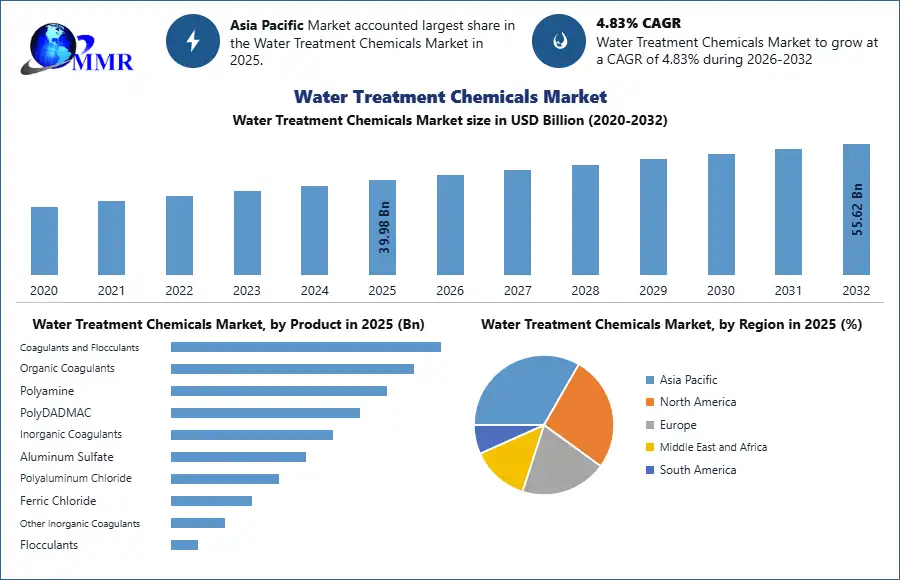
Flocculants and coagulants remain the leading product category because they play a central role in removing suspended solids and contaminants during municipal and industrial wastewater treatment.
Biocides and disinfectants continue supporting microbial control despite increasing regulatory scrutiny regarding environmental safety.
Corrosion inhibitors remain essential for protecting industrial assets, pipelines, boilers, and cooling systems, reducing maintenance costs and extending equipment life.
Primary coagulation and flocculation continue representing the largest treatment stage, while tertiary treatment chemicals gain importance as industries pursue higher water purity standards.
Regional Growth Story
Asia Pacific dominates the global market with nearly 40% market share. China, India, and Japan continue expanding industrial production, municipal wastewater treatment infrastructure, and desalination capacity. Rapid urbanization and stricter wastewater regulations support sustained regional demand.
North America maintains a significant market position through aging infrastructure modernization, strict environmental compliance standards, and increasing adoption of digital water management technologies across industrial sectors.
Europe continues emphasizing sustainable water management through circular economy initiatives, bio-based chemicals, and stringent industrial discharge regulations that encourage advanced specialty chemical adoption.
Middle East & Africa represent major growth opportunities due to increasing desalination investments and water security initiatives. Industrial expansion and municipal infrastructure development further strengthen regional demand.
South America continues expanding wastewater treatment investments across mining, agriculture, food processing, and municipal infrastructure, creating opportunities for specialty water treatment suppliers.
Competitive Landscape
Competition is increasingly focused on sustainable chemistry, digital water management, and integrated treatment solutions rather than commodity chemical supply.
Ecolab, SUEZ SA, Kemira, BASF SE, Solenis, Dow, Kurita Water Industries, Veolia Water Technologies, SNF, DuPont, Ion Exchange, Thermax, GE Water, Lanxess, Nouryon, Baker Hughes Company, LG Chem Ltd., Evonik Industries AG, Arkema S.A., Clariant AG, Calgon Carbon, IDE Technologies, Metito, Gradiant, and H2O Innovation continue expanding portfolios through technology development, strategic partnerships, and sustainability-focused innovation.
Market leaders are differentiating themselves by combining specialty chemicals with AI-powered monitoring platforms, predictive analytics, and integrated water management services that improve customer efficiency while reducing environmental impact.
Recent Developments
- April 2025: SUEZ introduced BioFloc, a plant-based flocculant that reduces sludge generation while supporting EU sustainability standards.
- March 2025: Kemira launched ASF 4600, a phosphate-free anti-scalant developed for high-temperature desalination plants across the Middle East and North Africa.
- 2024: BASF expanded its Sokalan ECO portfolio with biodegradable corrosion inhibitors for industrial cooling systems.
- April 2025: Solenis partnered with Samsung C&T to supply green biocides for smart city water recycling projects across Southeast Asia.
- May 2025: Ecolab introduced Nalco Water Vision, an AI-powered water management platform providing predictive maintenance and optimized chemical dosing.
Future Outlook
Companies that combine sustainable chemistry, AI-enabled water management, and advanced wastewater reuse technologies will secure the strongest competitive position as governments and industries accelerate investment in resilient, low-impact water infrastructure.
Analyst Perspective
The Water Treatment Chemicals Market is evolving beyond conventional chemical supply toward integrated, technology-driven water management solutions. Rising water scarcity, stricter environmental regulations, and increasing industrial wastewater reuse are accelerating demand for high-performance and sustainable treatment chemicals. At the same time, digital innovations such as AI-powered monitoring, predictive analytics, and smart dosing systems are improving operational efficiency and reducing chemical consumption.
About Maximize Market Research
Maximize Market Research Pvt. Ltd. (MMR) is a global market research and consulting company that provides reliable, data-focused, and practical business insights. The firm serves a wide range of industries, including healthcare, pharmaceuticals, technology, automotive, electronics, chemicals, personal care, and consumer goods. Through market forecasts, competitive analysis, strategic consulting, and industry impact assessments, MMR helps organizations understand changing market conditions, identify growth opportunities, and make informed business decisions for long-term success.
Contact Us :
2nd Floor, Navale IT Park Phase 3
Pune Banglore Highway, Narhe
Pune, Maharashtra 411041, India
+91 9607365656
sales@maximizemarketresearch.com
