Key Highlights
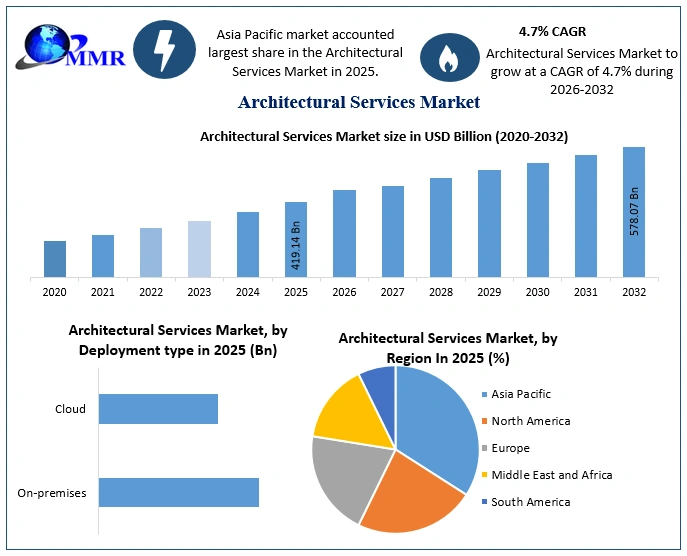
- Architectural Services Market size reached US$ 419.14 Bn in 2025, signaling strong global design and infrastructure demand.
- Market is projected to reach US$ 578.07 Bn by 2032, reflecting sustained expansion across developed and emerging economies.
- Growth is driven by digital transformation in construction workflows, including BIM and cloud-based collaboration tools.
- Rising infrastructure investments across urban development, commercial real estate, and public works are reshaping demand patterns.
- Integration of advanced design technologies is accelerating productivity, accuracy, and lifecycle efficiency in architectural projects.
Why This Matters Now
Architectural services are moving from manual design-centric workflows to fully digitized, data-driven ecosystems. This shift is reshaping how infrastructure is planned, approved, and executed across global cities under pressure from rapid urbanization and climate resilience requirements.
For technology leaders and enterprise infrastructure stakeholders, architectural services now sit at the intersection of construction, cloud computing, and digital engineering platforms. The sector is becoming increasingly dependent on real-time collaboration systems, interoperable design software, and AI-assisted modeling tools. This convergence is redefining project timelines, cost structures, and execution risk across global construction pipelines.
Market Overview
The Architectural Services Market is evolving into a digitally enabled professional services ecosystem that integrates design intelligence, engineering precision, and lifecycle management. Valued at US$ 419.14 Bn in 2025, the market reflects sustained demand from urban infrastructure expansion, commercial construction, and modernization of aging built environments.
Growth toward US$ 578.07 Bn by 2032 at a CAGR of 4.7% signals a stable but structurally transforming industry. The expansion is not volume-driven alone; it is increasingly tied to digital tool adoption, regulatory complexity in construction standards, and rising demand for energy-efficient and smart building designs.
Architectural firms are increasingly operating as technology-enabled service providers. Cloud-based design platforms, real-time collaboration systems, and integrated project delivery frameworks are replacing traditional siloed workflows. This transformation is aligning architectural services with broader enterprise IT modernization trends seen in manufacturing, telecom infrastructure planning, and smart city development.
Key Trends Driving Growth
Digital transformation is reshaping architectural workflows. Building Information Modeling (BIM) is becoming central to project design, enabling multi-dimensional visualization, simulation, and lifecycle tracking of structures. This reduces design errors and improves cross-functional collaboration across engineering and construction stakeholders.
Cloud adoption is accelerating, enabling distributed teams to collaborate on complex projects in real time. This shift is particularly important for global architecture and engineering firms managing multi-region infrastructure projects.
Automation and generative design tools are improving productivity by enabling rapid iteration of design concepts. These tools are increasingly integrated with AI-driven optimization systems that evaluate material usage, energy efficiency, and structural feasibility.
Smart infrastructure development is creating demand for architectural services capable of integrating IoT-ready building systems, digital twins, and energy-efficient frameworks. This is especially relevant in urban redevelopment and commercial real estate expansion.
Cybersecurity considerations are also emerging as architectural workflows move into cloud ecosystems. Protection of sensitive design data and intellectual property is becoming a strategic priority for firms adopting digital platforms.
Segment Insights
- Dominant Segment: Not specified in the provided report data.
- Fastest-Growing Segment: Not specified in the provided report data.
Despite the absence of explicit segmentation disclosure, industry dynamics indicate increasing demand for digitally enabled architectural design services, particularly those integrated with BIM, sustainability consulting, and smart infrastructure planning. These areas are emerging as key value pools within the broader service ecosystem.
Regional Growth Story
Developed economies such as the United States, Germany, and Japan continue to lead in advanced architectural services adoption, driven by smart city initiatives, commercial infrastructure upgrades, and regulatory compliance requirements for sustainable construction.
China and India are emerging as high-growth markets, supported by large-scale urbanization, transportation infrastructure expansion, and government-led smart city programs. These markets are accelerating demand for scalable architectural design services that can support rapid infrastructure deployment.
The United Kingdom and South Korea are focusing on digital construction ecosystems, where architectural services are increasingly embedded within integrated urban planning platforms. This includes adoption of digital twin frameworks and cloud-based infrastructure planning systems.
Across all regions, the convergence of infrastructure investment and digital design platforms is creating a unified shift toward technology-enabled architectural services delivery.
Competitive Landscape
The competitive environment in architectural services is shifting from traditional design expertise toward technology-enabled service ecosystems. Firms are increasingly differentiated by their ability to integrate digital design platforms, cloud collaboration tools, and data-driven project management systems.
This transition signals a broader consolidation of architectural services into platform-driven ecosystems where software capability, interoperability, and digital workflow integration define competitiveness. Firms that fail to adopt BIM-enabled and cloud-native workflows risk margin compression and reduced participation in large-scale infrastructure projects.
Strategically, the market is moving toward hybrid models where architectural firms collaborate with technology providers, construction firms, and cloud platforms. This convergence is reshaping procurement patterns and shifting value toward integrated digital delivery networks rather than standalone design services.
Recent Developments
- Expansion of cloud-based architectural design platforms enabling global project collaboration.
- Increased adoption of BIM and digital twin frameworks in large infrastructure projects.
- Integration of AI-assisted design tools for automated modeling and optimization workflows.
- Growing emphasis on sustainable and energy-efficient building design standards.
- Rising use of collaborative project delivery systems across cross-border architectural teams
Strategic Implications
Architectural services are becoming a core node in the broader digital infrastructure ecosystem. CIOs and CTOs in construction-adjacent industries are increasingly aligning architectural workflows with enterprise cloud strategies, data governance frameworks, and AI-driven design systems.
For telecom and technology providers, the rise of smart buildings and digitally connected infrastructure creates new demand for integrated connectivity solutions, edge computing deployment, and IoT-enabled building systems. Architectural design is no longer isolated from digital infrastructure planning; it is embedded within it.
Investors are increasingly evaluating architectural firms not only on design capability but also on their digital maturity, platform partnerships, and ability to scale globally through cloud-enabled delivery models.
Future Outlook
The Architectural Services Market is transitioning toward a digitally orchestrated ecosystem where AI-assisted design, cloud collaboration, and smart infrastructure integration determine competitive advantage rather than traditional design capacity alone.
Analyst Perspective
“The Architectural Services Market is entering a phase where digital infrastructure defines design capability. Firms that align BIM, cloud platforms, and intelligent design systems will lead global infrastructure transformation, while traditional models will progressively lose relevance in large-scale projects,” said Yash Ghosalkar, Analyst.
About Maximize Market Research
Maximize Market Research Pvt. Ltd. (MMR) is a global market research and consulting company that provides reliable, data-focused, and practical business insights. The firm serves a wide range of industries, including healthcare, pharmaceuticals, technology, automotive, electronics, chemicals, personal care, and consumer goods. Through market forecasts, competitive analysis, strategic consulting, and industry impact assessments, MMR helps organizations understand changing market conditions, identify growth opportunities, and make informed business decisions for long-term success.
2nd Floor, Navale IT Park Phase 3
Pune Banglore Highway, Narhe
Pune, Maharashtra 411041, India
+91 9607365656
sales@maximizemarketresearch.com
