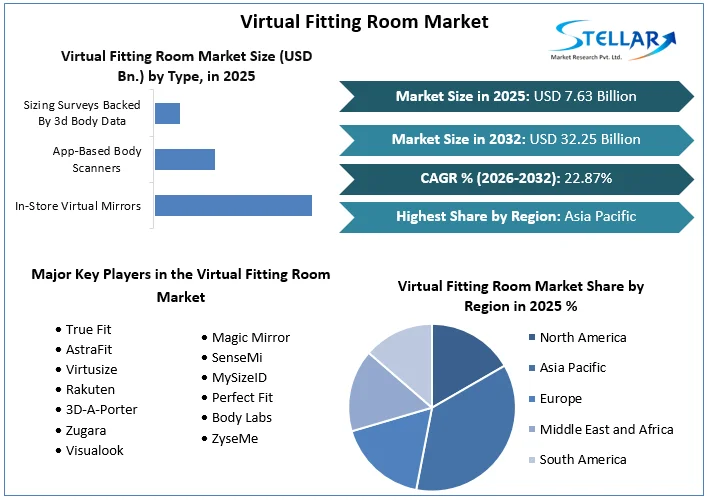
The Virtual Fitting Room Market is witnessing remarkable growth as retailers increasingly adopt artificial intelligence (AI), augmented reality (AR), and computer vision technologies to enhance online shopping experiences and reduce product return rates. Virtual fitting rooms enable consumers to digitally try on apparel, footwear, eyewear, cosmetics, jewelry, and fashion accessories using smartphones, tablets, computers, or smart mirrors. The rapid expansion of e-commerce, growing consumer demand for personalized shopping, and advancements in immersive technologies are driving widespread adoption across the global retail industry.
Retailers and technology providers are investing in AI-powered body scanning, 3D visualization, digital avatars, and real-time product simulation to improve purchase confidence and customer satisfaction. As omnichannel retail strategies continue evolving, virtual fitting rooms are becoming an essential component of modern digital commerce.
𝐃𝐨𝐰𝐧𝐥𝐨𝐚𝐝 𝐅𝐫𝐞𝐞 𝐏𝐃𝐅 𝐁𝐫𝐨𝐜𝐡𝐮𝐫𝐞: https://www.stellarmr.com/report/req_sample/Virtual-Fitting-Room-Market-/1489
E-Commerce Expansion Drives Market Growth
One of the primary drivers of the Virtual Fitting Room Market is the continued growth of online retail. Consumers increasingly prefer the convenience of shopping online but often face uncertainty regarding product size, fit, color, and style, resulting in high return rates.
Virtual fitting room technologies allow shoppers to visualize products before purchasing, helping them make informed buying decisions while reducing sizing errors. Retailers benefit from improved customer engagement, higher conversion rates, and lower logistics costs associated with product returns.
The ongoing digital transformation of retail continues to strengthen demand for immersive shopping technologies.
Artificial Intelligence Enhances Personalization
Artificial intelligence is playing a transformative role in the Virtual Fitting Room Market by enabling highly personalized shopping experiences. AI-powered body measurement systems analyze customer dimensions, body shapes, and preferences to recommend the most suitable clothing sizes and styles.
Machine learning algorithms continuously improve recommendation accuracy by learning from consumer behavior, purchase history, and product interactions. AI also supports personalized fashion suggestions, color recommendations, and styling advice, creating a more engaging and customized online shopping journey.
These intelligent capabilities improve customer satisfaction while increasing retailer sales performance.
Augmented Reality Improves Customer Experience
Augmented reality technology has significantly enhanced virtual fitting room capabilities by allowing consumers to view products in real time through smartphone cameras or smart devices. Customers can virtually try on clothing, eyewear, cosmetics, watches, jewelry, and footwear while observing how products appear from different angles.
High-resolution 3D rendering, motion tracking, and realistic visualization create immersive shopping experiences that closely replicate in-store product trials. AR-powered mirrors in physical retail stores also enable customers to explore multiple styles without physically changing outfits, improving convenience and shopping efficiency.
The growing accessibility of AR-enabled devices continues accelerating consumer adoption.
Fashion and Beauty Industries Lead Adoption
The fashion and beauty sectors remain the largest adopters of virtual fitting room technologies. Apparel brands use virtual fitting solutions to address sizing challenges and improve customer confidence, while cosmetics companies offer virtual makeup trials that allow users to experiment with different shades before making purchases.
Luxury brands are also integrating virtual fitting experiences to showcase premium products through interactive digital platforms. Jewelry, eyewear, handbags, and footwear manufacturers continue expanding virtual try-on capabilities to enhance product visualization and increase online sales.
The growing demand for personalized digital experiences continues supporting industry-wide implementation.
Omnichannel Retail Strategies Create New Opportunities
Retailers are increasingly integrating virtual fitting rooms into omnichannel commerce strategies that connect physical stores with digital platforms. Customers can use virtual try-on applications online before visiting stores or complete purchases directly through e-commerce websites and mobile applications.
Cloud computing, mobile commerce, and digital payment technologies further enhance seamless customer experiences across multiple sales channels. Retailers also leverage virtual fitting data to optimize inventory planning, merchandising strategies, and product development.
The convergence of physical and digital retail environments continues expanding commercial opportunities.
𝐀𝐜𝐜𝐞𝐬𝐬 𝐭𝐡𝐞 𝐅𝐮𝐥𝐥 𝐑𝐞𝐩𝐨𝐫𝐭: https://www.stellarmr.com/report/Virtual-Fitting-Room-Market-/1489
Regional Market Outlook
North America remains the leading Virtual Fitting Room Market, driven by high e-commerce penetration, advanced AI adoption, strong digital infrastructure, and significant investments in retail technology innovation. The United States and Canada continue leading the development of immersive shopping platforms and personalized retail solutions.
Europe represents another significant market due to increasing digital transformation across fashion retail, widespread smartphone adoption, and growing demand for sustainable shopping experiences. Germany, the United Kingdom, France, Italy, and Spain continue investing in AI-powered retail technologies and omnichannel commerce.
Asia-Pacific is expected to witness the fastest growth during the forecast period. China, India, Japan, South Korea, and Southeast Asian countries are experiencing rapid expansion of online retail, mobile commerce, and digital fashion platforms, creating substantial growth opportunities for virtual fitting room providers.
Latin America and the Middle East & Africa are emerging markets as internet penetration, smartphone usage, and e-commerce adoption continue increasing.
Competitive Landscape
The Virtual Fitting Room Market is highly competitive, with retail technology companies, software developers, artificial intelligence firms, augmented reality providers, and e-commerce platforms focusing on AI-powered body scanning, 3D visualization, cloud computing, and immersive digital experiences. Companies are investing in computer vision, deep learning, digital avatars, virtual mirrors, and personalized recommendation engines to strengthen their market positions.
Strategic collaborations among fashion brands, beauty companies, retailers, technology providers, and cloud service companies continue accelerating innovation and market adoption. Research and development efforts focus on improving visualization accuracy, real-time rendering, user experience, and cross-platform compatibility.
Manufacturers are also expanding enterprise software solutions that integrate virtual fitting technologies with inventory management, customer analytics, and digital marketing platforms.
Future Outlook
The future of the Virtual Fitting Room Market remains highly promising as artificial intelligence, augmented reality, spatial computing, and digital commerce continue transforming the global retail industry. Advances in 3D body scanning, generative AI, computer vision, virtual avatars, and wearable technologies will further improve personalization, visualization accuracy, and customer engagement.
Growing investments in omnichannel retail, fashion technology, beauty innovation, and immersive shopping experiences are expected to sustain long-term market growth. Companies that prioritize AI innovation, seamless user experiences, data privacy, and digital retail integration will be well positioned to capitalize on evolving consumer expectations, ensuring sustained expansion of the global virtual fitting room market.
About Stellar Market Research:
Stellar Market Research is a multifaceted market research and consulting company with professionals from several industries. Some industries we cover include medical devices, pharmaceutical manufacturers, science and engineering, electronic components, industrial equipment, technology and communication, cars and automobiles, chemical products and substances, general merchandise, beverages, personal care, and automated systems.
Contact Stellar Market Research:
Address: Phase 3, Navale IT Zone, S.No. 51/2A/2, Office No. 202, 2nd floor, Near, Navale Brg, Narhe, Pune, Maharashtra 411041
Website: http://stellarmr.com/
Email: sales@stellarmr.com
Mobile: +91 9607365656
