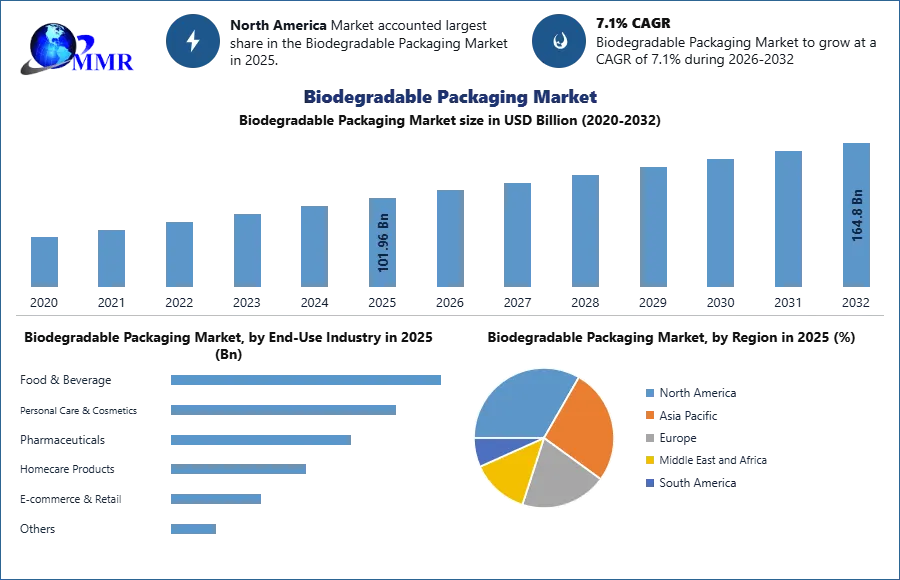
The global packaging industry is undergoing a structural reconfiguration as regulatory pressures and corporate ESG mandates dismantle the traditional dominance of persistent, non-degradable plastics. With the Biodegradable Packaging Market Size valued at USD 101.96 billion in 2025 and a clear trajectory toward USD 164.08 billion by 2032 at a 7.1% CAGR, this sector has moved beyond a “niche” environmental initiative to become a core industrial imperative. For chemical manufacturers and procurement leaders, the transition to high-performance, compostable materials is now a non-negotiable component of long-term supply chain resilience.
Why This Matters Now
The rapid transition from conventional plastics to bio-based alternatives is creating a supply-demand imbalance that rewards early movers and penalizes laggards. As governments worldwide intensify bans on single-use items, the ability to source high-volume, performance-stable biodegradable resins has become a primary bottleneck for global brands. Chemical companies that successfully scale the production of polymers like PLA and PHA are capturing significant market share, while those tethered to fossil-based feedstocks face increasing margin pressure and regulatory headwinds.
Market Overview
Biodegradable packaging utilizes materials—including starches, cellulose, and advanced bio-polymers—that naturally decompose into the environment without toxic residues. The market expansion to USD 164.08 billion by 2032 is not merely a product of consumer sentiment; it is driven by the massive scale of the food and beverage industry, which represents the largest application of these technologies. By replacing trays, cups, and films with compostable variants, the industry is successfully lowering the carbon footprint of its largest-volume output.
Key Trends Driving Growth
Material Diversification: The industry is moving beyond basic cornstarch-based materials to explore high-performance alternatives like seaweed, mycelium, and agricultural waste. These innovative feedstocks offer better barrier properties, shelf-life stability, and moisture resistance, making them increasingly viable for secondary and tertiary packaging.
Infrastructure-Led Adoption: As waste management infrastructure matures, particularly in North America and Europe, the ability to certify packaging as “industrial compostable” or “home compostable” is creating a premium tier of products. This technical certification allows companies to command higher margins and secure long-term utility-scale contracts.
Supply Chain Circularity: Chemical manufacturers are shifting toward “closed-loop” production models where bio-waste is reclaimed as a feedstock. This decoupling of the packaging sector from volatile fossil fuel pricing is enhancing the stability and economic viability of the entire supply chain.
Technological Purity: The development of polymers that mimic the mechanical performance of conventional plastics is enabling seamless adoption on existing, high-speed automated packaging lines. This compatibility minimizes the capital expenditure needed for manufacturers to switch, significantly lowering the barrier to entry.
Segment Insights
Dominant Segment: The Food & Beverage industry holds the largest market share. Driven by the high consumption of disposable items such as trays, wraps, and clamshells, this segment serves as the foundational pillar for the market’s volume and is expected to grow at a robust 7.2% CAGR through the forecast period.
Fastest-Growing Segment: The Bio-based polymers (e.g., PLA, PHA) segment is seeing the most rapid acceleration. As production capacity scales globally, these resins are becoming the go-to performance choice for complex packaging formats that require superior barrier properties.
Regional Growth Story
North America currently dominates the global market, accounting for the highest share in 2025. This leadership is fueled by a combination of high environmental awareness among the consumer base, a mature waste-management infrastructure, and an aggressive regulatory push at both the state and federal levels to reduce single-use plastic reliance.
Asia-Pacific represents the most significant opportunity for long-term growth. Rapid urbanization and the expansion of the middle class in China, India, and Southeast Asia are driving demand for mass-market sustainable packaging. The region is currently investing heavily in local manufacturing capacity to support this domestic demand, signaling a shift toward regionalized, decentralized production hubs.
Europe remains the global leader in policy innovation. Its Circular Economy Action Plan provides a strategic framework that forces producers to prioritize material recyclability and compostability. European chemical leaders continue to lead in R&D, setting the global technical benchmark for bio-polymer performance.
Competitive Landscape
The competitive landscape is characterized by a mix of traditional chemical giants and agile, tech-focused material startups. Established players are utilizing their massive manufacturing footprint and R&D budgets to secure vertical integration, while new entrants are focusing on disruptive, low-cost bio-feedstock technologies. This dynamic is leading to a wave of strategic partnerships and M&A, where legacy manufacturers acquire bio-polymer expertise to preserve their market relevance in a decarbonizing economy. Pricing power is currently migrating toward those who can demonstrate a secure and sustainable supply of high-purity resin grades.
Recent Developments
Strategic Expansion: Leading global polymer producers have recently announced multi-million dollar investments in bio-based resin facilities, designed specifically to meet the high-volume demand from North American and European food retailers.
Feedstock Innovation: New R&D initiatives are focusing on utilizing non-food-competing agricultural waste, effectively solving the “food vs. plastic” debate and enhancing the environmental credentials of the final packaging product.
Global Standardization: Industry-wide efforts are establishing unified certification standards for “compostability,” which is reducing friction in cross-border trade and allowing brands to streamline their global packaging specifications.
Strategic Implications
Procurement leaders should prioritize long-term partnerships with suppliers who can guarantee both volume stability and verifiable sustainability metrics. The “green premium” that once characterized these materials is rapidly eroding due to economies of scale; thus, firms that lock in supply chains now will avoid the inevitable scramble for resources as more industries fall under mandatory sustainability compliance. Investors should focus on companies with high-margin intellectual property in bio-polymer degradation control, as this will be the most lucrative niche in the next decade of material development.
Future Outlook
The winners in this market will be the chemical and material firms that successfully master the balance between material performance and compostable certification, effectively turning regulatory compliance into a competitive advantage.
Analyst Perspective
“The biodegradable packaging market has transcended the experimental phase to become a central pillar of global industrial strategy. Success through 2032 will belong to those who treat sustainability not as a cost center, but as a critical technical specification for high-volume, performance-driven global supply chains,” says Ankita Kagawade, Analyst at Maximize Market Research.
About Maximize Market Research
Maximize Market Research Pvt. Ltd. (MMR) is a global market research and consulting company that provides reliable, data-focused, and practical business insights. The firm serves a wide range of industries, including healthcare, pharmaceuticals, technology, automotive, electronics, chemicals, personal care, and consumer goods. Through market forecasts, competitive analysis, strategic consulting, and industry impact assessments, MMR helps organizations understand changing market conditions, identify growth opportunities, and make informed business decisions for long-term success.
2nd Floor, Navale IT Park Phase 3
Pune Banglore Highway, Narhe
Pune, Maharashtra 411041, India
+91 9607365656
sales@maximizemarketresearch.com
