Key Highlights
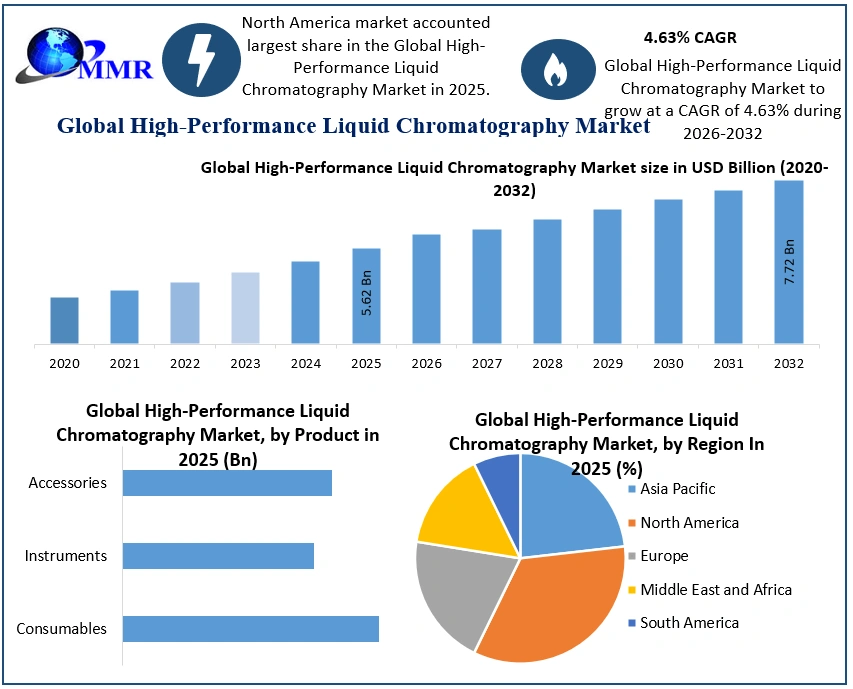
Market Valuation: The global High-Performance Liquid Chromatography market was valued at USD 5.62 billion in 2025.
Growth Forecast: Expected to reach USD 7.72 billion by 2032, expanding at a CAGR of 4.63%.
Dominant Segment: Consumables currently lead the market share, driven by continuous usage in research and testing environments.
Key Driver: Increasing R&D investment in pharmaceutical and biopharmaceutical sectors is the primary catalyst for market expansion.
Regional Leadership: North America remains the primary market, supported by robust healthcare infrastructure and extensive NIH-backed research funding.
Why This Matters Now
Chemical manufacturers and life science organizations are currently facing heightened regulatory scrutiny regarding drug purity and specificity. As analytical requirements move toward higher resolution, the reliance on high-performance liquid chromatography (HPLC) has evolved from a laboratory luxury to an operational necessity. For procurement leaders and industrial stakeholders, understanding the trajectory of this market is critical to securing supply chains for specialized consumables and next-generation instrumentation.
Market Overview
High-Performance Liquid Chromatography, formerly known as high-pressure liquid chromatography, serves as a cornerstone for separating, identifying, and quantifying components in complex mixtures. By pumping pressurized liquid solutions through columns filled with solid adsorbent materials, the technique provides the precision required for modern drug development and quality control.
High-Performance Liquid Chromatography Market Size Valued at USD 5.62 billion in 2025, the market is set to achieve a valuation of USD 7.72 billion by 2032. This sustained 4.63% CAGR reflects a steady integration of HPLC into production workflows across pharmaceutical, diagnostic, and environmental testing sectors. The market is not merely growing; it is deepening its utility within the global chemical and materials infrastructure.
Key Trends Driving Growth
The shift toward more complex therapeutic modalities is dictating the current direction of HPLC development. As pharmaceutical companies prioritize innovative drug discovery, the demand for high-resolution purification and separation techniques has surged.
Concurrently, stationary phase technology has undergone significant evolution. Silica-based columns remain the industry standard, yet the introduction of core-shell packings, monolith packings, and zirconia packings has expanded the range of applications. Furthermore, the advent of nano-bore and microbore HPLC—capable of analyzing femtomole levels of material—is enabling high-precision research in peptide investigations that were previously beyond the scope of traditional equipment.
Segment Insights
Dominant Segment (Product): Consumables. The recurrent need for columns, reagents, and specialized tubing ensures that this segment commands the largest market share. As laboratory throughput increases, the replacement cycle for these components accelerates, creating a stable revenue stream for providers.
Fastest-Growing Segment (Product): Consumables. Driven by persistent R&D activities in biotechnology and agricultural chemistry, this segment is outpacing instrument sales as laboratories focus on scaling their existing capacities rather than just initial capital equipment investment.
Dominant Segment (Application): Clinical Research. The requirement for stringent analytical testing in the development of new medications makes HPLC an essential tool for clinical trials and efficacy verification.
Regional Growth Story
North America holds the most significant market share, underpinned by the United States’ massive investment in pharmaceutical R&D and institutional support from organizations like the National Institute of Health (NIH). Stringent US FDA guidelines regarding drug purity and strength mandate the use of chromatography, creating a baseline of demand that continues to rise.
The Asia Pacific region is rapidly becoming the secondary engine of growth. Expanding healthcare infrastructure, coupled with a surge in local manufacturers developing equipment to meet regional demand, is positioning APAC as a critical hub for future market expansion. Europe maintains a steady influence, driven by advanced manufacturing and a sophisticated regulatory landscape that demands precise analytical validation.
Competitive Landscape
The market is characterized by high competitive intensity, with major players such as Waters Corporation, Agilent Technologies, and Thermo Fisher Scientific Inc. leading through robust product portfolios and global distribution networks. These companies are not only competing on hardware performance but are increasingly differentiating themselves through service-oriented models, such as supplying high-performance chiral chromatography columns and tailored software solutions.
Smaller, specialized firms are finding niches in microbore and nanocolumn production, challenging incumbents by offering solutions that handle increasingly small sample volumes with higher resolution. The competitive structure is evolving toward a “total solution” approach, where vendors provide the instrument, the consumables, and the associated data management software as a unified package.
Recent Developments
Consumable Innovation: Increased investment in stereo-active column packings (e.g., polysaccharide derivatives) to facilitate the separation of complex, optically active molecules.
Micro-scale Expansion: Broadening adoption of nano-bore columns with flow rates as low as 300 nL/minute for high-capacity peptide analysis.
Regulatory Alignment: Strengthening of instrument manufacturing standards to align with evolving international pharmacopeia guidelines for drug validation.
Strategic Implications
For investors and industrial buyers, the trend is clear: the transition toward automated, high-throughput analytical workflows is creating a structural shift in procurement strategies. Relying on commodity-tier instrumentation is no longer sufficient; the industry is moving toward high-resolution, application-specific columns that require long-term partnerships with specialized suppliers. The ability to maintain uptime and ensure compliance via high-quality consumables is now a primary determinant of operational efficiency in chemical and pharmaceutical manufacturing.
Future Outlook
Market participants who prioritize investment in advanced column technologies and high-sensitivity, small-volume instrumentation will be best positioned to capture the value generated by the next wave of clinical research and biopharmaceutical manufacturing; those failing to modernize their analytical capabilities risk falling behind increasingly stringent global quality standards.
Analyst Perspective
“The High-Performance Liquid Chromatography market is evolving from a standard laboratory requirement into a precision-critical component of global supply chains. As regulatory bodies continue to demand absolute purity in chemical and medical products, the reliance on advanced chromatographic consumables will drive the market toward its USD 7.72 billion forecast by 2032,” says Ankita Kagawade, Analyst at Maximize Market Research.
About Maximize Market Research
Maximize Market Research Pvt. Ltd. (MMR) is a global market research and consulting company that provides reliable, data-focused, and practical business insights. The firm serves a wide range of industries, including healthcare, pharmaceuticals, technology, automotive, electronics, chemicals, personal care, and consumer goods. Through market forecasts, competitive analysis, strategic consulting, and industry impact assessments, MMR helps organizations understand changing market conditions, identify growth opportunities, and make informed business decisions for long-term success.
2nd Floor, Navale IT Park Phase 3
Pune Banglore Highway, Narhe
Pune, Maharashtra 411041, India
+91 9607365656
sales@maximizemarketresearch.com
