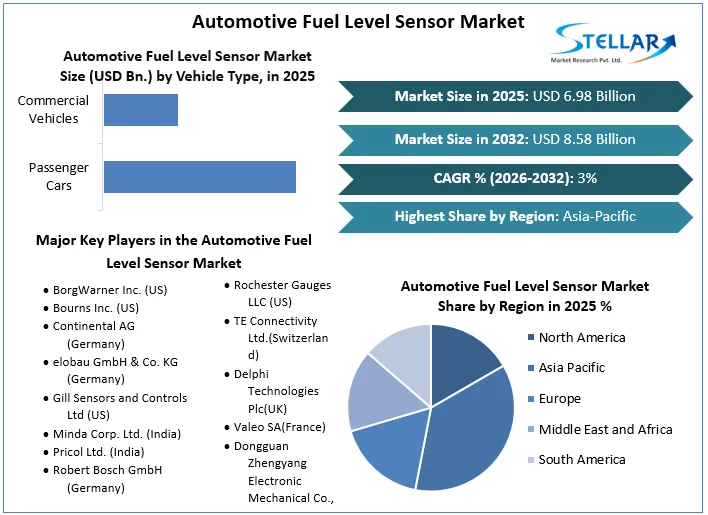
The Automotive Fuel Level Sensor Market is experiencing steady growth as automotive manufacturers increasingly integrate advanced sensing technologies to improve fuel efficiency, vehicle diagnostics, and driver convenience. Automotive fuel level sensors are critical components that accurately measure the amount of fuel in a vehicle’s tank and transmit real-time information to the instrument cluster and onboard electronic control systems. Growing vehicle production, stricter fuel efficiency regulations, and the rising adoption of connected and intelligent vehicles are driving demand for highly accurate, durable, and reliable fuel level sensing solutions across passenger cars, commercial vehicles, and off-highway equipment.
Technological advancements in electronic sensors, digital signal processing, and smart vehicle architectures are enabling manufacturers to develop compact, corrosion-resistant, and high-precision fuel monitoring systems. As the automotive industry continues its transition toward intelligent mobility, fuel level sensors remain an essential component in conventional, hybrid, and alternative-fuel vehicles.
Rising Vehicle Production Drives Market Growth
One of the primary drivers of the Automotive Fuel Level Sensor Market is the continued growth in global automobile production. Passenger vehicles, light commercial vehicles, heavy-duty trucks, buses, agricultural machinery, and construction equipment all require reliable fuel level sensing systems to ensure efficient operation and accurate fuel management.
Automotive manufacturers are increasingly adopting advanced electronic sensors that provide precise fuel level measurements under varying driving conditions, including acceleration, braking, and uneven terrain. Improved sensor accuracy enhances customer satisfaction by providing dependable fuel gauge readings and minimizing unexpected fuel shortages.
The expansion of the global automotive industry continues supporting sustained market demand.
𝐃𝐨𝐰𝐧𝐥𝐨𝐚𝐝 𝐅𝐫𝐞𝐞 𝐏𝐃𝐅 𝐁𝐫𝐨𝐜𝐡𝐮𝐫𝐞: https://www.stellarmr.com/report/req_sample/Automotive-Fuel-Level-Sensor-Market/645
Smart Vehicle Technologies Enhance Sensor Performance
The growing adoption of connected and intelligent vehicles is transforming the Automotive Fuel Level Sensor Market. Modern fuel level sensors are integrated with vehicle electronic control units (ECUs), onboard diagnostics (OBD), and telematics systems to provide real-time fuel consumption data and predictive maintenance insights.
Advanced sensor technologies support fleet management platforms by enabling remote fuel monitoring, fuel theft detection, route optimization, and operational efficiency improvements. Artificial intelligence and data analytics further enhance fuel management by analyzing consumption patterns and identifying performance anomalies.
Digital vehicle architectures continue increasing the importance of intelligent fuel sensing solutions.
Fuel Efficiency Regulations Encourage Innovation
Governments worldwide are implementing increasingly stringent fuel economy and emissions regulations, encouraging automotive manufacturers to optimize vehicle performance and fuel utilization. Accurate fuel level sensors contribute to efficient engine management by providing reliable fuel data that supports advanced vehicle control systems.
Manufacturers are investing in lightweight, low-power, and highly durable sensor technologies that improve measurement precision while meeting strict automotive quality standards. Enhanced fuel monitoring also supports preventive maintenance by identifying potential issues such as fuel leaks, sensor failures, or irregular consumption patterns.
Regulatory compliance continues driving technological innovation across the automotive electronics sector.
Commercial Vehicles Create Significant Opportunities
Commercial transportation remains an important application segment for the Automotive Fuel Level Sensor Market. Fleet operators require accurate fuel monitoring to reduce operating costs, prevent fuel theft, optimize logistics, and improve overall fleet efficiency.
Fuel level sensors integrated with telematics systems enable fleet managers to monitor fuel consumption remotely, improve route planning, and reduce unnecessary fuel expenses. Mining equipment, agricultural machinery, marine vessels, and construction vehicles also rely on robust sensing technologies capable of operating under harsh environmental conditions.
The continued expansion of logistics, transportation, and infrastructure industries is expected to strengthen demand for advanced fuel monitoring systems.
Sensor Technology Advancements Improve Reliability
Continuous innovation in sensing technology is improving the performance and durability of automotive fuel level sensors. Manufacturers are developing capacitive, ultrasonic, magnetic, and resistive sensor technologies that provide greater measurement accuracy while resisting corrosion, vibration, temperature fluctuations, and fuel contamination.
Advanced materials and electronic calibration systems enhance long-term reliability while reducing maintenance requirements. Compact sensor designs also support vehicle lightweighting initiatives and simplify integration into modern fuel tank architectures.
These technological improvements contribute to better vehicle performance and reduced lifecycle costs.
𝐀𝐜𝐜𝐞𝐬𝐬 𝐭𝐡𝐞 𝐅𝐮𝐥𝐥 𝐑𝐞𝐩𝐨𝐫𝐭: https://www.stellarmr.com/report/Automotive-Fuel-Level-Sensor-Market/645
Regional Market Outlook
Asia-Pacific dominates the Automotive Fuel Level Sensor Market, driven by high automobile production, expanding automotive manufacturing facilities, and growing demand for passenger and commercial vehicles. China, India, Japan, South Korea, and Southeast Asian countries continue investing in automotive electronics, intelligent transportation technologies, and vehicle production capacity.
Europe remains a significant market due to strict emissions regulations, advanced automotive engineering, and increasing adoption of connected vehicle technologies. Germany, France, Italy, the United Kingdom, and Spain continue emphasizing precision automotive electronics and fuel-efficient vehicle development.
North America represents another important market, supported by strong commercial vehicle production, fleet management adoption, and technological innovation. The United States, Canada, and Mexico continue investing in automotive manufacturing, intelligent transportation systems, and advanced sensor technologies.
Latin America and the Middle East & Africa are emerging markets as vehicle ownership, transportation infrastructure, and automotive production continue expanding.
Competitive Landscape
The Automotive Fuel Level Sensor Market is highly competitive, with automotive component manufacturers, sensor technology companies, and automotive electronics suppliers focusing on precision sensing, digital integration, lightweight engineering, and product durability. Companies are investing in advanced capacitive sensing technologies, intelligent diagnostics, corrosion-resistant materials, and electronic calibration systems to strengthen competitive positioning.
Strategic collaborations with automotive original equipment manufacturers (OEMs), Tier 1 suppliers, telematics providers, and fleet management companies continue accelerating innovation and market expansion. Research and development efforts remain focused on improving measurement accuracy, environmental resistance, sensor lifespan, and integration with connected vehicle platforms.
Manufacturers are also expanding production capabilities to meet increasing demand from both OEM and aftermarket segments.
Future Outlook
The future of the Automotive Fuel Level Sensor Market remains highly promising as connected vehicles, intelligent transportation systems, and advanced automotive electronics continue reshaping the global automotive industry. Advances in artificial intelligence, Internet of Things (IoT), digital diagnostics, predictive maintenance, and smart sensor technologies will further improve fuel monitoring accuracy and operational efficiency.
Growing investments in vehicle electrification, commercial fleet modernization, automotive digitalization, and intelligent mobility solutions are expected to sustain long-term market growth. Companies that prioritize innovation, precision engineering, digital connectivity, and regulatory compliance will be well positioned to capitalize on evolving automotive requirements, ensuring sustained expansion of the global automotive fuel level sensor market
About Stellar Market Research:
Stellar Market Research is a multifaceted market research and consulting company with professionals from several industries. Some industries we cover include medical devices, pharmaceutical manufacturers, science and engineering, electronic components, industrial equipment, technology and communication, cars and automobiles, chemical products and substances, general merchandise, beverages, personal care, and automated systems.
Contact Stellar Market Research:
Address: Phase 3, Navale IT Zone, S.No. 51/2A/2, Office No. 202, 2nd floor, Near, Navale Brg, Narhe, Pune, Maharashtra 411041
Website: http://stellarmr.com/
Email: sales@stellarmr.com
Mobile: +91 9607365656
