Key Highlights
Cloud-native architectures and edge computing networks are replacing isolated hospital servers to ensure zero-latency data transmission during automated surgical procedures.
Medical robotic systems are moving toward software-driven platforms where machine learning algorithms provide real-time diagnostic telemetry and anatomical mapping.
The transition from legacy surgery into digital healthcare ecosystems is driving massive data center investments to process high-definition, multi-source visual feeds.
Fragmented regional healthcare guidelines and high initial hardware costs present operational friction, forcing vendors to focus heavily on value-driven instruments and accessories.
Why This Matters Now
Traditional surgical and rehabilitation frameworks are struggling to manage surging patient volumes and complex clinical demands without structural technology interventions. Institutional healthcare networks can no longer rely on manual, unassisted workflows while modern precision medicine requires real-time, data-backed guidance at the point of care. This operational necessity forces chief technology officers and medical enterprise buyers to overhaul legacy operating rooms and invest capital directly into connected robotic ecosystems.
Healthcare organizations that delay their digital transformation initiatives face immediate risks, including reduced surgical throughput, precision bottlenecks, and an inability to attract top-tier clinical talent. Software-driven automation platforms and specialized robotic systems are no longer futuristic experiments; they are baseline requirements for clinical competitiveness. Technology providers who integrate high-speed connectivity with advanced edge computing are capturing significant market share as hospitals modernise their technical layouts.
Market Overview
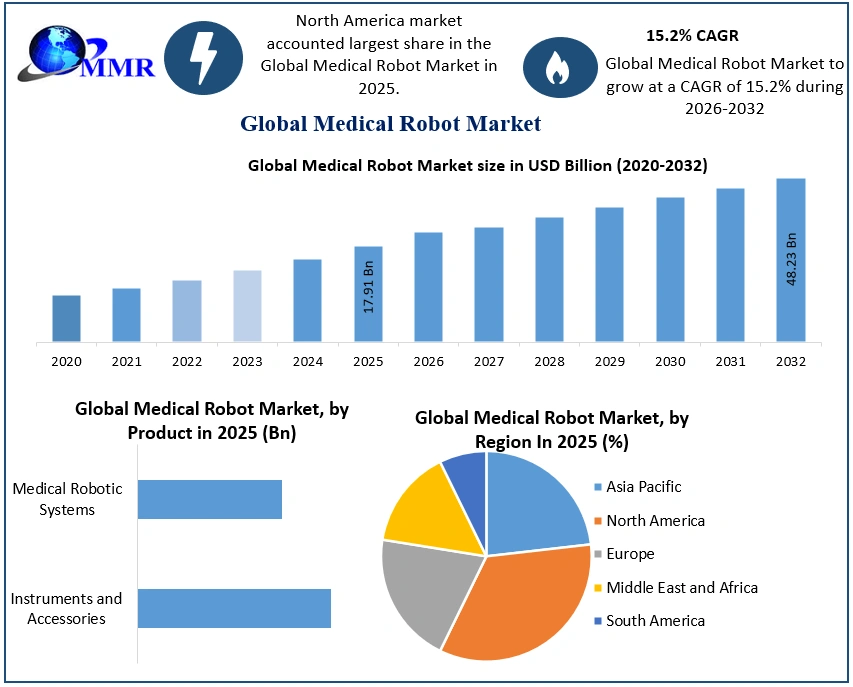
The global medical robot market Size was valued at USD 17.91 billion in 2025 and is projected to expand dynamically at a compound annual growth rate (CAGR) of 15.2% over the forecast period. This rapid growth reflects a profound shift in the healthcare boardroom: robotic hardware is no longer evaluated as an isolated equipment expense, but as a central component of an enterprise digital software strategy. What changed is the integration of next-generation connectivity and advanced data processing directly into active surgical loops.
This market evolution is happening now because standalone medical tools lack the ability to sync with broader hospital information systems, leading to data silos and delayed clinical decisions. Modern medical robots resolve this by acting as integrated network endpoints that communicate continuously with edge data centers. The primary beneficiaries are large-scale hospital groups, specialized surgical centers, and rehabilitation networks that require highly reliable, reproducible patient outcomes across multiple physical locations.
Key Trends Driving Growth
Artificial intelligence adoption and machine learning models are fundamentally changing how surgical robotics platforms assist clinical teams. Modern medical systems use computer vision and predictive tracking to actively monitor anatomical structures during live procedures. This software assistance reduces manual error, stabilizes instrument pathing, and shortens patient recovery times by supporting highly precise, minimally invasive incisions.
At the same time, the rollout of 5G infrastructure and network virtualization platforms is making telerefereeing and remote medical collaborations practical. High-speed, priority-access telecom lines allow specialized surgeons to guide robotic endpoints from distant command centers without experiencing dangerous transmission delays. This connectivity expansion allows healthcare networks to scale specialized medical services to regional outposts, optimizing asset utilization without duplicating expensive specialist personnel.
Get Free Sample: https://www.maximizemarketresearch.com/request-sample/809/
Segment Insights
Instruments and Accessories (Dominant Segment): Secures the largest share of market revenue, driven by a continuous institutional need for specialized single-use components, replacement parts, and sterile procedure kits that create a reliable, recurring SaaS-like business model.
Medical Robotic Systems (High-Value Catalyst): Commands major capital expenditure, encompassing complex surgical platforms, telemanipulators, rehabilitation systems, and automated pharmacy logistics units.
Surgical Applications (Dominant Vertical): Leads global deployment footprints as laparoscopy, orthopedics, and neurology departments heavily adopt robotic assistance to automate delicate tissue manipulation and bone sculpting.
Rehabilitation and Logistics (Fastest-Growing Applications): Witness rapid compound annual growth as healthcare facilities deploy autonomous mobile robots to automate pharmaceutical distribution and assist patient mobility.
Regional Growth Story
North America maintains structural dominance over the global medical robot landscape, supported by deep corporate healthcare investments and rapid cloud computing adoption. The United States market continues to expand as leading platform providers launch advanced systems that combine machine learning with real-time diagnostic imagery. Mature data center infrastructure across the region allows healthcare enterprises to store and process the massive datasets generated by high-density surgical video lines.
The Asia-Pacific region is emerging as the fastest-growing technology deployment zone, propelled by aggressive healthcare infrastructure modernizations in China and India. Rapidly aging populations and a shortage of specialized clinical workers are forcing regional health authorities to prioritize automated surgical and diagnostic systems. Local technology ecosystems are focusing on open API platforms and flexible hybrid-cloud architectures to reduce deployment friction within diverse regional hospital networks.
Competitive Landscape
The competitive environment is defined by strategic consolidation and ecosystem expansion, with established medical technology leaders actively acquiring software developers to boost their digital capabilities. Key global market participants include Intuitive Surgical, Stryker Corporation, Medtronic, Zimmer Biomet, and Smith & Nephew. These organizations are competing less on basic mechanical specifications and more on software intelligence, cloud compatibility, and predictive telemetry.
Market activity shows that hardware manufacturers are deliberately transforming into comprehensive platform providers to lock in enterprise customers. Industry leaders are focusing heavily on zero-trust cybersecurity frameworks and localized digital sovereignty configurations to clear strict government procurement hurdles. Vendors that deliver seamless compatibility with existing hospital enterprise resource planning software are winning high-value institutional contracts over companies that sell closed, non-virtualized hardware setups.
Recent Developments
Tier-one healthcare technology developers are rolling out automated cloud updates that add predictive tool-tracking features to legacy surgical systems without requiring physical hardware changes.
Cross-industry partnerships between telecom operators and medical system integrators are establishing private 5G networks within urban hospital campuses to protect robotic data lines from public network traffic.
Next-generation rehabilitation robots are launching with built-in edge computing modules, allowing units to adjust physical resistance levels in real-time based on patient biometric feedback.
Major enterprise software vendors are designing specialized API gateways that allow robotic data logs to feed directly into centralized electronic health record platforms.
Strategic Implications
The convergence of high-capacity data networks with precise medical robotics means that hospital Chief Information Officers can no longer manage surgical equipment in isolation. Corporate technology strategists must design high-bandwidth, resilient network backbones that can handle concurrent high-definition video streams without dropping frames. Failing to implement robust edge computing setups near active operating suites prevents automation platforms from delivering real-time assistance.
Furthermore, deploying connected medical robots requires a rigorous focus on cybersecurity resilience. Because these automated endpoints handle sensitive patient telemetry and interface directly with critical clinical functions, they are high-priority targets for malicious digital actors. Technology procurement teams must demand comprehensive end-to-end encryption, regular over-the-air security patches, and isolated network virtualization layers to ensure that critical hospital operations remain protected against external threats.
Future Outlook
The future of the medical robot market depends on how smoothly autonomous edge computing blends with multi-layered clinical networks. Future medical platforms will move beyond basic structural guidance, evolving into self-correcting ecosystems where robotic platforms adapt dynamically to subtle changes in a patient’s vital signs. This structural shift will reposition the robot from a passive mechanical assistant to an active, intelligent partner within the care team.
As digital networks continue to mature, a sharp performance gap will open between advanced, tech-driven healthcare organizations and legacy facilities. The future of global clinical excellence belongs exclusively to digital leaders who build highly elastic, cloud-managed, and AI-optimized robotic infrastructure portfolios that improve patient outcomes, while digital laggards remain restricted by rigid manual workflows and fragmented, unconnected systems.
Analyst Perspective
“The modern medical robotics landscape is undergoing a foundational transition from mechanical machinery to intelligent, data-driven platform networks,” states Yash Ghosalkar, Analyst at Maximize Market Research.
About Maximize Market Research
Maximize Market Research Pvt. Ltd. (MMR) is a global market research and consulting company that provides reliable, data-focused, and practical business insights. The firm serves a wide range of industries, including healthcare, pharmaceuticals, technology, automotive, electronics, chemicals, personal care, and consumer goods. Through market forecasts, competitive analysis, strategic consulting, and industry impact assessments, MMR helps organizations understand changing market conditions, identify growth opportunities, and make informed business decisions for long-term success.
2nd Floor, Navale IT Park Phase 3
Pune Banglore Highway, Narhe
Pune, Maharashtra 411041, India
+91 9607365656
sales@maximizemarketresearch.com
