Drip Irrigation Systems Market Thrives as Precision Agriculture and Water Conservation Drive Global Adoption
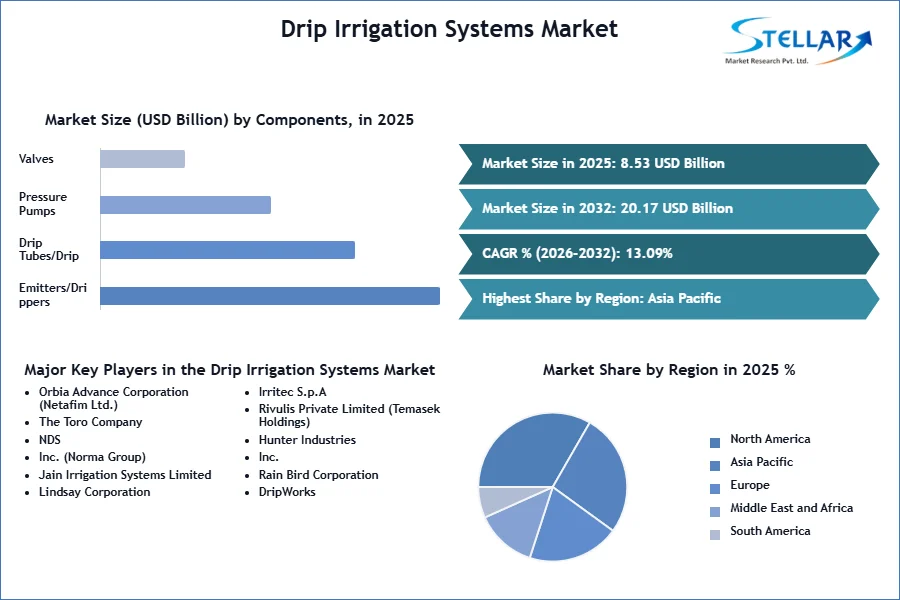
The global Drip Irrigation Systems Market is experiencing rapid growth as farmers increasingly adopt precision irrigation technologies to improve crop productivity while conserving water. Rising concerns over water scarcity, government support for sustainable agriculture, and the expansion of high-value crop cultivation are accelerating the demand for efficient irrigation systems. According to Stellar Market Research, the global Drip Irrigation Systems Market is expected to reach USD 20.17 billion by 2032, growing at a CAGR of 13.11% during the forecast period.
Water Scarcity and Sustainable Farming Fuel Market Growth
With agriculture accounting for a significant share of global freshwater consumption, farmers are increasingly shifting from traditional irrigation methods to drip irrigation systems that deliver water directly to plant roots with minimal wastage.
Major market growth drivers include:
- Rising global water scarcity
- Increasing demand for higher agricultural productivity
- Government subsidies for micro-irrigation
- Growing adoption of precision farming
- Expansion of horticulture and greenhouse cultivation
- Rising focus on sustainable agriculture
These factors are encouraging growers to invest in advanced irrigation technologies that improve water-use efficiency while enhancing crop yields.
𝐃𝐨𝐰𝐧𝐥𝐨𝐚𝐝 𝐅𝐫𝐞𝐞 𝐏𝐃𝐅 𝐁𝐫𝐨𝐜𝐡𝐮𝐫𝐞: https://www.stellarmr.com/report/req_sample/Drip-Irrigation-Systems-Market/1397
Precision Irrigation Improves Farm Productivity
Drip irrigation systems provide precise and controlled delivery of water and nutrients, reducing evaporation, runoff, and soil erosion. Compared to conventional irrigation methods, drip systems help farmers maximize resource utilization while lowering operational costs.
Key benefits include:
- Reduced water consumption
- Higher crop yields
- Improved fertilizer efficiency (fertigation)
- Lower weed growth
- Reduced labor requirements
- Better soil moisture management
These advantages make drip irrigation particularly suitable for fruits, vegetables, vineyards, orchards, and greenhouse farming.
Smart Irrigation Technologies Transform Agriculture
The integration of digital technologies is revolutionizing modern irrigation systems. Manufacturers are introducing smart solutions that allow farmers to monitor and automate irrigation based on real-time field conditions.
Emerging innovations include:
- IoT-enabled irrigation controllers
- Soil moisture sensors
- Weather-based irrigation scheduling
- Automated fertigation systems
- Remote monitoring through mobile applications
- AI-powered water management platforms
These technologies improve decision-making while minimizing water and fertilizer waste, supporting sustainable farming practices.
Surface Drip Irrigation Leads Market Adoption
Among installation methods, surface drip irrigation continues to dominate due to its lower installation cost, ease of maintenance, and widespread use across field crops and horticulture.
The market also includes:
- Surface drip irrigation
- Subsurface drip irrigation
- Inline emitters
- Online emitters
- Drip tubes and laterals
- Filters, valves, and pressure regulators
Subsurface systems are gaining traction in water-stressed regions where long-term efficiency and reduced evaporation are priorities.
Asia-Pacific Dominates the Global Market
The Asia-Pacific region holds the largest share of the global Drip Irrigation Systems Market due to its extensive agricultural sector, increasing government support, and growing awareness of water conservation.
Regional growth is supported by:
- Expanding agricultural modernization
- Government subsidy programs
- Rising cultivation of high-value crops
- Increasing adoption of precision farming
- Growing concerns over groundwater depletion
Countries such as India, China, and Australia are investing heavily in micro-irrigation systems to improve agricultural productivity and address water scarcity challenges.
Government Initiatives Accelerate Adoption
Governments worldwide are promoting drip irrigation through financial assistance, subsidies, and awareness programs aimed at improving water-use efficiency.
These initiatives encourage farmers to:
- Modernize irrigation infrastructure
- Reduce agricultural water consumption
- Improve crop quality
- Increase farm profitability
- Adopt climate-resilient farming practices
Public support continues to play a critical role in expanding drip irrigation adoption across developing and emerging economies.
𝐃𝐨𝐰𝐧𝐥𝐨𝐚𝐝 𝐅𝐫𝐞𝐞 𝐏𝐃𝐅 𝐁𝐫𝐨𝐜𝐡𝐮𝐫𝐞: https://www.stellarmr.com/report/req_sample/Drip-Irrigation-Systems-Market/1397
Competitive Landscape
Leading manufacturers are investing in product innovation, automation, and smart irrigation technologies to strengthen their market presence and expand global distribution networks.
Key companies operating in the global Drip Irrigation Systems Market include:
- Orbia Advance Corporation (Netafim Ltd.)
- The Toro Company
- NDS, Inc. (NORMA Group)
- Jain Irrigation Systems Limited
- Lindsay Corporation
- Irritec S.p.A.
- Rivulis Private Limited
- Hunter Industries, Inc.
- Rain Bird Corporation
- DripWorks, Inc.
Future Outlook
The future of the Drip Irrigation Systems Market remains highly promising as agriculture increasingly embraces precision farming, automation, and sustainable water management practices. Continuous advancements in IoT-enabled irrigation, sensor-based monitoring, and AI-powered farm management are expected to improve efficiency while reducing environmental impact.
With rising food demand, climate change challenges, and increasing investments in modern agricultural infrastructure, drip irrigation systems will continue to play a crucial role in enhancing global food security and promoting sustainable farming through 2032.
