Key Highlights
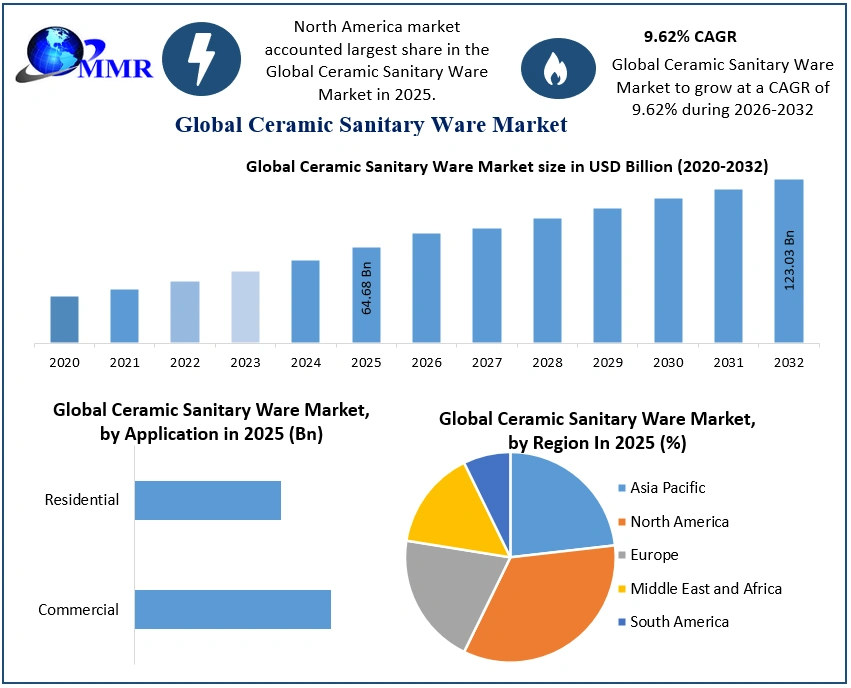
Global Market Scale and Valuation: Global Ceramic Sanitary Ware Market valued at USD 64.68 Billion in 2025.
Forward Projection: Projected to hit USD 123.03 Billion by 2032, expanding at a robust 9.62% CAGR.
Smart Technology Pivot: Luxury smart bidet integration, automated flushing, and built-in wellness tracking are shifting the market from basic utilities to premium smart home hubs.
Industrial Anchor: The Toilet Sinks and Water Closets segment commands the largest market share, serving as the core infrastructure baseline for both residential and commercial projects.
Green Manufacturing Shift: Top-tier manufacturers are deploying electric roller kilns powered by renewable energy to lower emissions and shield margins against fluctuating fossil fuel prices.
Leading End-Use: The Residential segment dominates global demand, energized by shifting consumer trends toward nuclear family housing and premium bathroom remodeling.
Why This Matters Now
Traditional ceramic manufacturing frameworks are facing massive structural changes due to intense carbon-reduction mandates and shifting consumer standards. For property developers, architectural design firms, global plumbing distributors, and municipal infrastructure planners, sanitary ware choices have evolved past simple price-per-unit metrics into a major selling point for real estate value. Integrating touchless, self-cleaning, and low-flow water designs has become standard practice for securing modern green building certifications. Organizations that adapt to localized, eco-friendly manufacturing setups will secure long-term supply arrangements with major commercial construction networks. Meanwhile, suppliers stuck on older, high-emission gas kilns face falling margins and tightening eco-regulations.
Market Overview
The Global Ceramic Sanitary Ware Market is moving rapidly past generic, unglazed fixtures into a specialized ecosystem defined by specialized glaze surfaces, space-saving designs, and automated water management. Reaching a valuation of USD 64.68 Billion in 2025, the industry’s path to USD 123.03 Billion by 2032 highlights a permanent structural upgrade in global residential and commercial builds. While water closets and basic toilets retain their massive volume foundation, the industry’s real value momentum is shifting toward high-margin vanity basins and integrated touchless solutions.
Advanced material formulations and automated production lines are re-engineering the sector’s cost dynamics. High-precision slip casting and advanced pressure casting methods enable brands to produce complex, minimalist geometries with fewer factory defects. These production advancements, alongside anti-stain and antimicrobial smooth glazes, help ceramic fixtures stand up to aggressive chemical cleaners, preserving their aesthetic appeal over decades of use in heavy-footprint public spaces.
Key Trends Driving Growth
The steady integration of internet-of-things (IoT) frameworks into bathroom fixtures is radically changing long-term product lifecycles. Real-time smart toilets with automated lid operation, heated seating elements, and built-in odor extraction systems have transitioned from niche luxury items to standard fixtures in high-end developments. This digital shift helps developers command higher rental and sale values by appealing directly to tech-focused and health-conscious buyers.
Water conservation regulations are also driving rapid design updates across global development boards. Dual-flush configurations, low-consumption cisterns, and advanced rimless flushing mechanisms allow facilities to cut down on utility expenses without sacrificing flushing performance. This resource-saving focus aligns directly with international green building certification frameworks, encouraging commercial project managers to replace older plumbing lines early.
Expanding hospitality networks and boutique luxury resorts are accelerating the demand for high-end, visual-first washroom spaces. Hotel management companies view premium ceramic finishes and sleek countertop basins as an extension of their hospitality brand identity, driving ongoing renovation contracts across urban centers.
At the same time, national public health mandates in developing regions continue to provide an important baseline for volume growth. Government-funded public infrastructure projects and rural sanitation upgrades create reliable, high-volume orders for durable economic-grade water closets, giving regional manufacturers stable cash flow to fund their smart tech upgrades.
Segment Insights
Dominant Segment: Water Closets and Toilet Sinks. The continuous need for basic sanitation across every single architectural blueprint keeps water closets at the top of overall industry volume. This segment benefits from highly resilient demand that withstands broader real estate downturns, supported by strict plumbing safety requirements and constant retrofitting projects.
Fastest-Growing Segment: Vanity Basins and Luxury Smart Fixtures. Driven by contemporary interior design preferences and urban space constraints, minimalist vanity structures are experiencing rapid growth. Homeowners are increasingly prioritizing premium, space-saving bathroom setups that double as functional design statements.
Regional Growth Story
The Asia-Pacific region maintains absolute volume dominance, supported by expanding housing developments and rapid urban expansion across India, China, and Southeast Asia. Rising middle-class disposable incomes and regional smart-city initiatives ensure steady demand for both economic and premium ceramic options, making the region a key investment hub for major manufacturing networks.
North America continues to lead the market in value-driven tech innovation and high-margin product adoption. The regional market benefits from a strong home remodeling culture and a high concentration of commercial real estate updates, where developers rely on premium smart-toilet setups to attract high-paying corporate tenants.
In Europe, industry momentum is guided by strict environmental manufacturing targets and a strong focus on circular product lifecycles. European manufacturers lead the way in building net-zero production sites, using advanced recycling setups to reintroduce clay and glaze waste back into the production line. Meanwhile, high-performance manufacturing centers across Japan and South Korea continue to set the global standard for smart bidet design and touchless bathroom automation.
Competitive Landscape
The global competitive layout features a mix of legacy multi-national bath brands and specialized regional ceramic producers. The market leaders rely on massive economies of scale and extensive distributor networks to protect their product placements in high-volume commercial real estate pipelines.
To capture shifting consumer preferences, major industry participants are prioritizing strategic acquisitions and specialized display centers. Leading entities such as Kohler Co., TOTO Ltd., Roca Sanitario S.A., Geberit International, Duravit, Villeroy & Boch, Ideal Standard, and LIXIL Corporation maintain market leadership by constantly expanding their product lines. These firms run dedicated design partnerships with architectural studios to secure early-stage inclusion in major international real estate specifications.
Regional producers are staying competitive by offering localized delivery networks and flexible product customization options. By pairing up with e-commerce portals and home improvement chains, mid-sized ceramic producers can bypass traditional wholesale networks, providing competitive pricing directly to contractors and local renovation teams.
Recent Developments
Renewable Hydroelectric Kiln Deployments (2025): Top-tier bath manufacturers launch eco-focused production plants utilizing fully electric roller kilns powered by renewable hydro energy, successfully moving away from old-style gas firing methods.
Multi-Million Unit Milestones for Smart Bidets (Late 2025): Major luxury bathroom brands report record-breaking international sales volumes for integrated bidet systems, confirming a permanent consumer shift toward smart wellness features.
Comprehensive Showroom Networks Launched (Early 2026): Global manufacturing groups unveil massive regional experience centers across emerging markets to showcase anti-bacterial surfaces, water-saving faucets, and smart fixtures under one roof.
Closed-Loop Zero-Waste Ceramic Reclamation Active (2026): Leading European brands activate advanced recycling systems that successfully capture and repurpose 100% of internal wastewater and raw material scraps back into production lines.
Strategic Implications
For large-scale building contractors, interior design firms, and property development boards, the modernization of sanitary ware products offers a reliable tool for enhancing building asset value. Upgraded bathroom installations let commercial property managers promote strict wellness and hygiene features to incoming tenants, helping shield properties from vacancy risks.
National urban planners must view modern sanitary installations as a cornerstone of city resource management. By working closely with manufacturing groups to set clear low-flow water standards and implement antimicrobial surfaces in public spaces, municipalities can lower public maintenance costs while safeguarding regional water supplies from excessive consumption pressures.
Future Outlook
The next chapter of industry growth will be won by manufacturers that successfully pair traditional ceramic durability with advanced digital efficiency. Companies that focus their development capital on zero-emission electric kilns, automated water conservation, and self-cleaning glazes will secure a strong position in tomorrow’s construction market. Conversely, operations that lag behind on eco-friendly transitions will find themselves cut out of modern, sustainable construction projects.
Analyst Perspective
“The global ceramic sanitary ware market is undergoing a major structural upgrade,” says Ankita Kagwade, Analyst at Maximize Market Research. “While water closets and basic wash basins supply massive, steady volume baseline demand, future value growth is consolidating around touchless smart designs and verified eco-friendly manufacturing methods. With the global market on track to reach USD 123.03 Billion by 2032, success belongs to manufacturers that invest early in electric kilns and smart home integrations. Upgrading production capabilities to meet global water-saving mandates and high-purity hygiene standards is no longer just a premium design option—it is a core business necessity for staying relevant in international building pipelines.” – Ankita Kagwade
About Maximize Market Research
Maximize Market Research Pvt. Ltd. (MMR) is a global market research and consulting company that provides reliable, data-focused, and practical business insights. The firm serves a wide range of industries, including healthcare, pharmaceuticals, technology, automotive, electronics, chemicals, personal care, and consumer goods. Through market forecasts, competitive analysis, strategic consulting, and industry impact assessments, MMR helps organizations understand changing market conditions, identify growth opportunities, and make informed business decisions for long-term success.
2nd Floor, Navale IT Park Phase 3
Pune Banglore Highway, Narhe
Pune, Maharashtra 411041, India
+91 9607365656
