Key Highlights:
Global market valuation reached USD 55.67 billion in 2024 and will expand to USD 82.25 billion by 2032.
Compound annual growth rate is established at 5% over the 2025–2032 forecast horizon.
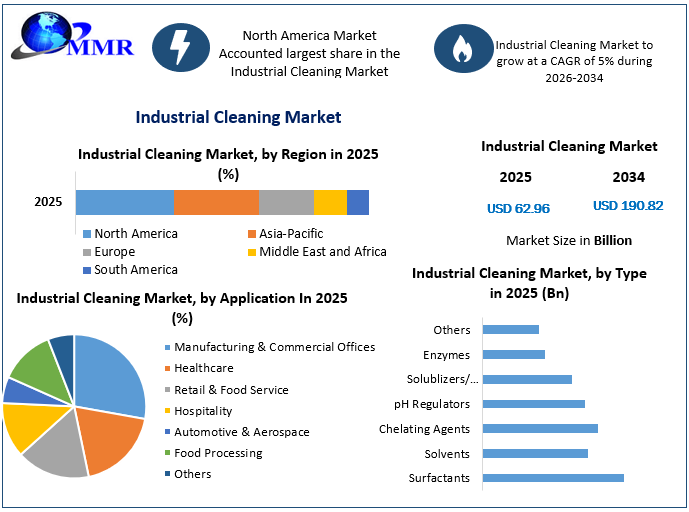
North America remains the leading regional market, while China serves as a critical growth engine with a high single-digit localized CAGR.
Surfactants, solvents, and chelating agents represent vital feedstock categories driving industrial cleaning solutions.
Regulatory compliance in healthcare and food processing mandates strict manufacturing hygiene protocols, accelerating demand for performance chemicals.
Why This Matters Now Volatile raw material costs and tightening environmental mandates are forcing chemical manufacturers to rapidly restructure their industrial cleaning product formulations. Procurement leaders face rising logistics and compliance costs, requiring long-term supply agreements with specialized chemical producers to mitigate supply chain disruptions.
Industrial buyers are shifting capital expenditure toward high-efficiency formulations that reduce water and energy utilization during plant maintenance cycles. Meanwhile, institutional investors are targeting chemical producers capable of scaling sustainable inputs to capitalize on strict corporate hygiene mandates across heavy manufacturing, retail, and healthcare hubs.
Market Overview The global industrial cleaning market reached a valuation of USD 55.67 billion in 2024, reflecting structural adaptation following pandemic-era supply chain imbalances. The market is projected to reach USD 82.25 billion by 2032, expanding at a compound annual growth rate (CAGR) of 5%. This steady upward trajectory stems directly from intensified capital investment in manufacturing capacity additions and commercial infrastructure globally.
During the pandemic, emergency disruptions caused temporary industrial site closures and halted new construction projects, causing a transient contraction in industrial cleaning chemicals demand. However, post-lockdown operations triggered a permanent recalibration of facility hygiene baselines. Factories, food processing facilities, and commercial office complexes institutionalized rigorous sanitation protocols, lifting baseline chemical volumes.
Simultaneously, major consumer goods and industrial chemical firms scaled up and modernized their manufacturing capacities to meet elevated structural requirements for health and cleanliness products. Supply chains have developed greater geographic flexibility to absorb regional localized demand spikes without interrupting downstream processing operations.
Key Trends Driving Growth Accelerated industrialization across emerging economies provides the primary volumetric catalyst for the industrial cleaning market. Heavy manufacturing installations require extensive maintenance cycles to prevent equipment degradation and optimize capacity utilization rates. This mechanical necessity translates into recurring, non-discretionary procurement of high-performance metal cleaners, solvents, and degreasers.
Regulatory intervention represents the second critical driver. Government agencies globally have tightened enforcement of hygiene frameworks in high-risk sectors like healthcare, pharmaceuticals, and food and beverage processing. Non-compliance carries severe operational and financial penalties, giving plant managers no choice but to purchase certified sanitizers and disinfectants.
Furthermore, downstream corporate end-users are enforcing internal environmental, social, and governance targets. This corporate mandate is shifting procurement preferences toward green cleaning chemicals that exhibit lower toxicity profiles and rapid biodegradability. Chemical producers must continually adapt their intermediate portfolios to deliver bio-based surfactants and neutral pH regulators that match legacy performance metrics without inflating production costs.
Segment Insights
Dominant Segment: Surfactants, solvents, and chelating agents constitute the largest feedstock and ingredient categories, forming the chemical foundation for general-purpose floor cleaners, dishwashing agents, and specialized industrial cleaning solutions.
Fastest-Growing Segment: Green cleaning chemicals and bio-based enzymes represent the most rapidly expanding product type, driven by corporate carbon-reduction mandates and strict chemical handling regulations across Europe and North America.
Application Dynamics: Manufacturing and commercial offices represent the highest-volume consumption base, while healthcare and food processing exhibit the most urgent demand for specialized sanitization agents.
Product Classification: The market remains diversified across specialized solutions, including oven and grill cleaners, metal cleaners, commercial laundry agents, and dedicated medical device cleaning formulations.
Regional Growth Story North America represents the largest regional market for industrial cleaning, holding the highest baseline share of global revenue. In the United States, demand for industrial cleaning chemicals is supported by an expansive network of corporate offices, advanced automotive manufacturing hubs, and heavily regulated healthcare institutions.
The U.S. market relies on deep domestic chemical feedstock availability and highly integrated distribution networks to maintain stable capacity utilization. However, the Asia-Pacific region represents the fastest-growing geographic arena over the forecast period. Rapid industrialization, major manufacturing investments, and expanding commercial construction projects across China, India, and South Korea are driving high regional volume requirements.
China stands out as an exceptional regional engine, expanding its domestic market size aggressively through a wave of manufacturing additions and infrastructure projects. Concurrently, European chemical hubs, led by Germany, are pivoting their domestic production frameworks toward high-value, sustainable specialty chemicals to comply with regional carbon reduction targets and strict maritime and industrial chemical disposal regulations.
Competitive Landscape The global market features a highly consolidated core of multinational chemical leaders alongside agile specialty chemical producers. Major industry participants include Diversey Inc., Evonik Industries AG, BASF SE, The Dow Chemical Company, Stepan Company, Spartan Chemical Company, Inc., Ecolab, and Solvay. Additional competitive positioning is driven by Pilot Chemical Corp, Croda International PLC, DuPont De Nemours Inc., Clariant, Huntsman Corporation, Enaspol A.S., Unger Fabrikker A.S., Aarti Industries, EOC Group, and KLK Oleo.
These entities actively vie for market share by leveraging distinct pricing power strategies, backward integration into key petrochemical feedstocks, and proprietary formulation technologies. To protect profit margins against raw material price volatility, market leaders are increasingly optimizing their product portfolios toward high-margin specialty cleaners rather than low-tier commodity surfactants.
This structural shift forces smaller, non-integrated players to secure niche positions through regional customization or specialized contract cleaning service alliances. Competitive advantage belongs to firms that maintain strong multi-regional supply chains capable of delivering large chemical volumes while complying with localized environmental policies.
Recent Developments
FMCG and specialty chemical firms revised manufacturing strategies and scaled production assets to guarantee the consistent availability of hygiene items during regional demand spikes.
Chemical producers executed strategic capacity modernizations to improve the supply chain resilience of hand sanitizers, antiseptic sprays, and germ protection applications.
Industry participants expanded contract cleaning service capabilities for specialized industrial applications, providing trained personnel to manage dangerous physical and chemical plant hazards.
Global consortiums increased capital expenditure toward the development of advanced chelating agents to address growing downstream consumption across the United States, Japan, and China.
Regional suppliers in the Middle East capitalized on major commercial and residential megaprojects, including the Capital Market Authority in Saudi Arabia and the Diamond Tower in Dubai, to lock in long-term commercial laundry and facility maintenance supply agreements.
Strategic Implications The evolution of the industrial cleaning market signals an permanent shift in downstream chemical procurement structures. Plant managers can no longer treat facility hygiene as a generic overhead cost. Instead, cleaning chemical efficiency directly dictates operational downtime, equipment lifespan, and corporate regulatory compliance exposure.
For chemical manufacturers, this operating environment demands continuous capital allocation toward flexible production assets that can easily switch between traditional petroleum-derived solvents and sustainable, bio-based intermediates. Procurement leaders must reassess their import-export dependencies, as regional trade flows face disruption from shifting environmental policies and localized manufacturing mandates.
Firms that establish secure, vertically integrated feedstock sources for surfactants and chelating agents will successfully exercise superior pricing power. Conversely, unintegrated blending operations will likely face severe margin compression as raw material costs fluctuate.
Future Outlook Looking forward, the global industrial cleaning market will increasingly penalize producers that fail to balance high performance with environmental compliance. Success belongs to chemical enterprises that can systematically replace hazardous solvents with advanced green alternatives while maintaining the cost structures demanded by large-scale industrial consumers.
Analyst Perspective “The global industrial cleaning landscape is undergoing a profound regulatory and formulation transformation. Chemical manufacturers must proactively transition toward high-efficiency, bio-based cleaning chemistries to defend their market share as downstream buyers increasingly tie procurement contracts directly to corporate sustainability benchmarks.” — Ankita Kagawade, Research Analyst, Maximize Market Research
About Maximize Market Research
Maximize Market Research Pvt. Ltd. (MMR) is a global market research and consulting company that provides reliable, data-focused, and practical business insights. The firm serves a wide range of industries, including healthcare, pharmaceuticals, technology, automotive, electronics, chemicals, personal care, and consumer goods. Through market forecasts, competitive analysis, strategic consulting, and industry impact assessments, MMR helps organizations understand changing market conditions, identify growth opportunities, and make informed business decisions for long-term success.
2nd Floor, Navale IT Park Phase 3
Pune Banglore Highway, Narhe
Pune, Maharashtra 411041, India
+91 9607365656
sales@maximizemarketresearch.com
