Key Highlights:
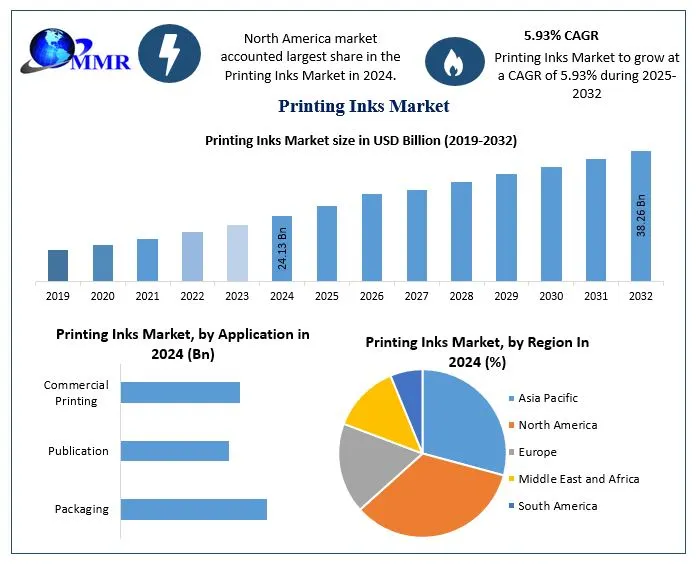
Global market size reached USD 24.13 billion in 2024 and will expand to USD 38.26 billion by 2032.
The industry expands at a compound annual growth rate (CAGR) of 5.93% over the 2025–2032 forecast period.
The packaging segment serves as the primary application volume driver across tags, labels, flexible materials, and metal cans.
Water-based formulations represent the rapid transition toward low-emission, eco-friendly chemical alternatives.
The digital printing process segment claims the largest growth footprint due to active investments in research and development.
Why This Matters Now Volatile petrochemical monomer costs and changing consumer safety regulations are forcing chemical manufacturers to restructure their core printing ink lines immediately. Procurement leaders face challenging supply disruptions as traditional solvent-based printing inks encounter strict regional volatile organic compound (VOC) limits.
Industrial buyers are pivoting their long-term supply agreements toward sustainable, water-based printing inks to insulate their consumer-facing brands from compliance risks. Meanwhile, institutional investors are prioritizing capital deployment toward ink manufacturers that possess proprietary resin-sourcing capabilities and digital print compatibility to capture high-margin packaging conversions.
Market Overview The global printing inks market achieved a baseline valuation of USD 24.13 billion in 2024, demonstrating strong integration with global consumer goods logistics and heavy manufacturing networks. The market is projected to reach USD 38.26 billion by 2032, expanding at a compound annual growth rate (CAGR) of 5.93%. This steady expansion reflects a major structural shift from legacy media publications toward highly dynamic, functional industrial packaging formats.
The baseline stability of the market is anchored by non-discretionary utilization across pre-packaged food items, paper cartons, and metal beverage cans. While conventional publishing fields like newspapers and commercial magazines face structural consolidation, the surge in global e-commerce and retail product tracking keeps baseline chemical volume requirements elevated.
Producers are actively adapting their supply chain logistics to handle regional spikes in packaging demand. This operational elasticity ensures that downstream logistics hubs can maintain continuous high-speed labeling without experiencing chemical delivery bottlenecks.
Key Trends Driving Growth Accelerated global logistics and the massive proliferation of consumer goods packaging provide the primary volumetric catalyst for the printing inks market. Modern supply chains rely heavily on scannable tags, barcodes, and colorful flexible substrates to handle real-time inventory tracking and brand communication. This industrial requirement translates directly into recurring, high-volume procurement of specialized oil-based printing inks and high-performance surface coatings.
Simultaneously, the expansion of global consumer economies acts as a robust driver. Rising population metrics and expanding disposable income levels across key international markets spur demand for pre-packaged foods, pharmaceutical protection, and custom consumer items.
Furthermore, strict government oversight regarding food-contact materials is changing chemical formulation practices. Regulatory entities globally are tightening limits on chemical migration from external packaging into food products, forcing chemical companies to develop highly advanced, purified water-based alternatives that match the drying efficiency of legacy solvent lines.
Segment Insights
Dominant Segment: Solvent-based printing inks and traditional oil-based printing inks maintain the largest baseline volume footprint, servicing heavy commercial printing arrays and high-speed metal can coating assets.
Fastest-Growing Segment: Water-based printing inks represent the fastest-growing product type, propelled by shifting global consumer preferences toward low-VOC, eco-friendly packaging components.
Process Leadership: The digital printing process segment commands a major expansion share, driven by rapid technological advancements and high research and development investments by leading chemical manufacturers.
Downstream Driver: The packaging application segment acts as the main driver for the global market, demonstrating continuous volume growth across tags, labels, flexible materials, and paper cartons.
Regional Growth Story North America represents the largest regional market for printing inks, holding the highest baseline share of global revenue in 2024. The U.S. market benefits from highly mature flexible packaging lines, massive corporate logistics hubs, and an expansive commercial printing base. This regional structure relies on integrated domestic chemical infrastructure to maintain stable volume deliveries to large-scale packaging operations.
Conversely, Europe is projected to generate the highest CAGR over the forecast period. The European growth trajectory is uniquely supported by the easy regional availability of performance resins, allowing local ink manufacturers to optimize their manufacturing costs and advance sustainable product development faster than import-dependent regions.
Simultaneously, the Asia-Pacific region fuels global printing ink market growth in the forecast period. Economic superpowers like China and India drive intense regional volume requirements, as their massive domestic manufacturing zones expand food processing exports and consume significant volumes of industrial labeling chemistry.
Competitive Landscape The global printing inks market features a consolidated structure dominated by international specialty chemical corporations. Key industry participants include Flint Group, Siegwerk Druckfarben AG & Co. KGaA, DIC Corporation, hubergroup Deutschland GmbH, Toyo Ink SC Holdings Co., Ltd., Sakata INX Corporation, ALTANA AG, and Wikoff Color Corporation. Additional market presence is driven by specialized suppliers, including T&K Toka Co., Ltd. and Zeller+Gmelin GmbH & Co.
These established entities deploy focused organic and inorganic growth strategies, including multi-regional collaborations, plant expansions, and targeted patent filings to defend their regional market positions. Leading ink manufacturers are shifting their capital portfolios toward high-margin digital formulations and eco-friendly chemistries to counter margin compression in the commodity print space.
This strategic redirection allows tier-one producers to exercise superior pricing power over unintegrated local blending operations that lack the research capacity to formulate advanced, migration-free food-contact inks. Competitive dominance belongs to firms that can guarantee continuous supply chain resilience while meeting the localized sustainability standards enforced across major trading blocks.
Recent Developments
Global ink manufacturers revised their domestic manufacturing strategies to scale up the production of high-performance eco-friendly inks, matching shifting consumer expectations.
Chemical enterprises executed targeted capital investments in research and development to improve print quality, dot retention, and overall drying efficiency across modern digital print assets.
Key suppliers optimized their multi-regional logistics systems to guarantee the consistent availability of specialized packaging inks for pre-packaged food lines and metal can producers.
International consortiums expanded their technical collaboration initiatives to overcome raw material constraints and insulate their operations from localized resin shortages.
Leading chemical producers secured new process certifications for water-based portfolios, ensuring immediate compliance with tightening international environmental safety frameworks.
Strategic Implications The rapid transformation of the printing inks market requires a major restructuring of corporate procurement frameworks. Plant managers can no longer treat ink choices as a simple finishing cost; ink compatibility directly determines packaging line speed, waste metrics, and corporate regulatory exposure.
For base chemical manufacturers, this operating environment demands flexible asset deployment to transition away from high-VOC solvent-based lines toward low-emission water systems. Sourcing managers must re-evaluate their regional resin supply chains, as European producers leverage superior local raw material availability to enhance their competitive margins.
Firms that establish secure, long-term resin contracts will successfully navigate supply shocks and display strong pricing power. Meanwhile, unintegrated ink blenders will likely face increasing margin pressure as global compliance standards elevate product entry barriers.
Future Outlook The global printing inks market will increasingly favor chemical innovators that can successfully combine high-speed digital print performance with strict environmental compliance. Ultimate success belongs to chemical enterprises that master water-based chemistry to replace legacy solvents without lowering the operational throughput demanded by global packaging hubs.
Analyst Perspective “The global printing inks sector is entering a structural transformation driven by packaging innovation and strict volatile organic compound limitations. Chemical manufacturers must direct capital expenditure toward water-based formulations and digital print capabilities to maintain their preferred supplier status as global consumer brands aggressively phase out legacy solvent systems.” — Ankita Kagawade, Research Analyst, Maximize Market Research
About Maximize Market Research
Maximize Market Research Pvt. Ltd. (MMR) is a global market research and consulting company that provides reliable, data-focused, and practical business insights. The firm serves a wide range of industries, including healthcare, pharmaceuticals, technology, automotive, electronics, chemicals, personal care, and consumer goods. Through market forecasts, competitive analysis, strategic consulting, and industry impact assessments, MMR helps organizations understand changing market conditions, identify growth opportunities, and make informed business decisions for long-term success.
2nd Floor, Navale IT Park Phase 3
Pune Banglore Highway, Narhe
Pune, Maharashtra 411041, India
+91 9607365656
sales@maximizemarketresearch.com
