Key Highlights
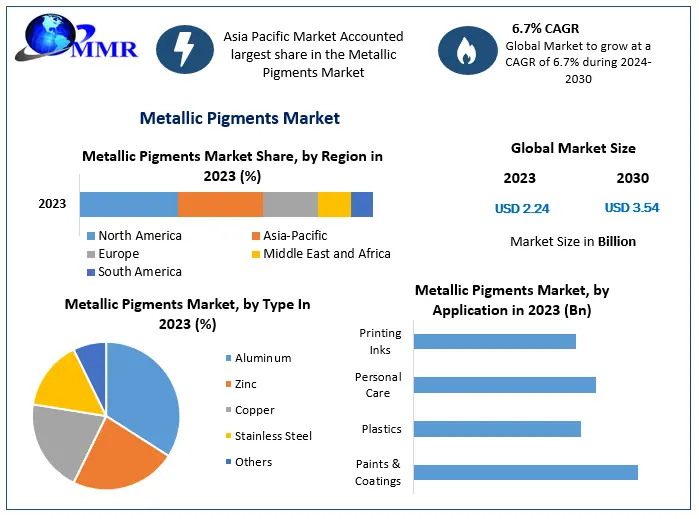
- Chemical suppliers are entering a metallic pigments cycle shaped by coatings performance, automotive gloss, packaging differentiation and Asia Pacific demand. The Metallic Pigments Market was valued at US$ 2.24 Bn in 2023 and is expected to reach US$ 3.54 Bn by 2030, creating a steady opportunity for pigment producers and downstream formulators.
- The market is forecast to grow at a 6.7% CAGR from 2024 to 2030, which signals demand-led expansion across paints, coatings, packaging, plastics, personal care and printing inks.
- Aluminum is the predominant metallic pigment type and is available in leafing and non-leafing grades, making it the core material category for suppliers.
- Paints and coatings dominated by application, linking market demand directly to automotive finishes, industrial coatings and construction activity.
- Asia Pacific held the highest share in 2023 and is also expected to be the fastest-growing region, giving producers a clear geographic demand priority.
Why This Matters Now
Metallic pigments are no longer only decorative additives. They protect metallic surfaces against corrosion, create reflective shine in coatings and help packaging brands add visual value in crowded consumer markets.
The urgency comes from downstream pull. Automotive producers need glossy vehicle finishes, paints and coatings producers need differentiated effects, and packaging companies need metallic appearance to improve shelf appeal.
Market Overview
Metallic Pigments Market size was valued at US$ 2.24 Bn in 2023, and the market is expected to grow at a CAGR of 6.7% from 2024 to 2030, reaching US$ 3.54 Bn by 2030. That outlook gives manufacturers a measured growth market where application quality and regional access matter more than commodity volume alone.
Metallic pigments are inorganic pigments with metallic characteristics. They are used for printing, packaging coloration and corrosion protection, and metallic particles are mixed with epoxy to create coating shine that reflects light and spreads different colours.
The market is segmented by type into aluminum, zinc, copper, stainless steel and others. It is segmented by application into paints and coatings, plastics, personal care, printing inks and others.
Key Trends Driving Growth
Specialty metallic pigment demand is the first growth driver. MMR identifies rising demand from automotive, paints and coatings, and construction as the prime driver, which ties pigment demand to industrial output and surface-performance requirements.
Packaging is the second driver. Growing demand from packaging industries to enhance the glamorous element of packaging is increasing metallic pigment use, giving suppliers exposure to consumer-goods branding and premium visual effects.
Automotive finishes remain a high-value use case. The report states that the most popular use of metallic colors is in automobiles to achieve glossy vehicle shine, making automotive coating demand a key signal for pigment producers.
The public page does not disclose feedstock availability, raw material pricing, capacity additions, sustainability initiatives, circular economy developments, import-export flows or named regulatory changes. That gap matters because procurement decisions in pigments depend on metal input costs, regional supply reliability and compliance visibility.
Get a Preview of Market Trends with a Free Sample
Segment Insights
- Dominant Segment — Aluminum by Type: Aluminum is the most predominant metallic pigment and is available in leafing and non-leafing grades. Its role as a coloring additive makes it the main type-level demand anchor.
- Dominant Segment — Paints and Coatings by Application: Paints and coatings dominated the Metallic Pigments Market by application. This links the market to automotive, construction and industrial coating demand.
- Fastest-Growing Segment — Personal Care: Personal care is expected to be the fastest-growing application segment in the near future. The report does not disclose a segment CAGR, so no numeric growth rate is stated.
- Application Scope — Plastics and Printing Inks: Plastics and printing inks are included in the application scope, but public revenue shares and growth rankings are not disclosed.
- Type Scope — Zinc, Copper and Stainless Steel: These types are included, but the public page does not rank them by share or growth rate.
Regional Growth Story
Asia Pacific held the highest share in 2023 and is expected to emerge as the fastest-growing regional market during the forecast period. That makes the region the priority demand center for suppliers targeting volume growth and customer proximity.
The report covers China, South Korea, Japan, India, Australia, Indonesia, Malaysia, Vietnam, Taiwan, Bangladesh and Pakistan within Asia Pacific. It does not disclose country-level market size, production capacity, pricing, trade flows or investment data.
North America and Europe follow Asia Pacific in regional market position. The report scope includes the United States, Canada and Mexico in North America, and the UK, France, Germany, Italy, Spain, Sweden and Austria in Europe.
For Germany, the United States, China, India, Japan and South Korea, the public page confirms regional coverage but does not provide specific production, import-export or regulatory data. Procurement and investment conclusions beyond regional participation should therefore remain cautious.
Competitive Landscape
Key players include BASF, Sudarshan Chemicals, Eckhart Pigments, Schlenk Metallic Pigments, Sun Chemical Performance Pigments, Ferro Corporation, Carlfors Bruk, Toyal America Inc., Asahi Kasei Corporation, Umicore, ALTANA AG, Kolortek, AMETEK, COPRABEL, METAFLAKE, Hunter Chemical, First Source Worldwide, Crescent Bronze Powder, Riverdale Global and BENDA-LUTZ WERKE.
The supplier base spans global chemical majors, specialty pigment producers and regional manufacturers. That structure suggests buyers can source from multiple vendor categories, but the public page does not disclose market shares, plant capacity or company-level utilization.
Competition is likely to focus on type portfolio, product quality, price positioning, financial strength, regional presence and growth strategies, because these are listed as competitive-analysis parameters in the report. No specific acquisition, partnership, expansion or investment is disclosed publicly, so company-level strategic interpretation is limited.
For suppliers, aluminum pigment capability and coatings-market access are central. For buyers, vendor selection should prioritize grade consistency, corrosion-protection performance, coating compatibility and regional supply reliability.
Recent Developments
- Asia Pacific Demand Signal: Asia Pacific held the highest share in 2023 and is expected to grow fastest, indicating that regional demand concentration is moving toward Asian coating, packaging and industrial markets.
- Application Shift: Personal care is expected to be the fastest-growing application segment, creating an emerging demand pocket beyond coatings and packaging.
- Aluminum Leadership: Aluminum remains the predominant metallic pigment type, reinforcing its role as the main product category for manufacturers.
Strategic Implications
For chemical manufacturers, the Metallic Pigments Market rewards application specialization. Paints and coatings dominate demand, but packaging and personal care create higher-value opportunities where visual effect and formulation performance can support differentiation.
For procurement leaders, the central risk is data visibility. The public report page does not disclose raw-material pricing, feedstock trends or trade flows, so buyers should maintain qualified supplier options across regions and monitor aluminum-related input exposure.
For investors, the market offers exposure to coatings, construction, automotive finishes, packaging, printing inks and personal care. The main constraint is limited public disclosure on segment values, capacity additions and company-level competitive moves.
Future Outlook
The Metallic Pigments Market is forecast to grow from US$ 2.24 Bn in 2023 to US$ 3.54 Bn by 2030 at a 6.7% CAGR. Growth will come from aluminum pigments, paints and coatings, automotive gloss finishes, packaging enhancement, personal care demand and Asia Pacific expansion.
The winners will be suppliers that combine aluminum pigment strength, coatings expertise, Asia Pacific market access and reliable sourcing before raw-material opacity and regional demand shifts weaken buyer confidence.
Analyst Perspective
“Metallic pigments are becoming a performance and design-led materials market where coatings, automotive finishes, packaging and Asia Pacific demand define supplier opportunity,” said Ankita Kagawade, Analyst at Maximize Market Research. “The strongest producers will combine aluminum pigment capability, formulation support, regional reach, pricing discipline and application-specific product quality.”
About Maximize Market Research
Maximize Market Research Pvt. Ltd. (MMR) is a global market research and consulting company that provides reliable, data-focused, and practical business insights. The firm serves a wide range of industries, including healthcare, pharmaceuticals, technology, automotive, electronics, chemicals, personal care, and consumer goods. Through market forecasts, competitive analysis, strategic consulting, and industry impact assessments, MMR helps organizations understand changing market conditions, identify growth opportunities, and make informed business decisions for long-term success.
Contact Us
2nd Floor, Navale IT Park Phase 3
Pune Banglore Highway, Narhe
Pune, Maharashtra 411041, India
+91 9607365656
sales@maximizemarketresearch.com
