Key Highlights
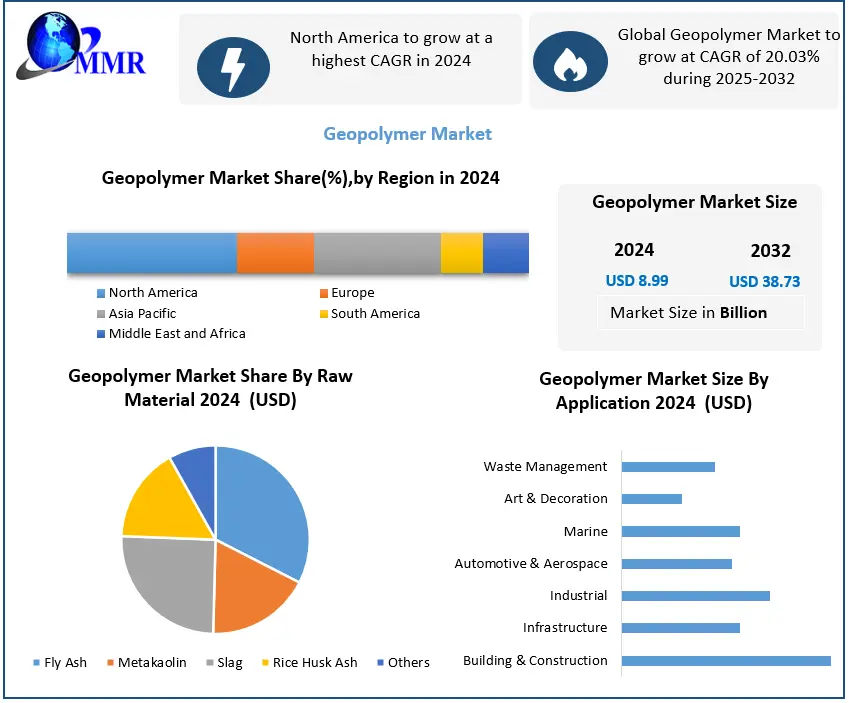
Market valuation reached USD 8.99 billion in 2024 and is projected to expand to USD 38.73 billion by 2032.
Compound Annual Growth Rate (CAGR) is established at 20.03% over the 2025–2032 forecast timeline.
Cement and Concrete alternatives represent the dominant product type across the global infrastructure landscape.
Fly ash-metakaolin-based geopolymer pastes exhibit high structural stability after thermal exposure between 90°C and 850°C.
China launched a US$ 1.4 trillion infrastructure initiative covering airport expansions, rail networks, and 5G stations.
Class F fly ash-based matrices retain superior tensile properties under intense heat due to elevated iron concentration.
Why This Matters Now Volatile environmental compliance mandates and aggressive industrial decarbonization targets are forcing the building materials sector to abandon high-emission options. Procurement leaders and structural engineering firms face immediate resource vulnerabilities as global carbon taxes target traditional Portland cement production. Linear industrial models cannot withstand these tightening regulatory landscapes. Chemical companies that secure stable, low-carbon geopolymer binder channels will insulate their supply lines from future environmental penalties. Organizations that remain tied to traditional, energy-intensive binders risk immediate margin erosion and exclusion from state-backed green infrastructure projects.
Market Overview The global geopolymer market marks a structural shift from traditional, emission-heavy Portland cement toward sustainable, closed-loop industrial material alternatives. In 2024, the global market valuation reached USD 8.99 billion. Driven by rising environmental awareness and expanding infrastructure networks, the industry is positioned to hit USD 38.73 billion by 2032. This trajectory represents a compound annual growth rate (CAGR) of 20.03% over the forecast period.
What changed? The transition from niche research to mainstream commercial adoption occurred because traditional concrete production contributes heavily to greenhouse gas emissions. Why now? Urban development is driving global infrastructure demand, making the high energy consumption of traditional binders unsustainable. Utilizing industrial manufacturing leftovers enables geopolymers to deliver a massive reduction in the manufacturing carbon footprint while matching the strength and restoration capabilities of legacy materials. Chemical manufacturers, real estate developers, and infrastructure procurement teams are accelerating capital allocation toward advanced aluminosilicate processing to capitalize on these low-carbon demands.
Key Trends Driving Growth Strict building codes and expanding green technology initiatives are the primary engines driving global market expansion. Regulatory authorities are actively promoting energy-saving building envelopes, anti-UV exterior coatings, and high-performance noise barriers to optimize residential and commercial structures. Geopolymers address these multiple technical requirements directly. The density of the geopolymer matrix determines its noise-reducing coefficient, turning this material into a highly effective acoustic insulation medium for dense urban environments.
Concurrently, heavy transportation and aerospace industries are integrating these binders to solve complex safety challenges. The US Federal Aviation Administration implemented strict heat release rate approval criteria for commercial aircraft cabin interiors based on time-to-flashover metrics. Testing indicates that traditional industrial thermoplastics ignite quickly and generate dense smoke, whereas geopolymer-based substances will never burn, reach flashover, or release toxic fumes. This complete resistance to fire has also triggered adoption in motorsports, where carbon-geopolymer hybrid components shield sensitive combustion setups. This development establishes a path for mass-producing high-temperature automotive emission tubes and thermal shields.
Segment Insights
Cement and Concrete (Dominant Segment): This product type dominates the global market share due to an urgent demand for sustainable alternatives to Portland cement. Driven by performance advantages including high chemical resistance and reduced production emissions, this segment is widely utilized in roads, bridges, and commercial infrastructure projects. The massive consumption volume of public works programs guarantees that cement and concrete alternatives remain the primary revenue driver for global geopolymer producers.
Building Construction (Fastest-Growing Segment): The building construction end-use category is expanding at a steady 3.1% CAGR, establishing a dominant position within the long-term forecast. Growth is driven by the material’s superior thermal performance when applied as fire-resistant structural coatings. Research confirms that after exposure to severe temperatures between 90°C and 850°C, the twisting and tensile strength of fly ash-metakaolin-based geopolymer paste remains significantly higher than its original, unheated state.
Fly Ash & Slag Raw Materials: Industrial leftovers form the foundational feedstock for the geopolymer supply chain. Class F fly ash matrices maintain excellent tensile strength under extreme heat because of their elevated iron concentration, outperforming metakaolin-based alternatives in low-permeability applications. Leveraging these secondary industrial waste streams protects manufacturers from primary raw material price shocks while meeting strict circular economy mandates.
Regional Growth Story The Asia-Pacific region, spearheaded by China, represents the most active, capital-intensive theater in the global geopolymer landscape. The Civil Aviation Administration of China launched services at 12 new airports and is completing a 13th facility in Shaanxi province. Furthermore, the expansion of the Zhangjiakou Airport runway increased annual passenger volume from 650,000 to 1.1 million, providing a high-capacity logistics gateway. The government is also expanding over 30 additional airports to connect regional networks directly to the primary hub at Chengdu International Airport.
These aviation projects align with China’s broader US$ 1.4 trillion mega-infrastructure plan. This capital injection covers massive data centers, high-speed rail lines, metro networks, 5G ground stations, and electric vehicle charging points. Concurrently, rapid rural-to-urban migration and rising household wages are sustaining long-term residential development. This extensive construction activity creates steady procurement demand for geopolymer-based bricks, sheets, blocks, and panels, positioning the country as the central hub for low-carbon material consumption.
Competitive Landscape The global geopolymer market is transitioning from fragmented regional suppliers to integrated industrial operations. Key market players, including CEMEX SAB de CV, Wagners, Schlumberger Limited, and Zeobond Pty Ltd, are forming supply agreements with power utilities and metallurgical plants to secure exclusive access to high-quality fly ash and slag feedstocks. This control over raw material pipelines increases their pricing power, leaving unaligned downstream buyers vulnerable to supply variations.
Industrial investments are focused heavily on scaling production capacity for precast elements, structural blocks, and specialized coatings. Firms like Pyromeral Systems, Geopolymer Solutions LLC, and Banah UK Ltd are refining automated formulation processes to deliver consistent chemical performance. By eliminating variability in curing times and chemical resistance, these suppliers are making geopolymers directly competitive with legacy commodity chemicals, positioning themselves to secure long-term procurement contracts with multinational construction groups.
Recent Developments
Precast manufacturing facilities across Europe scaled up production lines for geopolymer blocks and architectural panels to satisfy strict regional carbon-reduction mandates.
Specialty chemical companies deployed automated mixing systems for geopolymer adhesives and sealants, targeting industrial containment applications that require high acid resistance.
Infrastructure consortia in the Asia-Pacific region completed large-scale test pours of fly ash-based geopolymer concrete across major mass-transit metro networks.
Aerospace component suppliers integrated carbon-geopolymer composites into commercial interior brackets to meet international fire-safety and time-to-flashover requirements.
Strategic Implications For procurement officers and industrial chemical executives, the rapid growth of the geopolymer market requires a swift shift away from traditional, emission-heavy material sources. Relying solely on standard Portland cement exposes project budgets to carbon penalties and supply interruptions as emission rules tighten. Forward-looking corporations are establishing direct joint ventures with industrial processors. Securing these low-carbon binder volumes guarantees access to resilient, high-strength feedstocks, protects projects against rising carbon taxes, and ensures compliance with green building initiatives.
Future Outlook Market dominance will belong exclusively to chemical companies and material processors that secure proprietary, high-volume industrial waste pipelines to manufacture standardized precast geopolymers, while unaligned construction suppliers will face severe margin compression as carbon enforcement eliminates the cost advantages of traditional Portland cement.
About Maximize Market Research
Maximize Market Research Pvt. Ltd. (MMR) is a global market research and consulting company that provides reliable, data-focused, and practical business insights. The firm serves a wide range of industries, including healthcare, pharmaceuticals, technology, automotive, electronics, chemicals, personal care, and consumer goods. Through market forecasts, competitive analysis, strategic consulting, and industry impact assessments, MMR helps organizations understand changing market conditions, identify growth opportunities, and make informed business decisions for long-term success.
2nd Floor, Navale IT Park Phase 3
Pune Banglore Highway, Narhe
Pune, Maharashtra 411041, India
+91 9607365656
sales@maximizemarketresearch.com
