Key Highlights
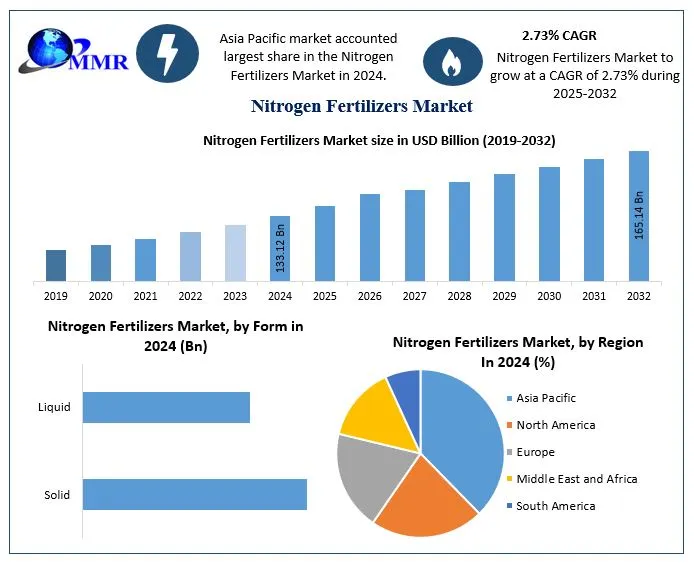
- Food security is becoming a chemical supply-chain issue as population growth pushes farmers to increase crop output from limited land. The Nitrogen Fertilizers Market was valued at USD 133.12 Bn in 2024 and is expected to reach nearly USD 165.14 Bn by 2032, giving fertilizer producers a steady demand base tied to food production rather than discretionary consumption.
- The market is forecast to grow at a 2.73% CAGR from 2025 to 2032, which signals measured expansion shaped by farm economics, state support and raw-material risk.
- Urea held the largest product-type position and is expected to drive nitrogen fertilizer demand, supported by lower cost, high nitrogen content of about 45% and productivity benefits.
- Asia Pacific held the highest share in 2024, driven by China and India, which makes the region the primary demand center for producers, traders and procurement teams.
- Raw-material price unpredictability, government export bans and environmental or health concerns remain the main risks for manufacturers and buyers.
Why This Matters Now
Nitrogen is essential for plant growth, but only a few plants can absorb and use atmospheric nitrogen directly. That makes nitrogen fertilizers a core agricultural input for crop productivity and soil fertility management.
The pressure is rising because food demand is increasing with population growth. Governments are investing in advanced and environment-friendly fertilizers to raise yields, which creates demand for chemical producers that can supply effective nitrogenous products at scale.
Market Overview
Nitrogen Fertilizers Market size was valued at USD 133.12 Billion in 2024, and total Nitrogen Fertilizers revenue is expected to grow at a CAGR of 2.73% from 2025 to 2032, reaching nearly USD 165.14 Billion. That outlook gives producers a defensive market, but not a risk-free one, because margins remain exposed to raw-material costs and policy action.
Nitrogenous fertilizers are inorganic and include nitrous compounds such as calcium ammonium nitrate, ammonium sulfate, ammonium nitrate and other compounds. The market is segmented by product type into urea, di-ammonium phosphate, ammonium nitrate, sodium nitrate, ammonium sulfate, calcium ammonium nitrate, ammonium chloride and others.
The report also segments the market by application method into broadcasting, foliar and fertigation; by form into solid and liquid; and by crop type into oil seeds, cereals and grains, fruits and vegetables, and others. This structure places nitrogen fertilizers across both bulk crop production and more targeted application methods.
Key Trends Driving Growth
Food production is the first driver. MMR links market growth to rising population, higher food demand and the need to improve yield from limited space, making nitrogen fertilizers a direct input into food-security planning.
Farmer awareness is the second driver. Rising understanding of nitrogen fertilizer benefits, nutritional balance and soil fertility is supporting adoption in developing countries, especially where state support is available.
Government R&D is the third growth signal. Public investment in advanced, efficient and eco-friendly nitrogenous fertilizers can support producers that align product development with yield improvement and environmental expectations.
Feedstock and policy risk remain material. MMR identifies raw-material price unpredictability and export bans by governments seeking to protect domestic demand as restraints, which means procurement leaders must treat fertilizer sourcing as both a chemical and policy-risk decision.
Environmental and health hazards are also constraining adoption. The public page does not disclose specific regulatory rules, capacity expansion projects, import-export volumes, carbon-reduction investments or recycling programs, so those areas remain open due-diligence gaps.
Start Your Market Research Journey with a Free Sample Report
Segment Insights
- Dominant Segment — Urea: Urea had the largest market compared with other fertilizers. Its lower cost, about 45% nitrogen content and productivity benefit support demand, making it the key product benchmark for suppliers and farm buyers.
- Fastest-Growing Segment: The public MMR page does not identify a fastest-growing product type, application method, form or crop-type segment with a complete usable CAGR. No fastest-growth claim is inferred.
- Application Method Scope: Broadcasting, foliar and fertigation are included in the report scope, but public market shares and growth rates are not disclosed.
- Form Scope: Solid and liquid nitrogen fertilizers are covered, but the public page does not rank them by revenue share or growth.
- Crop Demand Signal: Rice production is expected to lead demand for nitrogenous fertilizers in Asia Pacific, giving producers a strong crop-linked demand indicator.
Regional Growth Story
Asia Pacific held the largest market share in 2024 and is expected to lead through the forecast period. China and India drive the region, which accounts for about 65% of total global nitrogenous fertilizer usage, while China alone accounts for about 50% of regional consumption.
The regional demand case is built on population growth, government funding for advanced farming techniques, fertilizer use for high productivity, rising disposable income and farmer awareness. For producers, Asia Pacific is not only a sales market; it is the core demand anchor for nitrogen fertilizer planning.
North America, led by the United States, held the second-largest market share in 2024. Europe’s demand is driven by ammonium nitrate, but Europe and North America are expected to show balanced growth because of market saturation.
Latin America, the Middle East and Africa are expected to show high growth in coming years because of demand from rice, corn and sugarcane. The report covers China, India, Japan, South Korea, the United States, Germany, the UK and other markets, but does not disclose country-level production, pricing, trade-flow or capacity data.
Competitive Landscape
Key players include Agrium, ICL, Coromandel International Ltd, CF Industries Holdings Inc., Bunge Ltd, Potash Corp, CVR Partners, Yara International ASA, Sinofert Holdings Ltd., Eurochem, Mosaic, K+S, Koch Industries Inc., Potash Corp. of Saskatchewan Inc., Nutrien Inc., PJSC Togliattiazot, OCI Nitrogen, SABIC Group, Indian Farmers Fertiliser Cooperative and Hellagrolip.
The supplier base spans global fertilizer majors, regional producers and farmer-linked organizations. That structure gives buyers multiple sourcing options, but it does not eliminate exposure to feedstock volatility or government export restrictions.
The report states that competitive analysis covers product, price, financial position, growth strategies and regional presence. It does not disclose named acquisitions, partnerships, plant expansions or capacity additions, so company-level pricing power and capacity utilization cannot be assigned from the public page.
For producers, the strongest positioning will come from urea competitiveness, regional access to Asia Pacific demand, raw-material risk management and product development aligned with efficient and eco-friendly fertilizer use.
Recent Developments
- Government R&D Focus: Governments are investing in research and development to create more efficient and eco-friendly nitrogenous fertilizers, signaling a shift toward productivity with lower environmental burden.
- Export-Ban Risk: Governments may ban exports to support domestic demand, which can tighten international supply and raise sourcing risk for import-dependent buyers.
- Asia Pacific Consumption Concentration: Asia Pacific accounts for about 65% of global nitrogenous fertilizer usage, with China alone accounting for about 50% of regional consumption, creating concentrated demand exposure.
Strategic Implications
For fertilizer manufacturers, the Nitrogen Fertilizers Market rewards scale, product efficiency and policy awareness. Urea’s dominant role makes cost position critical, while government R&D and eco-friendly fertilizer demand push producers toward better formulations.
For procurement leaders, raw-material volatility and export bans are the main sourcing risks. Buyers should treat nitrogen fertilizers as strategic agricultural inputs where domestic policy can alter availability as quickly as demand.
For investors, the market offers exposure to food demand, yield improvement, Asia Pacific agricultural intensity and nitrogenous fertilizer adoption. The main risks are environmental pressure, health concerns, raw-material cost instability and limited public disclosure on capacity expansion and trade flows.
Future Outlook
The Nitrogen Fertilizers Market is forecast to grow from USD 133.12 Bn in 2024 to nearly USD 165.14 Bn by 2032 at a 2.73% CAGR. Growth will come from urea demand, population-driven food requirements, farmer awareness, state support, rice production in Asia Pacific and government investment in advanced fertilizers.
The winners will be producers that secure raw materials, defend urea economics, serve Asia Pacific demand and align fertilizer efficiency with environmental expectations before policy shocks and price volatility weaken supply security.
Analyst Perspective
“Nitrogen fertilizers remain a disciplined agricultural chemicals market where food demand, urea economics and Asia Pacific consumption define supplier opportunity,” said Ankita Kagawade, Analyst at Maximize Market Research. “The strongest producers will combine raw-material resilience, product efficiency, farmer reach, regional supply reliability and readiness for environmental scrutiny.”
About Maximize Market Research
Maximize Market Research Pvt. Ltd. (MMR) is a global market research and consulting company that provides reliable, data-focused, and practical business insights. The firm serves a wide range of industries, including healthcare, pharmaceuticals, technology, automotive, electronics, chemicals, personal care, and consumer goods. Through market forecasts, competitive analysis, strategic consulting, and industry impact assessments, MMR helps organizations understand changing market conditions, identify growth opportunities, and make informed business decisions for long-term success.
Contact Us
2nd Floor, Navale IT Park Phase 3
Pune Banglore Highway, Narhe
Pune, Maharashtra 411041, India
+91 9607365656
sales@maximizemarketresearch.com
